


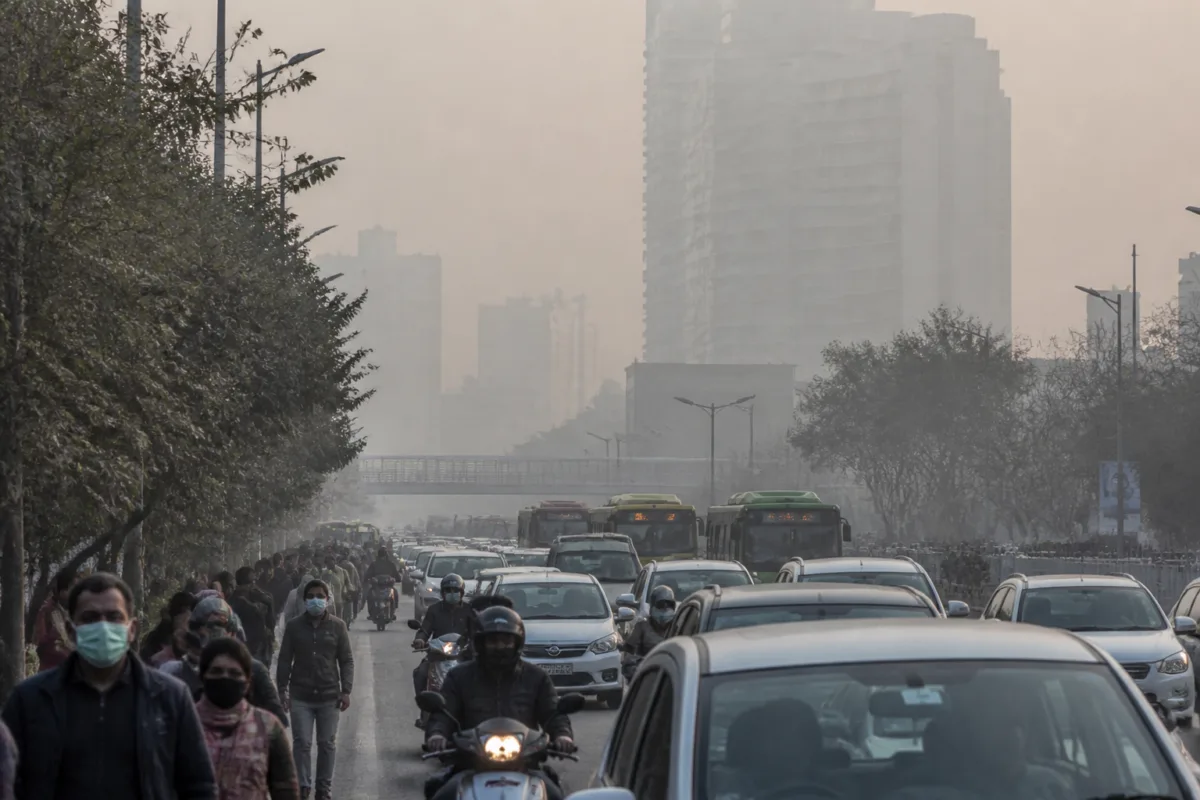
Delhi air pollution intensified sharply on Thursday, with the air quality index reaching 595 at 4 am and six monitoring locations recording AQI readings above 400, a level classified as severe. The Central Pollution Control Board said relief was unlikely for the next three days.
The deterioration followed a rise in Delhi’s average AQI from 313 on Wednesday to 350 by 4 pm on Thursday, according to the CPCB data cited in the report. The city’s pollution levels were highest during the early morning and night, when weak winds and falling temperatures contributed to the accumulation of pollutants.
Real-time monitoring data cited by the report showed Delhi’s AQI at 211 at 6 pm on Wednesday. It rose to 423 by 10 pm and reached 494 at midnight. Between 4 am and 8 am on Thursday, the pollution level was at its highest, with the AQI touching 595 at 4 am.
Six areas recorded severe-category readings at 4 pm on Thursday. The highest was reported at the Indian Institute of Technology Delhi station, with an AQI of 431. NSUT Jaffarpur recorded 421, North Campus 419, Chandni Chowk 415, Pusa 413 and ITO 407. The locations include both densely populated areas and major traffic corridors, exposing residents and commuters to hazardous air across different parts of the capital.
The report attributed the worsening conditions to a combination of local emissions, pollution transported from other National Capital Region cities and unfavourable weather. The Indian Institute of Tropical Meteorology’s air-quality warning system estimated that transport contributed 20.2% of Delhi’s pollution on Thursday. Stubble burning accounted for 9.2%, while Haryana’s Jhajjar contributed 13.2% as an external source.
The source report said Delhi was expected to remain under pressure over the following days, with transport likely to remain the largest contributor. Its revised forecast estimated that the transport sector’s contribution could rise to 20.5% on Saturday. The projected contribution from stubble burning was 13.29%, lower than the roughly 20% contribution anticipated in an earlier forecast for Thursday.
The pattern marks a shift from October, when Delhi’s air was reported to have been better than in previous years. Pollution began rising more sharply from the start of November, with the early-morning and late-night peaks indicating the role of atmospheric conditions in trapping emissions close to the ground.
The CPCB’s three-day outlook means Delhi residents are likely to continue experiencing severe pollution episodes before conditions improve. The next monitoring updates and revised forecasts will determine how the relative contributions of transport, crop-residue burning and regional sources change across the capital and its surrounding urban area.

