


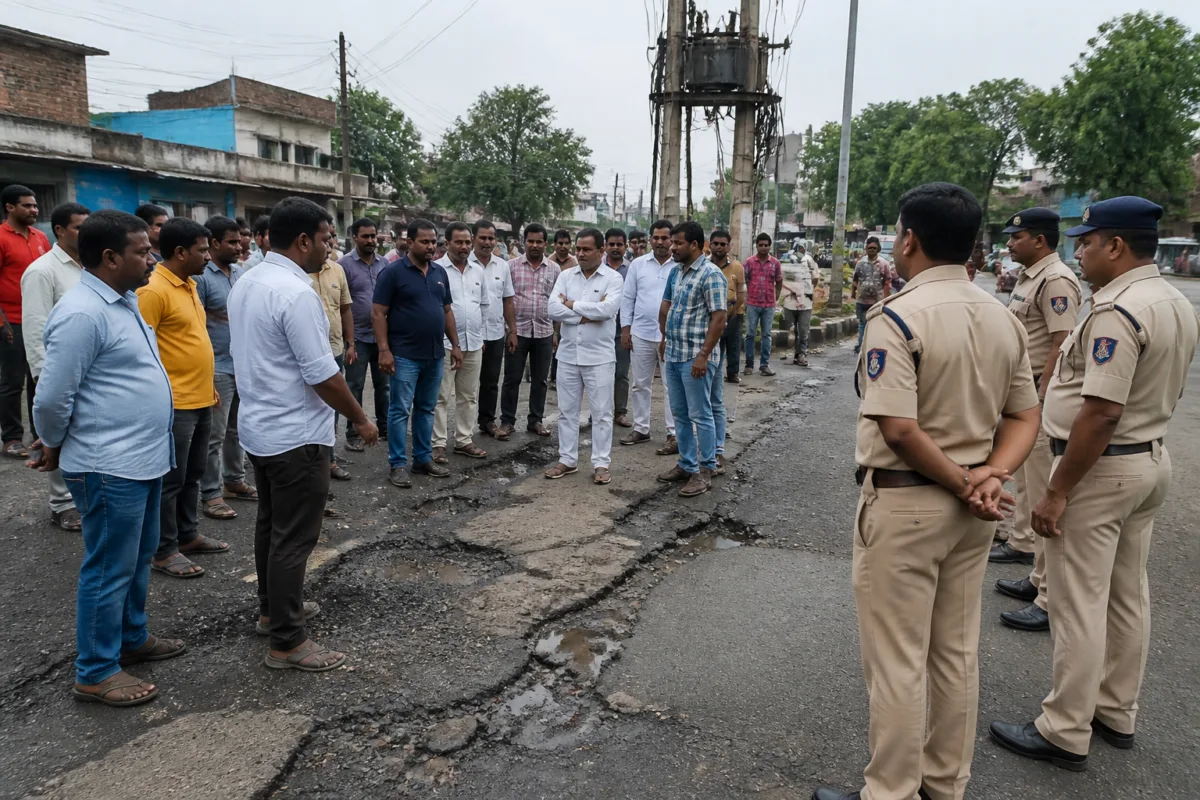
The Nagpur bench of the Bombay High Court has quashed an FIR, chargesheet and criminal case against a 26-year-old Chandrapur man who led a protest demanding action over a battered road, holding that prosecuting peaceful demonstrators can amount to an abuse of the legal process.
Justice MW Chandwani said it would be a “sad day for democracy” if criminal cases were filed against people who participated in peaceful protests. The court cited the Supreme Court’s position that prosecutions must not be launched to suppress agitations forming part of the democratic process, provided protesters do not use violence, take the law into their own hands or damage public or private property.
The case arose after a pickup vehicle hit an electricity pole and overturned near Nandgaon on January 21. At least one person was critically injured in the incident, according to the prosecution. A crowd subsequently gathered and demanded action against Public Works Department officials and the road contractor over alleged poor-quality construction and the condition of the road.
Mul police named Nishkarsh Nimgade in an FIR invoking offences including wrongful restraint and unlawful assembly. The proceedings also included other alleged offences, though the court found that the material in the chargesheet did not establish the essential ingredients required for prosecution against him.
The court noted that the chargesheet did not identify who had obstructed traffic and that no passerby’s statement had been recorded. It also observed that Nimgade’s name did not appear in the part of the FIR alleging obstruction. His presence later among people who were protesting could not, by itself, be treated as an offence, the court held.
The bench further noted that no prohibitory order was placed on record to attract Section 135 of the Maharashtra Police Act. It said the constitutional right under Article 19(1)(b) protects the right to assemble peacefully and without arms, while acknowledging that reasonable restrictions may be imposed on its exercise.
However, those restrictions cannot be diluted or used to stifle the right through vague allegations lacking the essential elements of an offence, Justice Chandwani said. The court’s observations place the conduct of civic protests within the wider legal framework governing public assembly, traffic management and allegations of obstruction.
The order was limited to Nimgade. The court quashed the FIR, chargesheet and the case pending before the judicial magistrate first class at Mul only in relation to him. The ruling does not determine responsibility for the road’s condition or the vehicle accident, nor does it direct any specific repair or departmental action against the PWD or contractor.
The immediate legal consequence is that criminal proceedings against Nimgade have ended. The case also records the court’s insistence that allegations against protesters must be supported by specific evidence rather than inferred from their presence at a public agitation.

