


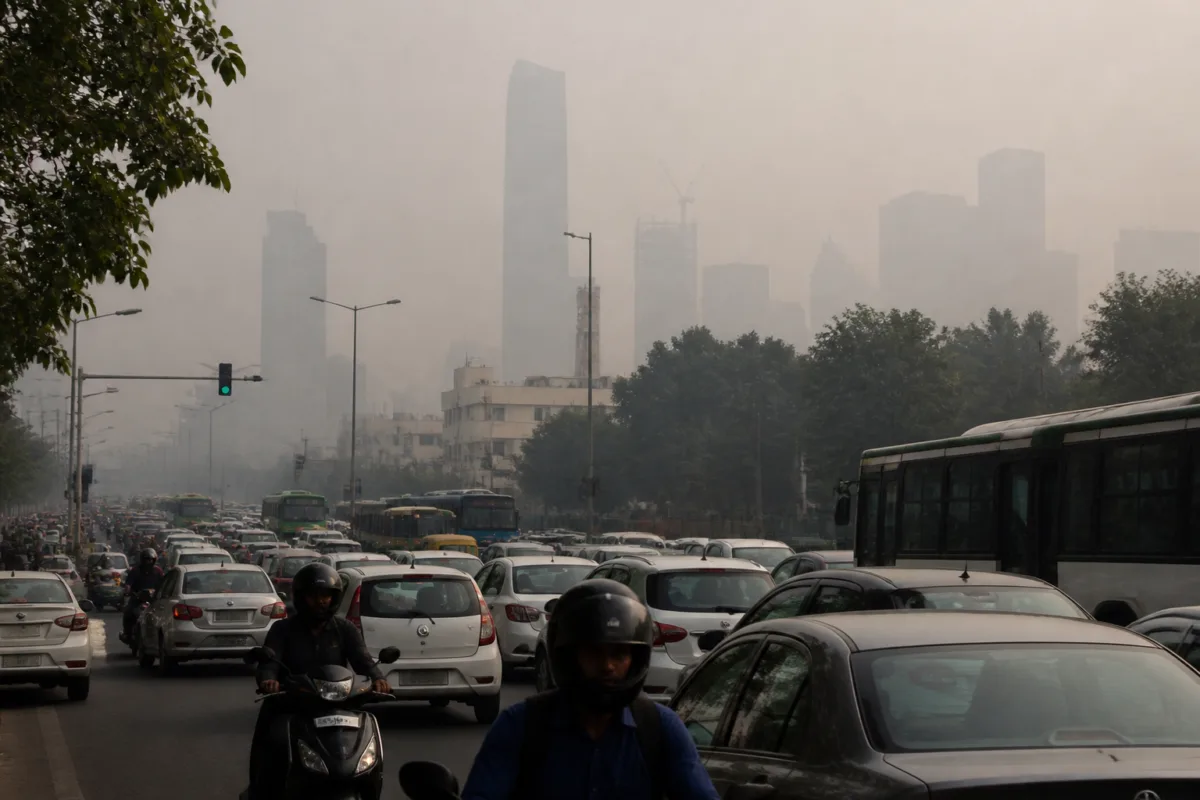
Delhi entered the Diwali period with its highest pre-festival pollution levels in three years, but the most important finding in the latest Centre for Science and Environment analysis is not simply that the air worsened before the fireworks. It is that the city’s pollution baseline had already become dangerously high, exposing the limits of treating an annual winter emergency through short-term restrictions alone.
The average PM2.5 concentration during the week preceding Diwali stood at 236 micrograms per cubic metre in 2026, according to the CSE analysis cited by Millennium Post. That was nearly 97 per cent higher than the corresponding figure of 120 micrograms per cubic metre in 2025 and above the 179 micrograms per cubic metre recorded in 2024. The comparison suggests that the pre-festival period was not merely a brief deterioration immediately before firecracker emissions. It began from a much more polluted starting point.
The timing matters because Diwali is often treated as the defining trigger for Delhi’s annual pollution crisis. The CSE findings place the festival within a wider pollution system that was already operating at a severe level. Firecrackers may add to the burden, but the evidence supplied in the analysis points to multiple sources operating before the festival, including transport, local emissions and pollution moving across the National Capital Region.
Delhi’s air quality remained in the ‘very poor’ category on Thursday, with the Air Quality Index recorded at 350 at 4 pm by the Commission for Air Quality Management. Several monitoring locations reported substantially higher readings. IIT Delhi and IITM recorded 416, while NSUT Jaffarpur and Delhi Pollution Control Committee stations recorded 404. Anand Vihar registered 319 and DTU recorded 372.
These station-level readings show how uneven exposure can be across the city. A citywide AQI figure provides a broad measure, but the monitoring data cited in the report also records significantly worse conditions at particular locations. That variation is relevant to how residents experience pollution: exposure is not necessarily uniform across neighbourhoods, roads, institutional districts or traffic corridors.
The CSE analysis, based on pollution data from November 1 to November 8, also challenges the idea that Delhi can address the crisis through actions within its municipal boundaries alone. More than half of Delhi’s PM2.5 pollution was attributed to emissions transported from neighbouring National Capital Region districts. Local sources accounted for 33 per cent, while stubble burning contributed 14.2 per cent.
The figures do not make local action irrelevant. They instead show that Delhi’s pollution burden is divided between sources operating inside the city and emissions moving across administrative borders. The city’s response therefore sits within a regional governance problem. Measures implemented by Delhi authorities cannot, by themselves, control pollution generated elsewhere in the NCR, even though Delhi residents experience the resulting air quality.
The source analysis identifies vehicles as the largest local contributor, accounting for 52 per cent of the city’s pollution load among local sources. This finding places mobility at the centre of the pollution problem. It also complicates an approach that concentrates public attention on a small number of highly visible seasonal events while leaving everyday transport emissions as a continuing source of pollution.
The distinction between total pollution and local pollution is important. Vehicles account for 52 per cent of local sources in the CSE assessment, while local sources as a whole account for 33 per cent of the city’s pollution and more than half is attributed to transported emissions from neighbouring NCR districts. The numbers describe different layers of the same system: Delhi has significant internal sources, but its total exposure is also shaped by regional flows.
That structure creates an institutional challenge. Air pollution responsibility is distributed across city governments, neighbouring districts, regional authorities and agencies responsible for transport and enforcement. The Commission for Air Quality Management is already involved in monitoring the regional situation, while the CSE analysis connects the pollution readings to sources that extend beyond Delhi’s municipal limits. Effective action therefore depends on coordination as much as on individual restrictions.
The data also illustrates why seasonal interventions can appear active without resolving the underlying problem. The city can introduce temporary restrictions around Diwali or respond to a sudden AQI deterioration, but the evidence presented here shows that the pollution baseline is established before the festival. If the pre-festival average is already 236 micrograms per cubic metre, emergency measures introduced only around the celebration are addressing a late stage of the pollution cycle.
The report does not establish that one intervention would solve the problem, nor does it provide a detailed assessment of the effectiveness of individual government measures. It does, however, identify a mismatch between the timing of the crisis and the timing of public action. The pollution burden is present across the period measured from November 1 to November 8, while the most visible debate often intensifies around Diwali itself.
The recurring role of vehicles further shifts the policy question from seasonal enforcement to the everyday functioning of the city. Transport emissions are tied to how people travel, how goods move, how roads are used and how regional commuting is organised. The supplied CSE findings do not provide a breakdown of vehicle categories or a performance assessment of transport policies, but they establish that vehicles are the largest local contributor in the analysis.
This matters for urban governance because pollution control is not a separate environmental task detached from planning and mobility. It is connected to the city’s transport system and to the relationship between Delhi and the wider NCR. Regional emissions, local vehicles and seasonal sources appear in the same pollution profile, requiring different administrative responses even though they contribute to the same public-health burden.
The comparison across the three pre-Diwali periods also provides a clear warning about volatility. Delhi’s average PM2.5 concentration increased from 120 micrograms per cubic metre in 2025 to 236 micrograms per cubic metre in 2026, while the 2024 figure was 179 micrograms per cubic metre. The supplied material does not explain the causes of the year-on-year changes, so those causes cannot be assigned on the basis of this report alone. What the figures confirm is that the pollution baseline can vary sharply from one year to another and can reach severe levels before the festival.
Public response is adding pressure to the administrative debate. Protests over deteriorating air quality and pollution-control measures were continuing in the capital, with demonstrators demanding stronger accountability and concrete action. The protests indicate that the issue is being experienced not only as an environmental statistic but also as a governance concern. Residents are questioning whether existing measures are sufficient to address a recurring crisis.
The central lesson from the CSE analysis is therefore structural. Delhi’s pre-Diwali pollution cannot be understood only as a firecracker story. The evidence supplied in the report points to a layered regional problem in which transported emissions, local sources, stubble burning and vehicles combine to produce hazardous air. The festival may coincide with a further deterioration, but the city’s exposure begins earlier.
The immediate facts are clear: Delhi’s average pre-Diwali PM2.5 level reached 236 micrograms per cubic metre in 2026; the figure was nearly 97 per cent higher than in the corresponding period of 2025; the AQI reached 350 on Thursday afternoon; and some monitoring stations crossed 400. The source analysis also attributes more than half of the pollution to emissions transported from neighbouring NCR districts and identifies vehicles as the largest local contributor.
What remains unresolved is how authorities will translate those findings into sustained, coordinated action across the region. The continuing protests, the station-level readings and the sharp rise in the pre-festival average make that the next institutional question to watch. The evidence already shows that Delhi’s pollution emergency is in place before the fireworks begin.

