


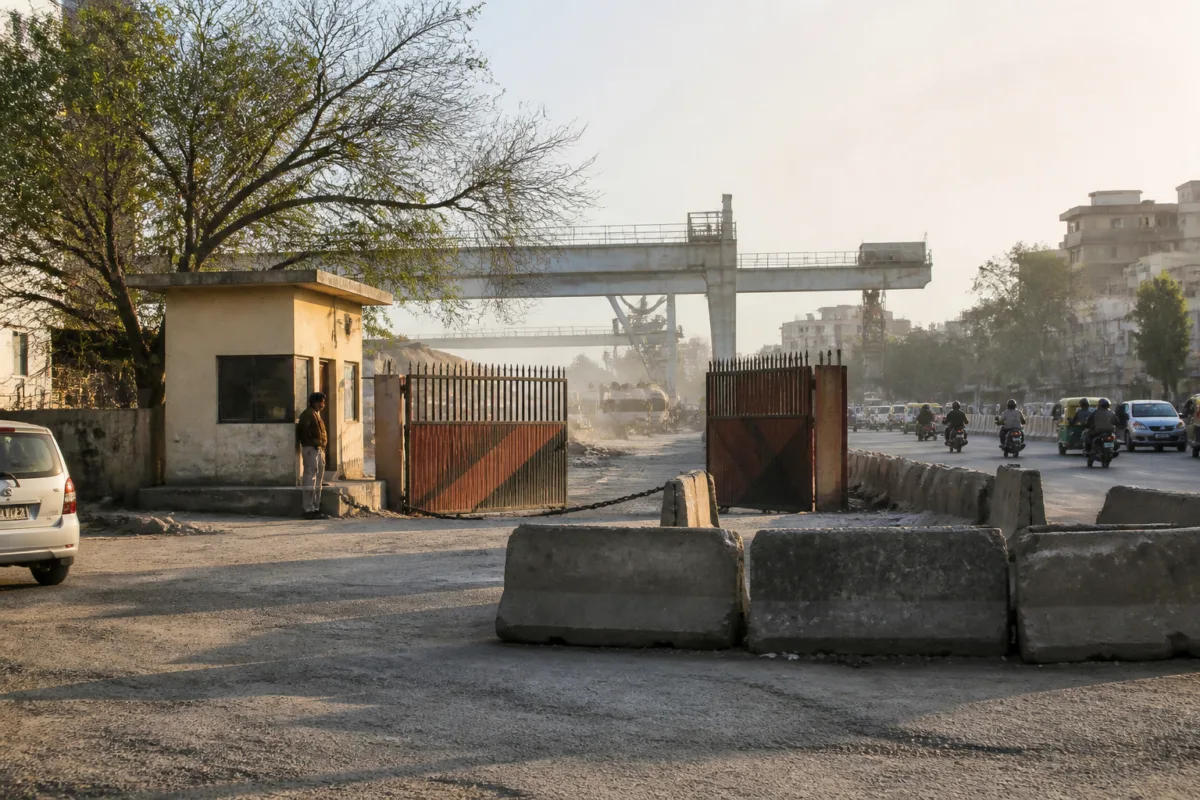
The barricading of the Railway Cement Siding Yard in Punjabi Bagh is a small administrative intervention with a larger significance: Delhi’s dust-pollution response depends on several agencies controlling different parts of the same urban landscape. The measure, reported by Millennium Post, followed an inspection by West Delhi Nodal Secretary Rupesh Kumar Thakur and was intended to restrict access and curb pollution from the site.
The Railway Cement Siding Yard was barricaded after directions issued during an inspection on October 28. Entry was restricted, while the Railways established a Railway Protection Force post and deployed personnel to prevent unauthorised entry and activities, according to the report. The action was taken at what officials identified as an air-pollution hotspot in Punjabi Bagh.
On the surface, the response appears straightforward: secure a site associated with cement handling, limit access and prevent activities that could generate or spread dust. But the inspection also examined vehicular emissions, road dust, construction and demolition activity and waste accumulation. That wider review matters because it shows that the administration was not treating the cement yard as an isolated source. It was examining a cluster of pollution sources operating within the same neighbourhood.
This is a recurring difficulty in managing urban air quality. A location may be identified as a hotspot, but the pollution experienced by residents is often produced by several activities at once. A cement yard, traffic corridor, unpaved or dusty road edge, construction site and waste accumulation point can exist within the same area while falling under different institutional responsibilities. Controlling one source therefore does not establish that the wider pollution problem has been resolved.
The Punjabi Bagh intervention also illustrates the difference between access control and environmental control. Barricading a site can prevent unauthorised entry and reduce activities taking place inside it. The RPF deployment gives the measure an enforcement mechanism, rather than leaving the restriction as a paper direction. Yet the supplied report does not establish how much dust the yard contributed to local pollution, whether dust levels changed after barricading, or whether the measure was intended to be temporary or permanent.
Those missing details are important for evaluating the action. A pollution-control order has at least three separate components: identifying the source, implementing a corrective measure and measuring the result. The report records the first two. Officials identified the yard as part of an air-pollution hotspot and ordered measures that included barricading, restricted entry and security deployment. It does not provide monitoring data or a post-intervention assessment of air quality.
That gap does not invalidate the intervention. It does, however, limit what can be concluded from it. The available evidence supports saying that the administration acted to reduce dust-related risks at the site. It does not support saying that Punjabi Bagh’s air quality improved, that the yard was the dominant pollution source, or that the hotspot has been brought under control.
The institutional structure described in the report is equally significant. The West Delhi Nodal Secretary conducted the inspection and reviewed compliance. The Railways undertook site-security measures through the RPF. The Municipal Corporation of Delhi’s West Zone office hosted a review meeting at which officials discussed actions by different departments and proposed corrective steps. This is a multi-agency arrangement, with one administration reviewing a site connected to the Railways and coordinating with civic departments.
Such arrangements are necessary because urban pollution does not respect administrative boundaries. A railway facility may sit beside roads maintained by a municipal body, buildings under private ownership, construction sites regulated through civic permissions and traffic routes managed by another authority. Each agency may control one operational element, while residents experience the combined effect as a single neighbourhood-level problem.
The report’s reference to a review meeting is therefore more than a procedural detail. It indicates that enforcement was being followed by interdepartmental coordination. Officials were briefed on measures already undertaken and proposed corrective action. The effectiveness of this model will depend on whether those proposals are assigned to specific departments, tied to deadlines and followed through with subsequent inspections. The supplied material does not state whether such deadlines or responsibility matrices were issued.
The inspection’s scope also points to a broader administrative challenge. Vehicular emissions, road dust, construction and demolition activity and waste accumulation require different responses. Vehicles may require traffic enforcement or emissions checks. Road dust may require control of exposed surfaces and cleaning practices. Construction and demolition sites may need compliance with dust-management rules. Waste accumulation may require removal and prevention of repeated dumping. A common inspection can identify these sources, but implementation still depends on separate operational systems.
This is where hotspot-based governance can either become useful or remain reactive. A hotspot designation can concentrate attention on a location and bring multiple agencies together. It can also encourage short-term measures focused on visible conditions, such as barricades or clearance drives, without establishing whether the underlying sources are being controlled over time. In Punjabi Bagh, the report confirms a visible enforcement step and a review process, but not the duration, performance indicators or long-term management plan.
The available account contains no air-quality readings, particulate concentrations, traffic counts, construction inventories or waste-volume estimates. It also does not provide a comparison between conditions before and after the barricading. As a result, the evidence cannot support a numerical assessment of the intervention. The most defensible conclusion is narrower: officials responded to a recognised pollution hotspot by restricting access to a railway cement yard and reviewing other nearby sources.
That distinction is relevant for residents. People living or travelling near the site are affected not by the administrative classification of a source, but by the conditions on roads, around construction areas and near material-handling facilities. If dust from the yard is reduced while road dust, vehicle emissions or waste accumulation continue, the neighbourhood may still experience poor local conditions. Conversely, if several sources are addressed together, the combined effect may be more meaningful, although the supplied report does not document such an outcome.
The episode also raises questions about the governance of industrial and logistics spaces within built-up neighbourhoods. A cement siding yard is connected to the movement and handling of construction material, while Punjabi Bagh is an established urban area with roads, residences and daily commuter activity. The report does not describe the yard’s operating pattern, the volume of material handled or its distance from homes and public facilities. Those facts would be necessary to assess the site’s exposure profile and the adequacy of its dust-control arrangements.
For now, the administration’s response is best understood as an enforcement and coordination measure rather than proof of a completed clean-up. The barricading addresses unauthorised entry and activity. The RPF post creates a mechanism for maintaining the restriction. The review meeting creates a forum for departments to report action and propose corrections. What remains unclear is whether the arrangement includes continuous monitoring, documented compliance checks and a public account of results.
The Punjabi Bagh case therefore illustrates both the value and the limits of hotspot management. It shows that a specific site can trigger action when an official inspection identifies a pollution concern. It also shows why urban air-quality enforcement must connect site-level controls with neighbourhood-level assessment. Without that connection, agencies may be able to report that a direction was issued, a barricade installed or a meeting held, while the public remains unable to determine whether exposure has actually declined.
The next relevant developments are the implementation of the proposed corrective actions, further inspections and any evidence of air-quality or source-level improvement. Until such information is available, the confirmed position is that the Railway Cement Siding Yard in Punjabi Bagh has been barricaded and placed under restricted access as part of an official response to dust pollution, while other pollution sources in the area remain under review.

