


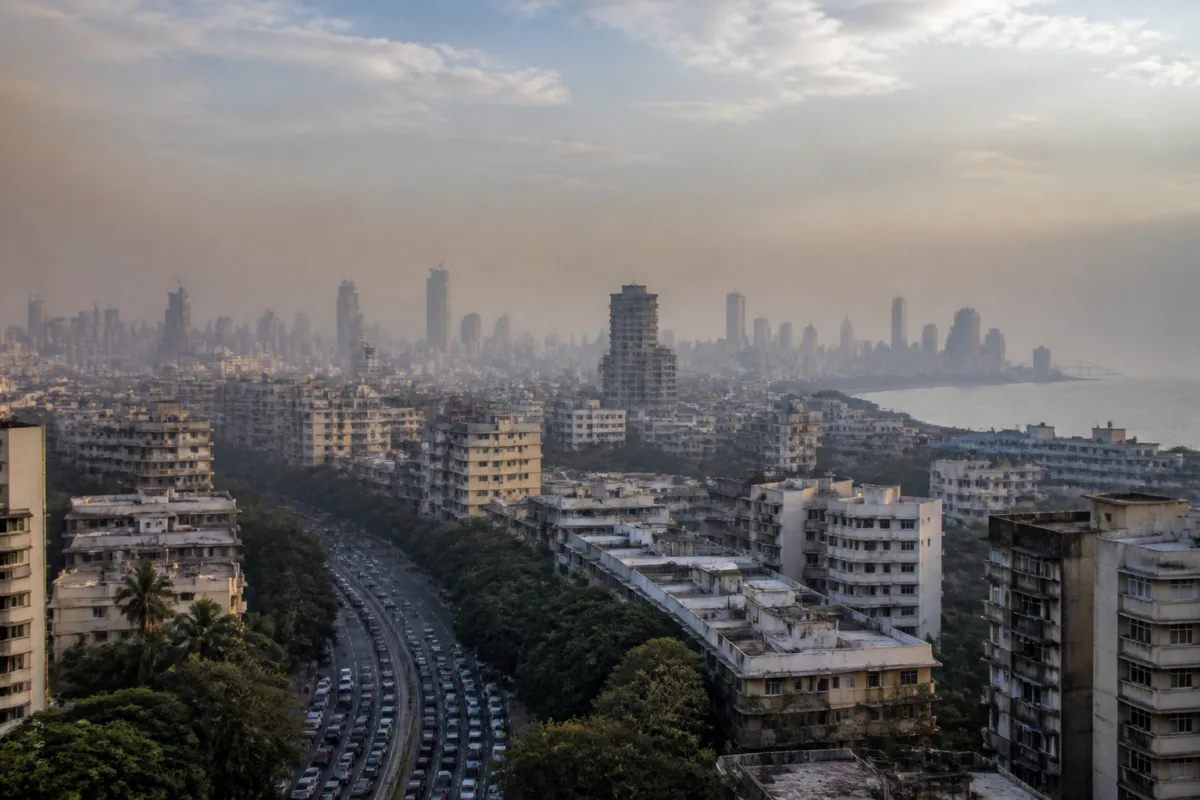
Mumbai’s air pollution recovers faster after Diwali than in several northern Indian cities, but the city’s temporary advantage should not be mistaken for immunity. A three-year analysis of Central Pollution Control Board data by Climate Trends shows that Mumbai’s air quality still worsened sharply during the festival, while geography and weather helped disperse pollutants within days.
The report, covering 2024 to 2026, found that Mumbai recorded a 46% to 64% rise in the Air Quality Index during the Diwali period. Its AQI peaked at 200 in 2025, placing the city’s festival pollution episode well above its cleaner-day conditions, even though the deterioration was less persistent than in cities across the Indo-Gangetic Plain.
That contrast is the central urban lesson in the data. Diwali pollution is not experienced uniformly across India. The same burst of firecracker emissions can produce a short-lived spike in one city and a prolonged smog episode in another, depending on how quickly the atmosphere can mix and carry pollutants away.
### Why Mumbai recovers faster
Firecrackers release concentrated quantities of PM2.5, PM10, sulphur dioxide, nitrogen oxides and metal-laden particles, mainly between 7pm and 2am. These emissions create a sharp overnight pollution pulse. Whether that pulse becomes a longer air-quality crisis depends on local atmospheric conditions.
In Mumbai, sea breezes help disperse pollutants from the urban area. Retreating monsoon showers along the coast and stronger winds also support recovery, according to the report. These conditions reduce the likelihood that smoke will remain trapped close to the ground for several consecutive days.
The city’s coastal setting therefore acts as a form of atmospheric advantage. It does not prevent pollution from rising, but it can shorten the duration of the episode. That distinction matters for urban air-quality planning because a lower number of persistent pollution days does not mean that residents avoid exposure during the peak period.
Mumbai’s 2025 peak AQI of 200 illustrates this difference. The number signals a substantial festival-related deterioration, while the report’s comparison with northern cities indicates that the pollution was dispersed more quickly. The data does not establish that Mumbai’s air remains consistently cleaner throughout the year; it shows that the city’s post-Diwali recovery pattern is more favourable.
### The northern contrast
The report found that northern cities face a more difficult combination of emissions and atmospheric conditions during October and November. Delhi’s average Diwali AQI rose from 334 in 2024 to 348 in 2025 and 360 in 2026, remaining in the “very poor” category. Gurugram recorded a peak AQI of 370, while Patna and Lucknow also experienced substantial pollution levels.
Across the Indo-Gangetic Plain, cities often remained between 18% and 88% more polluted than before Diwali, according to the Climate Trends analysis. In these cities, festival emissions add to an already deteriorating seasonal air-quality baseline rather than appearing as an isolated event.
The post-monsoon period is important to this pattern. Calm and cool nights, lower mixing heights and temperature inversions can trap pollutants near the ground. When the atmosphere is unable to disperse emissions vertically or horizontally, the effects of a few hours of firecracker use can persist well beyond the night of the celebration.
The report also points to paddy-stubble burning in Punjab and Haryana, which peaks around the same period. Smoke can travel down the Indo-Gangetic Plain towards Delhi-NCR, Lucknow and Patna. This means that local firecracker emissions are only one part of the regional pollution burden affecting northern cities.
Mumbai does not face the same combination of inland stagnation and regional smoke transport identified in the report. Its coastal winds provide a different atmospheric setting. The comparison shows why national air-quality responses cannot rely on a single template for every city.
### A pollution spike is still a public-health event
Faster recovery can make Mumbai appear relatively resilient, but it does not remove the risks associated with a short, intense pollution spike. The report identifies PM2.5, PM10, sulphur dioxide, nitrogen oxides and metal particles as components of firecracker emissions. These pollutants are released during the hours when residents are likely to be outdoors, travelling, celebrating or living in neighbourhoods where smoke accumulates temporarily.
The difference between a short episode and a prolonged one is important for exposure, but duration is not the only measure of urban air quality. A city can experience a significant deterioration even if readings improve within days. The report’s finding that Mumbai’s AQI rose by 46% to 64% during the period underlines this point.
It also complicates the idea that coastal geography can substitute for pollution control. Sea breezes and rainfall are natural advantages, not municipal interventions. Their effectiveness can vary with weather conditions, while the emissions generated during festivals remain within the city’s built environment and affect residents during the peak hours.
For Mumbai, the relevant question is therefore not whether the city clears Diwali smoke faster than Delhi or Patna. It is whether the city can reduce the height of the pollution spike while preserving the conditions that allow air quality to recover quickly. The supplied analysis does not provide a city-level inventory of local emission sources or an assessment of Mumbai’s enforcement measures, so it cannot establish which interventions contributed to the reported outcome.
### Geography changes the policy problem
The regional contrast has direct implications for governance. Northern cities dealing with persistent smog must manage local festival emissions alongside seasonal atmospheric stagnation and transported smoke. Coastal and southern cities may have greater dispersal capacity, but they still need measures for intense short-term spikes.
The Climate Trends report describes Chennai as recovering within a week after festival AQI spikes of up to 139%. Hyderabad and Bengaluru largely remained in the moderate AQI range, while Hyderabad’s post-Diwali average fell to 67 in 2025. These examples reinforce the report’s broader finding that geography and seasonal weather strongly influence recovery patterns.
A common national response may therefore produce uneven results. Measures designed for prolonged winter smog in the Indo-Gangetic Plain may not address the specific timing and exposure pattern of a coastal city such as Mumbai. Conversely, Mumbai’s faster recovery should not be used to conclude that festival pollution requires less attention there.
Palak Balyan, research lead at Climate Trends, said that a short-term pollution spike need not become a prolonged episode, adding that region-specific air-quality management could make clean-air interventions more effective. The statement captures the policy distinction emerging from the data: pollution control must account both for the source of emissions and for the atmospheric conditions that determine how long they remain concentrated.
The report also cites Surendra Kumar Dhaka of Delhi University, who said an impending Western Disturbance could provide temporary relief across north India by changing wind patterns, increasing atmospheric mixing and possibly bringing precipitation. His comments illustrate how dependent air-quality recovery can be on weather systems outside municipal control. Temporary improvement caused by atmospheric change is not equivalent to a reduction in emissions.
### The evidence and its limits
The three-year comparison provides a useful pattern rather than a complete explanation of Mumbai’s air quality. It establishes that the city saw a large Diwali-related AQI increase, that its 2025 peak reached 200 and that coastal conditions helped pollutants disperse within days. It also establishes a clear contrast with the higher and more persistent readings reported for several northern cities.
However, the supplied analysis does not identify daily AQI values for every Mumbai year, provide a full list of monitoring stations or separate the contribution of firecrackers from other urban pollution sources. It also does not establish how exposure varied between neighbourhoods or whether vulnerable groups experienced different conditions from the citywide readings.
Those limits matter because AQI is a city-level indicator, while pollution is experienced at street level. Local traffic, construction activity, waste burning, industrial emissions and neighbourhood form can affect air quality differently across Mumbai. The report’s regional comparison is therefore strongest as evidence about recovery conditions, not as a complete account of every source of pollution in the city.
The data nonetheless identifies a significant structural difference between Indian cities. Pollution episodes are shaped not only by what cities emit but also by whether their atmosphere can disperse those emissions. Mumbai’s coastal setting currently gives it a faster recovery pathway than many northern cities, but that advantage does not eliminate the need to control the initial spike.
The next phase of scrutiny should focus on whether Mumbai’s relatively quick recovery remains consistent across years and weather conditions, and whether targeted local measures can reduce the intensity of Diwali pollution. What the available evidence confirms is narrower but important: Mumbai clears festival smoke faster than many northern cities, while still experiencing a substantial and measurable deterioration in air quality during Diwali.

