


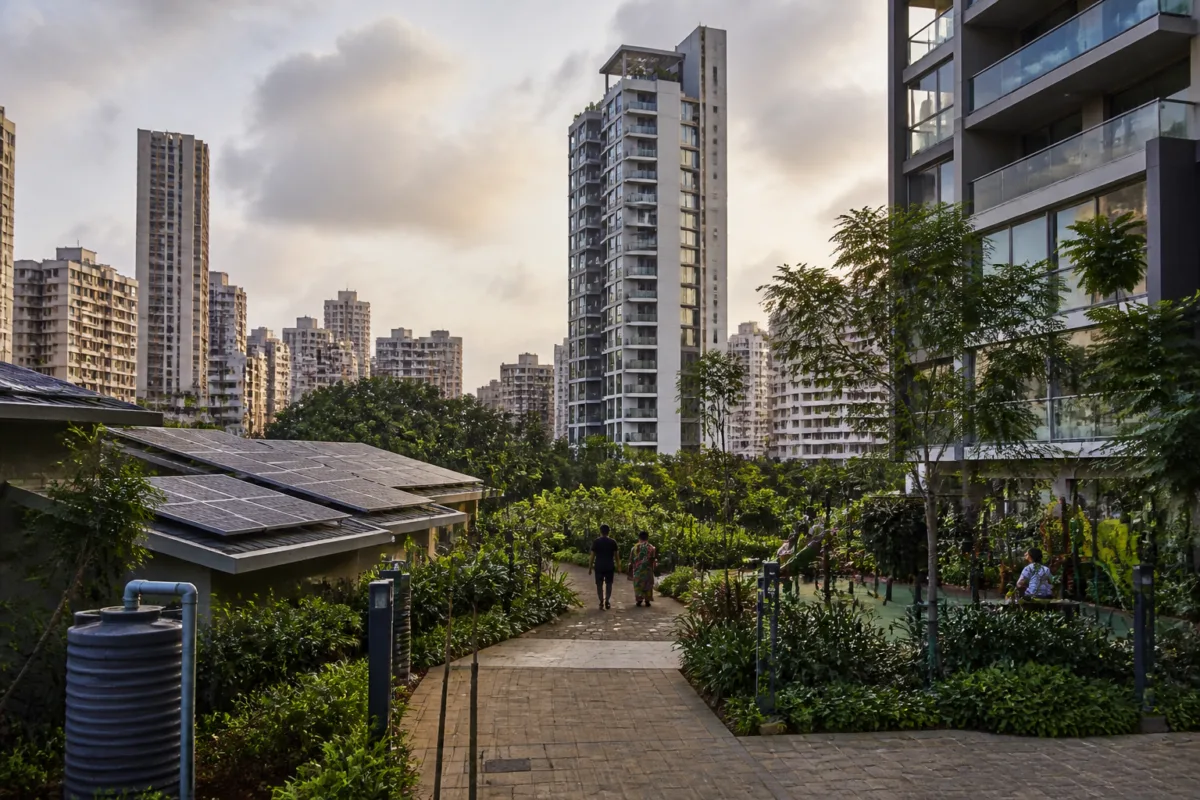
Maharashtra has become India’s largest green-building market, with 4,754 Indian Green Building Council (IGBC)-registered projects covering 5.01 billion square feet. Yet the state’s scale also reveals a less comfortable reality for Mumbai: the green-building movement remains concentrated in commercial and new developments, while the housing societies and existing buildings that define everyday urban life are still harder to bring into the transition.
The figures, released by the Confederation of Indian Industry’s IGBC, place Maharashtra well ahead of other states. Uttar Pradesh is second with 1,777 registered projects covering 1.90 billion square feet, while Gujarat, Karnataka and Tamil Nadu follow. Maharashtra accounts for approximately 23% of India’s registered green-building projects and 30% of the country’s registered green-building footprint.
The Mumbai region alone has 2,057 registered projects spread across 2.19 billion square feet. That is a substantial concentration of construction activity in a region facing rising temperatures, higher cooling demand, water stress and intense pressure on civic infrastructure. But registration is not the same as certification, and the area covered by green projects does not automatically indicate that most residents are experiencing greener or more affordable housing.
India has 20,621 IGBC-registered projects covering 16.55 billion square feet. Of these, 8,600 buildings covering 5.24 billion square feet have been certified. The distinction matters because registration indicates participation in a rating process, whereas certification indicates that a project has completed the relevant assessment. The data therefore show the reach of the green-building framework, but also point to the need for stronger attention to implementation and completed performance.
The composition of the national portfolio is equally important. Commercial buildings account for 11,991 of the registered projects, or 58.1%. Residential projects account for 5,775 projects, or 28%. Transit infrastructure contributes 1,342 projects, or 6.5%, while industrial and logistics facilities account for 1,022 projects, or 5%.
This imbalance is not merely a question of sectoral representation. Commercial developments are generally delivered through institutional ownership, professional project teams and centralised operations. A housing society, by contrast, must coordinate multiple owners, obtain agreement for capital works, manage maintenance budgets and work around an occupied building. Retrofitting an existing residential building can therefore involve a more complex administrative and financial process than incorporating green features into a new commercial project.
That distinction is central to Mumbai’s urban future. The city’s building stock is shaped by apartment societies, redevelopment schemes and vertical growth. Many residents experience the urban environment not through a newly planned office campus but through older buildings with ageing plumbing, inefficient cooling, limited ventilation, water losses and constrained common spaces. If green construction remains largely associated with premium offices and large new projects, its benefits will not reach the parts of the city where operational costs and infrastructure stress are felt most directly.
The potential benefits identified by IGBC extend beyond environmental branding. Green-building systems can include efficient lighting and cooling, better insulation, natural lighting and ventilation, rainwater harvesting, wastewater treatment and reuse, construction-waste reduction, improved indoor air quality and the use of lower-carbon materials. For households, these measures can affect electricity consumption, water use, maintenance costs and indoor comfort.
IGBC estimates that its rated buildings save approximately 64 billion units of electricity and 199 billion litres of water annually, while avoiding around 53 million tonnes of carbon dioxide emissions each year. These are aggregate estimates for the organisation’s rated building portfolio, not a guarantee of savings for every project. Actual outcomes depend on design quality, construction, equipment, building management and how occupants use the premises.
That qualification is particularly relevant to residential buildings. A building may be designed with efficient systems, but savings can be reduced if equipment is poorly maintained, common-area controls are not managed or residents are unable to finance necessary upgrades. The green-building question is therefore not limited to design standards. It also concerns ownership, maintenance and the distribution of costs and benefits over the life of a building.
Maharashtra’s policy framework already contains several incentives and mandates. The Pune Municipal Corporation and Pune Metropolitan Region Development Authority offer additional floor space index of 3%, 5% and 7% for buildings securing IGBC Silver, Gold and Platinum ratings, respectively. Such incentives connect green performance to development potential and can make certification more attractive to builders.
The state’s public works department has mandated that renovation of existing government buildings and construction of all new government buildings follow the appropriate IGBC rating system. The updated Unified Development Control and Promotion Regulations 2020 also mandate at least an IGBC Silver rating for buildings in integrated township projects. Maharashtra is additionally drafting Energy Conservation Building Code Rules 2025 to establish standardised energy-performance requirements for new commercial buildings.
These measures show that the state is moving from voluntary sustainability claims towards a combination of ratings, development incentives and mandatory standards. But their reach is uneven. FSI incentives are most directly relevant to projects that can use additional development potential. A housing society undertaking a retrofit may not receive the same immediate benefit, even though the work could reduce energy and water demand across an existing neighbourhood.
The policy challenge is therefore to connect green-building regulation with the economics of occupied housing. Residential societies may need access to affordable finance, technical advice and reliable methods to measure savings. Without these, the initial cost of efficient equipment, water systems, insulation, renewable-energy installations or waste-management infrastructure can remain more visible than the long-term reduction in operating expenses.
Finance is emerging as a central part of this discussion. IGBC plans to bring financial institutions, housing finance companies, developers and investors together to explore preferential interest rates for certified green projects, green home loans, green mortgages, green bonds and environmental, social and governance-linked investments. The stated objective is to narrow the gap between the upfront cost of sustainable construction and its longer-term operational savings.
For homebuyers, the usefulness of such products will depend on the terms offered and on whether projected savings can be demonstrated. A green home loan may improve affordability only if the financial benefit is not offset by a higher purchase price, additional certification costs or uncertain performance. The same issue applies to housing societies, where members must decide whether a capital investment will produce sufficiently clear savings in electricity, water and maintenance.
The next phase identified by IGBC includes retrofitting existing buildings, integrating renewable energy, adopting smart building-management systems and using low-carbon construction materials. This direction is significant because it moves the debate beyond the creation of new green buildings. Mumbai’s climate and infrastructure pressures cannot be addressed solely by adding better-performing buildings at the edge of the existing city; the operational performance of the current building stock also matters.
More than 350 organisations in the building sector have committed to achieving net-zero status for new and existing buildings under IGBC’s Mission on Net Zero, launched in 2021. The mission covers net-zero energy, water, waste and carbon. These four dimensions also illustrate why a building’s environmental performance cannot be reduced to electricity use alone. Water recycling, waste handling and construction materials affect municipal systems and resource demand in ways that are less visible than a building’s energy bill.
Several prominent Maharashtra projects are associated with the green-building movement, including the Reserve Bank of India Central Office Building, Bombay House, Chhatrapati Shivaji Maharaj Vastu Sangrahalaya, Chhatrapati Shivaji Maharaj Terminus, Mumbai International Airport and Mumbai Central railway station. The list demonstrates that green standards can be applied across offices, heritage sites, transport facilities and public institutions. It does not, however, establish that the same level of adoption has reached ordinary residential buildings.
That gap is the larger urban question. Maharashtra’s figures confirm that green construction has achieved significant scale, but the distribution of that scale matters. A market led by large commercial projects can produce impressive aggregate numbers while leaving the retrofit needs of housing societies unresolved. The next measure of progress should therefore include not only the square footage registered, but also the number of occupied residential buildings improved, the resources saved in operation and the affordability of those interventions.
The evidence currently confirms three things: Maharashtra leads India by registered green-building area; commercial projects form the majority of the national portfolio; and the policy and finance ecosystem is beginning to address both new construction and existing buildings. What remains less established is how quickly residential societies and redevelopment projects can adopt these measures at scale, and whether households will receive measurable savings in return. The Green Building Congress 2026 in Mumbai, scheduled from November 26 to 28, is expected to bring these questions together with discussions involving developers, lenders, investors and building-sector organisations.

