


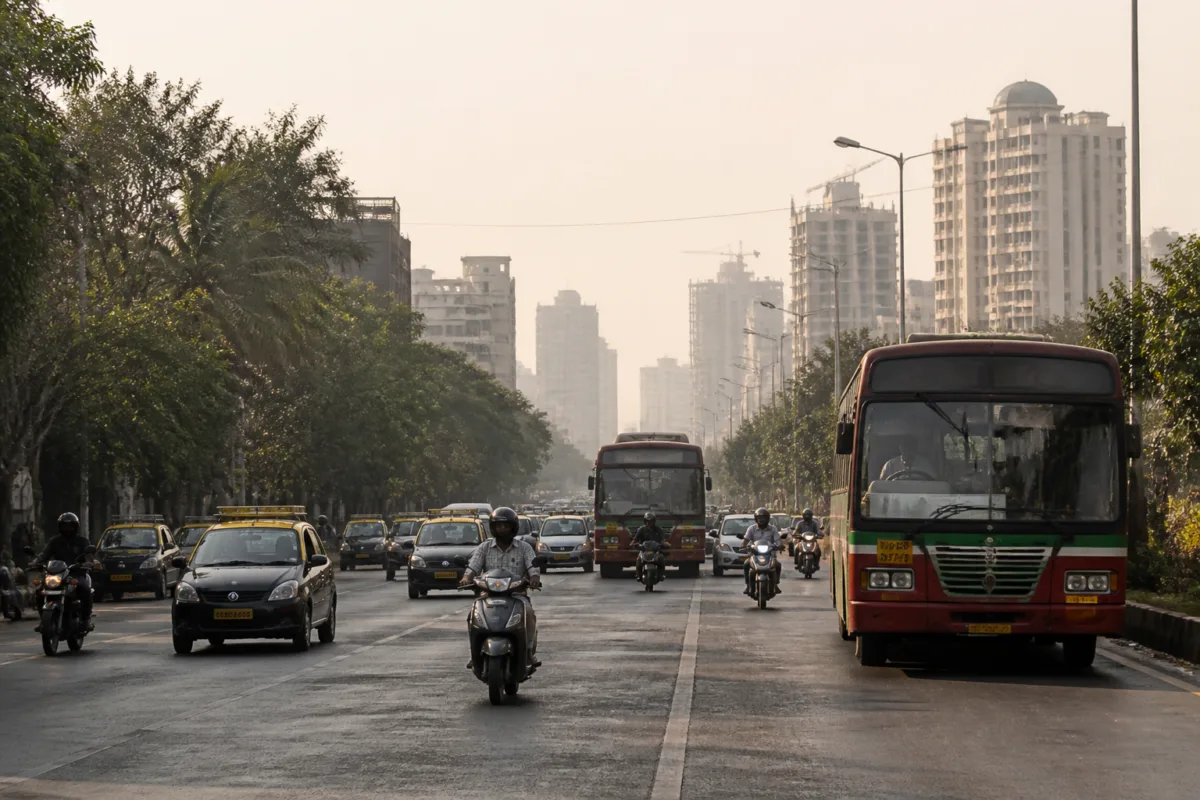
Mumbai recorded another hot and humid day on November 12, with the maximum temperature touching 36.1 degrees Celsius at Santacruz and air quality reaching the poor category at four monitored locations. The city’s overall Air Quality Index stood at 147, placing it in the moderate category, according to data from the Central Pollution Control Board’s SAMEER app cited in the weather update.
The India Meteorological Department forecast haze during the morning, followed by mainly clear skies across Mumbai and its suburbs. No rainfall was recorded at the Colaba and Santacruz observatories, as daytime temperatures remained above 35 degrees Celsius at both locations.
Santacruz recorded a minimum temperature of 19.6 degrees Celsius and a maximum of 36.1 degrees Celsius. Colaba, which is closer to the coast, recorded a minimum temperature of 25 degrees Celsius and a maximum of 35.4 degrees Celsius. The readings point to a marked difference between the city’s inland and coastal weather stations, while both areas remained warm during the day.
The citywide AQI of 147 falls within the moderate band under India’s national AQI classification. The classification places readings from 51 to 100 in the satisfactory category, 101 to 200 in the moderate category and 201 to 300 in the poor category. Mumbai’s overall figure therefore remained below the poor threshold, but station-level readings were considerably higher in several parts of the city.
Deonar recorded the highest AQI among the listed Mumbai stations at 218. Bandra-Kurla Complex followed with a reading of 206, while Andheri recorded 203 and Colaba recorded 201. All four locations were classified in the poor category. These readings show that the citywide number did not reflect uniform conditions across Mumbai, with pollution levels varying substantially between monitoring stations.
Other locations remained in the moderate category. Worli recorded an AQI of 165 and Borivali recorded 161. The variation is relevant for residents travelling across the city, as exposure conditions differed between neighbourhoods even while Mumbai’s overall air quality remained in the same broad classification.
Air quality in other parts of the Mumbai Metropolitan Region also remained moderate at the listed stations. Navi Mumbai recorded an AQI of 142, followed by Thane at 140 and Kalyan at 103. Kalyan’s reading was the lowest among the MMR locations cited in the report, though it remained within the moderate category.
The combined weather and air-quality readings present a city experiencing heat, morning haze and uneven pollution levels without rainfall during the recorded period. The IMD forecast mainly clear skies after the morning haze. Further weather and air-quality conditions will depend on subsequent observations from the city’s monitoring stations and the next official forecast.

