


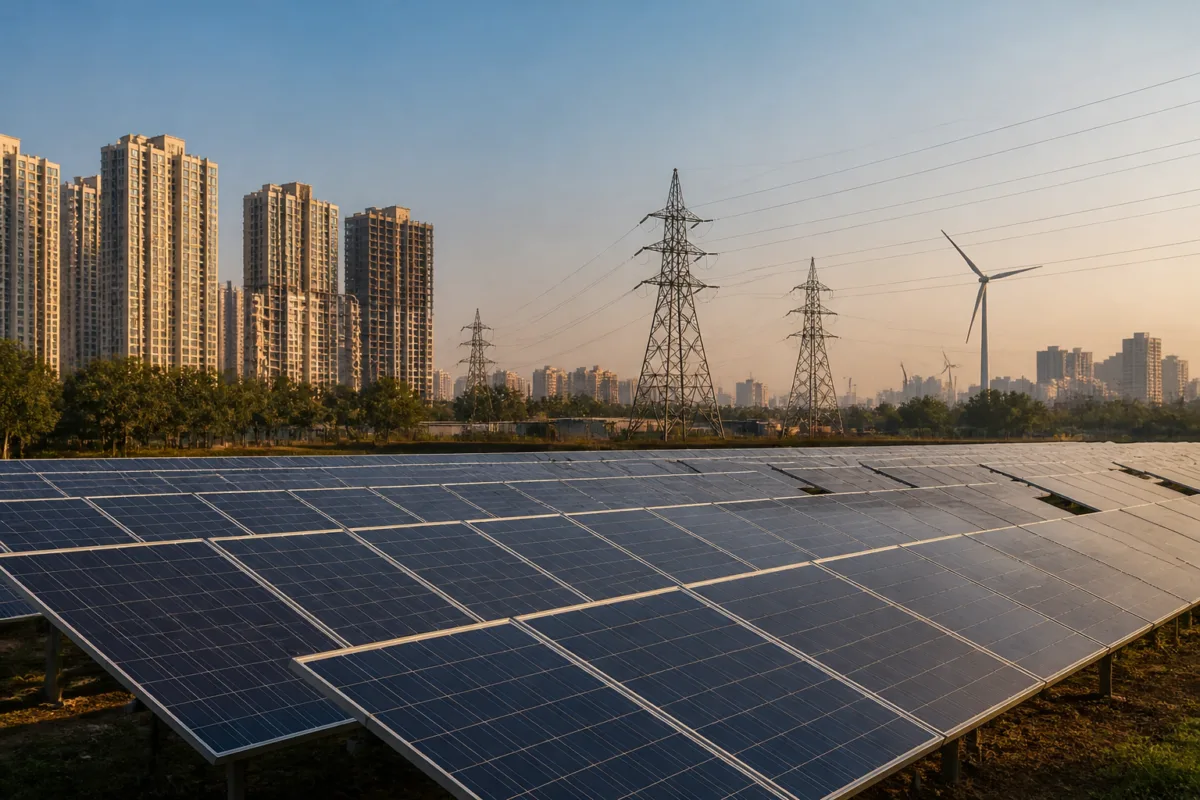
India’s renewable energy expansion has become more than a climate-policy story. According to the International Energy Agency’s India Renewable Energy Market Report 2026, solar, wind and bioenergy capacity added since 2010 helped the country avoid more than $100 billion in coal and natural gas import costs between 2011 and 2025. The finding places renewable energy at the centre of a much wider urban and economic question: how India powers its cities, industries, farms and expanding infrastructure without making electricity demand increasingly dependent on overseas fuel markets.
The IEA estimates that cumulative savings on coal and natural gas imports could approach $240 billion by 2030, equivalent to around Rs 22.6 lakh crore. That projection assumes international fuel prices remain broadly at their 2024-25 average levels. Annual savings could reach about $35 billion, or Rs 3.3 lakh crore, by 2030—more than India’s total expenditure on non-coking coal and natural gas imports in FY25, according to the report.
These figures do not represent a single budgetary allocation or a direct cash transfer to consumers. They describe fuel purchases that India did not need to make because renewable generation supplied part of the electricity that would otherwise have required coal or natural gas. The distinction matters. The economic dividend of renewables is not limited to the price of a solar or wind project; it also includes lower exposure to international fuel prices and reduced pressure on the balance of payments.
For cities, this changes the meaning of energy infrastructure. Urban India’s electricity system is usually experienced through distribution networks, household bills, commercial buildings, transport systems, water pumping and municipal services. Yet the cost and reliability of that system are also shaped by what happens upstream in power generation. A city may not visibly distinguish between electricity generated by a solar plant and electricity generated by imported coal, but its exposure to fuel markets, generation costs and supply risks is affected by that underlying mix.
The report’s most striking counterfactual is its estimate that, without the solar, wind and bioenergy capacity installed since 2010, India would have needed to import an additional 110 million tonnes of coal in 2025 alone. This is an estimate of avoided demand, not a record of an import transaction that was cancelled. But it illustrates the scale at which renewable capacity is beginning to influence the country’s energy system.
India’s renewable energy capacity has nearly quadrupled over the past decade, crossing 300 GW in 2026, the report said. Between March 2014 and September 2026, the country added 168 GW of solar capacity and 38 GW of wind capacity. Bioenergy capacity stood at nearly 12 GW by September 2026. The expansion has been accompanied by a broader change in the power system: non-fossil fuel sources accounted for 50% of installed electricity capacity in 2025, allowing India to reach its 2030 target five years ahead of schedule.
Installed capacity, however, is not the same as electricity generated at every hour of the day. Solar output varies with sunlight, while wind generation depends on weather conditions. The supplied IEA findings establish the scale of capacity growth and its estimated import savings, but they do not provide a complete account of generation patterns, storage capacity, transmission constraints or distribution performance. Those details remain important to understanding how far the economic benefit can translate into consistent service for electricity users.
The report attributes the expansion to sustained government policy support, ambitious renewable energy targets and long-term planning. Competitive bidding also helped reduce the cost of renewable power. Solar tariffs for projects commissioned in 2025 were around 40% lower than the average cost of coal-based electricity, the IEA said. This comparison helps explain why renewable energy has moved from a supplementary source towards a central component of capacity planning.
The policy architecture has also extended beyond large utility-scale projects. The PM Surya Ghar: Muft Bijli Yojana has encouraged households to install rooftop solar systems, enabling them to generate electricity and reduce power bills. The PM-KUSUM scheme has supported solar-powered irrigation pumps and the supply of solar electricity to agricultural consumers. These programmes connect national energy policy to the physical fabric of settlements: rooftops, farms, feeders, local distribution systems and the daily cost of electricity.
That decentralised dimension is significant for urban governance. Rooftop solar changes the relationship between buildings and the grid, while lower electricity demand from the network can affect the way distribution systems are planned. The supplied report does not establish how much capacity has been added under each scheme or how evenly benefits have been distributed across income groups and regions. It does, however, show that the renewable transition is no longer confined to distant power stations. It increasingly involves homes, public institutions, agricultural users and local electricity consumers.
The government has simultaneously sought to develop domestic manufacturing through Production Linked Incentive schemes and policies promoting locally manufactured solar equipment. The IEA linked these measures to investments in India’s solar manufacturing ecosystem. This adds an industrial and construction dimension to the energy transition. Renewable infrastructure requires modules, inverters, mounting systems, electrical equipment, transmission assets and land or building space. Manufacturing policy therefore affects not only energy security but also where value is created across the built environment.
India’s position in the global renewable market has strengthened alongside this domestic expansion. The IEA ranked the country as the world’s second-fastest-growing renewable energy market and the second-largest manufacturer of solar panels. These rankings describe market growth and manufacturing scale, but they do not by themselves settle questions about project execution, grid integration, land use or consumer affordability. The report’s economic case is strongest when read together with those implementation questions rather than as a substitute for them.
The projected $240 billion in cumulative avoided imports by 2030 is also sensitive to the assumption used. The IEA’s estimate assumes international fuel prices remain around their 2024-25 average levels. If prices move differently, the monetary value of avoided imports would change even if renewable generation remains the same. The physical benefit—producing electricity domestically rather than relying on imported fuel—would still exist, but its value in dollar terms would vary.
This makes renewable energy an unusual infrastructure asset. It can deliver several forms of resilience at once: lower exposure to imported coal and gas, reduced sensitivity to global fuel-price volatility, and additional domestic capacity. At the same time, the system must manage the operational requirements that accompany variable generation. The information supplied with the IEA report does not quantify storage, transmission investment or balancing requirements, so those aspects cannot be assessed here. They remain central to whether capacity growth becomes a stable foundation for urban electricity demand.
The report also places India’s net-zero transition aim for 2070 within a large capital story, estimating a $22.7 trillion investment opportunity for global capital. That figure signals the scale of financing implied by the transition, but the avoided-import estimate provides a more immediate economic measure: renewable generation has already reduced the fuel purchases required to supply India’s electricity system.
The larger urban question is therefore no longer whether renewable energy belongs in India’s infrastructure strategy. The evidence supplied by the IEA shows that it is already influencing the country’s import bill, generation economics, manufacturing ambitions and household-facing programmes. The next questions concern the quality and distribution of that expansion: how capacity is connected to the grid, how reliably it serves demand, how benefits reach consumers and how cities adapt their buildings and networks to a more decentralised power system.
What the report confirms is substantial growth with a measurable energy-security dividend. It estimates more than $100 billion in avoided coal and natural gas import costs between 2011 and 2025, and nearly $240 billion cumulatively by 2030 under its stated fuel-price assumption. The developments that require continued attention are the conversion of installed capacity into dependable generation, the performance of distribution systems and the ability of policy and manufacturing support to sustain the transition across India’s rapidly expanding urban economy.

