


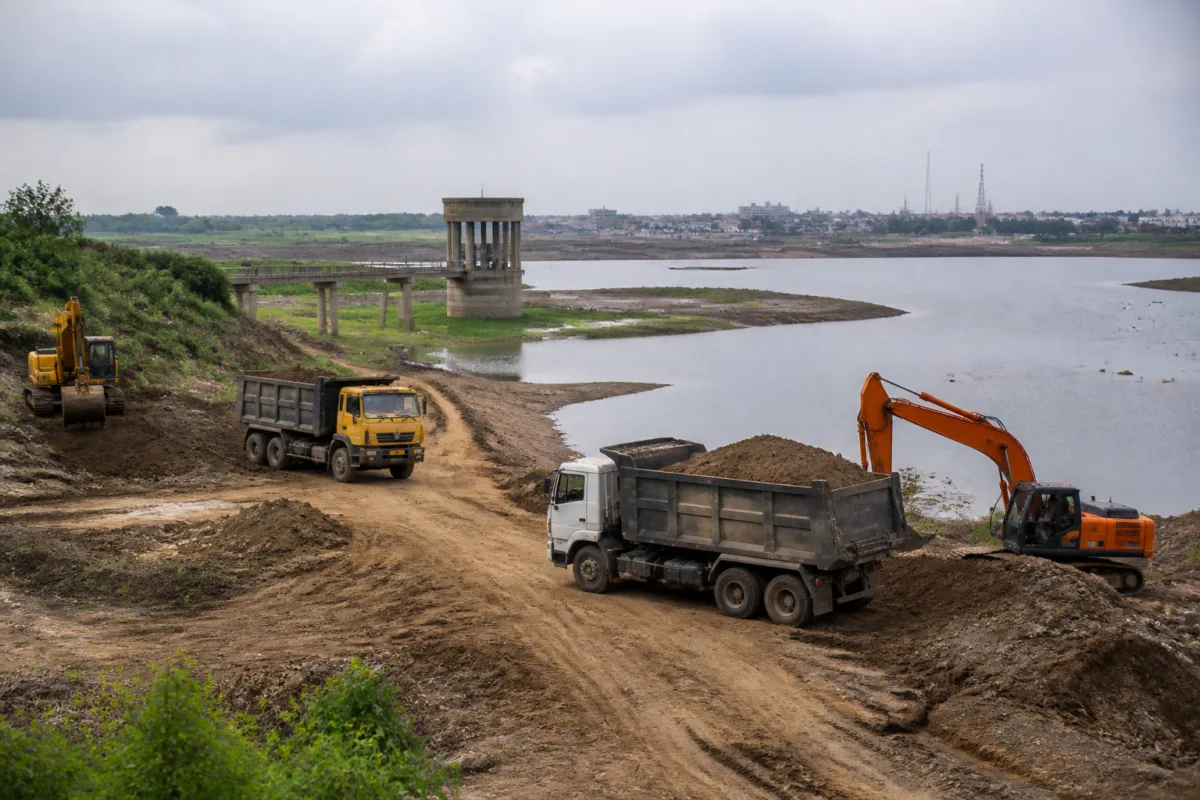
Cholavaram lake sand mining is no longer only a question of illegal extraction. It is a test of whether Chennai can protect the reservoirs that support its drinking-water system when enforcement is weak, legal supply chains are disrupted and construction demand continues to create a profitable market for material taken from sensitive landscapes.
The partially dry Cholavaram reservoir, one of the key waterbodies supplying drinking water to Chennai, is being excavated by trucks and earthmovers, according to a report by The Times of India. The newspaper said it tracked more than 17 trucks and three earthmovers operating around 10am on a Wednesday at the western end of the reservoir. The 2,200-acre lake had temporary pathways for heavy vehicles, while residents said trucks entered through a route leading to the reservoir every day.
The reported movement of material follows a clear logistics chain. Trucks carrying excavated earth and sand travel along Devaneri Karanodai Road towards GNT Road, with some of the material taken to stockyards. The report cited an estimate that more than 400 tonnes of sand can be removed at a time. Red sand is reportedly transported to stockyards in Red Hills before being moved to construction sites, according to S Yuvaraj, president of the Tamil Nadu State Sand Lorry Owners’ Federation.
That detail matters because the reservoir is not an isolated mining site. It is part of a wider regional network linking water infrastructure, roads, stockyards, construction demand and enforcement jurisdictions. Once material leaves the lake, the original extraction site becomes harder to monitor and the supply chain acquires the appearance of an ordinary commercial movement. The urban consequence, however, remains concentrated at the source: a drinking-water reservoir is being treated as an informal material bank.
Cholavaram is nearly 160 years old and has a capacity of 1,081 million cubic feet, according to a senior Water Resources Department official quoted in the report. Unscientific mining can affect the stability of the reservoir, the official said. The concern is therefore not limited to the loss of earth or the appearance of a damaged lakebed. Excavation along the bed and fringes can alter the physical condition of an ageing water-retention structure, even though the supplied report does not establish the precise extent of existing structural damage.
The evidence presented in the report also points to a regulatory gap between detection and prevention. A Tiruvallur district mining official said six lorries had been seized a week earlier for illegal sand mining at Cholavaram. The official also said police and revenue officials conducted a raid on Tuesday night. Yet a villager told the newspaper that illegal miners return soon after raids and that repeated complaints to the district administration had not produced sustained action.
This pattern suggests that enforcement is operating as a series of interventions rather than as a continuous protection system. Seizing vehicles can interrupt one operation, but it does not necessarily close access roads, dismantle stockyards, track the destination of extracted material or prevent replacement vehicles from returning. The report does not provide a complete account of how many cases have been registered, how many prosecutions have resulted or whether any extracted material has been recovered. Those gaps make it impossible to measure the full enforcement outcome, but the reported recurrence indicates that raids alone have not ended the activity.
The institutional responsibility is also distributed. Water-resources officials are concerned with the reservoir and its physical condition. Mining officials deal with extraction. Police and revenue officials participate in raids. The district administration is expected to respond to local complaints. The minister for natural resources has described the illegal trade as being driven by a powerful lobby. When responsibility is divided across departments, a problem can remain visible to each agency without becoming the settled responsibility of any one agency.
The supply-side history described in the report helps explain why pressure has intensified. The Enforcement Directorate’s raids in September 2023 disrupted legal river-sand operations, according to the report. By November 2023, state-sanctioned quarries had reportedly shut after private contractors vacated approved sites. Yuvaraj said that there had been no legal sand quarrying anywhere in the state for the previous two and a half years, while acknowledging that alternative materials and illegally sourced sand were entering the market.
Those claims are attributed to the lorry owners’ federation and should not be treated as an independently established measurement of the entire state market. But they identify a structural relationship: when formal supply is interrupted without a reliable replacement, construction demand does not automatically disappear. It searches for other channels. The reported alternatives include mud excavated from metro rail construction sites in Mylapore, Royapettah and Marina, manufactured white M-sand from Tiruvannamalai, and sand brought from Andhra Pradesh through Tada.
The material substitution described here creates its own quality and governance questions. The report says mud from construction sites has been sold as sand, but it does not establish the scale of that trade or the performance of the material in specific building applications. It does, however, show how a shortage can blur the boundary between construction spoil, manufactured material and illegally quarried natural sand. For cities, that boundary matters because the material entering a building site is connected to excavation practices, transport routes, stockyard controls and construction safety.
Tamil Nadu has announced a proposed response based on reopening selected legal river-sand quarries under direct online government operation. The reported plan includes satellite mapping and geographic information system-based monitoring intended to prevent contractors from mining beyond approved boundaries. According to Yuvaraj, the system had not yet started. The supplied report does not provide a launch date, list the selected quarries or specify the agency responsible for publishing monitoring data.
The proposed model is significant because it attempts to address both the legal-supply deficit and the monitoring problem. Direct government operation could reduce dependence on private contractors, while satellite and GIS tools could define permitted extraction zones and track changes over time. But technology cannot by itself resolve the institutional question raised at Cholavaram. Mapping may identify where excavation has occurred; it does not ensure that officials act on the information, that stockyards receive only authorised material or that repeat offenders face consequences strong enough to deter a return.
Cholavaram also exposes a planning contradiction. Chennai’s reservoirs are critical urban infrastructure, but their protection often becomes most visible when water levels are low and the exposed bed becomes accessible. A partially dry reservoir may appear to offer spare land or easily removable earth. In functional terms, however, the dry bed remains part of the city’s water system. Its capacity, edges, access routes and surrounding land conditions influence how the reservoir performs when water returns.
The report does not establish that current extraction has reduced Cholavaram’s storage capacity by a specific amount. Nor does it quantify the effect on Chennai’s water supply. Those questions require technical assessment by the responsible authorities. What is established is that the reservoir supplies drinking water to the city, that heavy machinery has been observed excavating its bed and fringes, and that a water-resources official has warned of possible stability effects from unscientific mining.
The larger issue is therefore not simply whether a particular truck is caught. It is whether Chennai’s water infrastructure is being governed as infrastructure at all points in its life cycle. Protection includes land-use control, access management, material tracking, interdepartmental coordination, transparent quarry permissions and action against stockyards. If any link is weak, an enforcement operation at the extraction point can be followed by a new operation elsewhere.
The Cholavaram case also shows why urban infrastructure cannot be managed in departmental silos. A reservoir, a construction site, a road corridor and a sand stockyard may fall under different authorities, but they are connected by the same material economy. The demand generated by housing and infrastructure construction can place pressure on rivers, reservoirs and excavation sites far from the final building. The governance system must therefore follow the material from source to destination rather than treating each location as a separate incident.
The evidence currently supports three conclusions. Illegal excavation has been reported at a major Chennai water source; enforcement actions have taken place but have not prevented recurrence; and the disruption of legal sand supply has contributed to a broader market for substitute and illegally sourced material, according to the named sources cited by The Times of India. The scale of reservoir damage, the volume removed over time and the consequences for storage capacity remain unestablished in the supplied material.
The next significant test will be whether the state’s proposed direct-operation model for legal sand quarries begins, whether its promised satellite and GIS monitoring becomes publicly verifiable, and whether authorities establish sustained control over access routes and stockyards. Until then, Cholavaram remains a warning that a city’s water security can be weakened not only by drought or contamination, but also by the quiet removal of the physical landscape meant to hold its water.

