


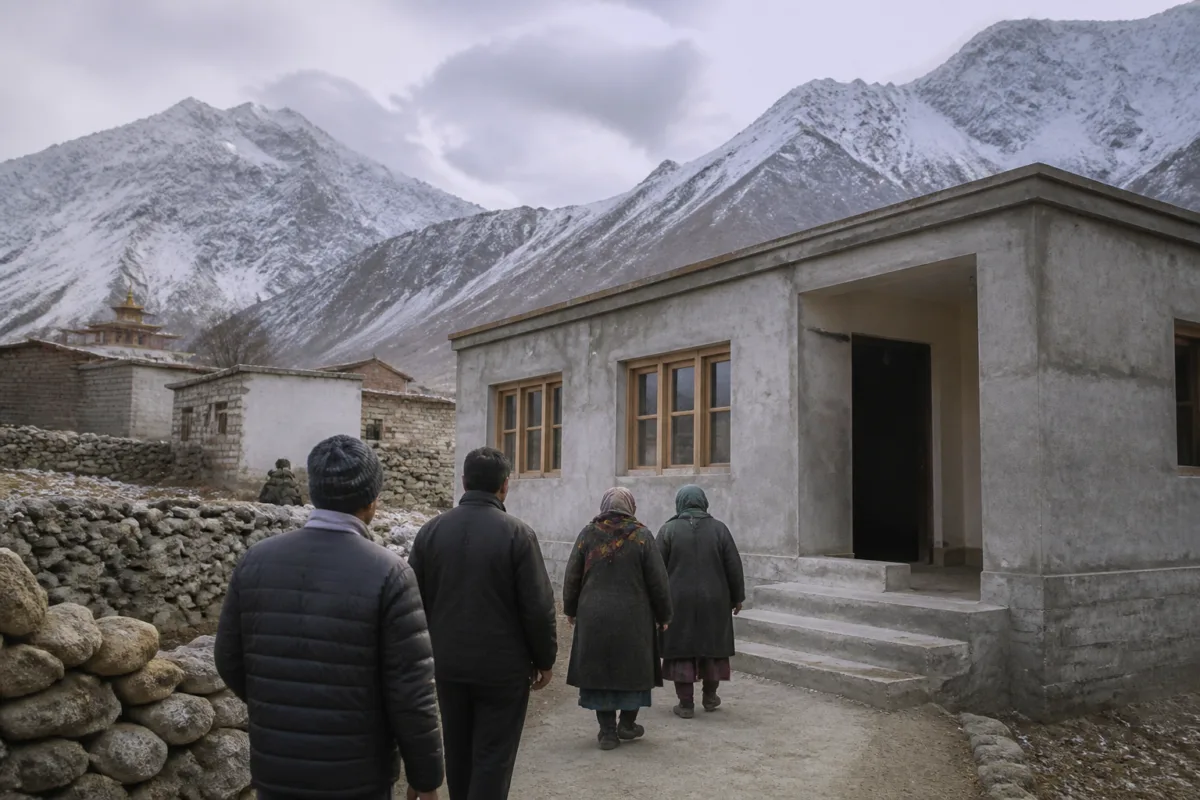
Ladakh’s election schedule has triggered a dispute over whether democratic participation can be protected when extreme winter, seasonal migration and sparse settlement patterns make physical access difficult. Leaders from Leh and Kargil have asked the Centre to defer upcoming local and hill council polls, while the administration has defended the schedule by pointing to open schools, planned facilities at polling stations and the need to proceed with the electoral process.
The immediate controversy is not only about dates. It exposes a difficult administrative question for a high-altitude Union Territory: should election logistics be designed around the formal availability of polling stations, or around the actual presence and mobility of the electorate? The answer has consequences for voter turnout, representation and confidence in institutions that govern places where populations are dispersed and seasonal movement is substantial.
Ladakhi leaders, including Leh Apex Body member and climate activist Sonam Wangchuk, appealed to President Droupadi Murmu, Prime Minister Narendra Modi and Union home minister Amit Shah to intervene and defer the elections. Wangchuk, speaking alongside Ladakh MP Mohmad Haneefa, Leh Apex Body co-chairman Chering Dorjay Lakrook and Kargil Democratic Alliance co-chairmen Asgar Ali Karbali and Sajjad Kargili, described the appeal as an “SOS call from Ladakh”.
Their central argument is that elections are being held during a period when parts of Ladakh experience severe cold and snowfall, while a significant share of residents is outside the Union Territory. Wangchuk said temperatures in some parts of Ladakh fall below minus 30 degrees Celsius and argued that December weather could make voting difficult. He also said students were already studying in other cities and that Leh, Kargil and other areas could be “nearly empty” during the election period.
The leaders’ claims raise two separate but connected access problems. The first is physical access: voters who remain in Ladakh may have to travel or queue in conditions that can be hazardous or uncomfortable, particularly for elderly residents. The second is electoral presence: residents who are temporarily outside the Union Territory may remain on the rolls but be unable to return to vote. The report does not establish the exact number of voters affected or the legal arrangements available for those who are away, but it records the political leadership’s claim that the absence could be substantial.
The administration has offered a different account of feasibility. Ladakh Chief Secretary Ashish Kundra described the elections as a “watershed moment” and a turning point for democracy in the region. Defending the decision to schedule the polls for December 4, he said schools in Ladakh remained open until December 15. On that basis, he argued that if children could attend school during the period, adults should not face difficulty coming out to vote.
That comparison reveals the limits of treating election access as a simple question of whether public institutions remain open. School attendance and voting do not necessarily involve the same people, travel patterns or time requirements. Students may be attending nearby schools, while voters may be working or studying outside the Union Territory. Elderly voters may also face different mobility constraints from school-going children. The supplied report does not provide travel distances, polling-station coverage or turnout modelling, so it cannot establish whether the administration’s logistical assurances will translate into broad participation.
The administration has nevertheless identified specific measures. Kundra said deputy commissioners had been instructed to provide necessary facilities at polling stations, including heaters, and to arrange separate queues for elderly voters. These steps address comfort and queue management at polling locations. They do not, on the evidence available in the report, resolve the wider question of how residents outside Ladakh will participate or how polling will be affected if snowfall disrupts movement between settlements.
The dispute comes amid a sequence of election announcements. The report says the Ladakh administration imposed a complete ban on protests and demonstrations within the municipal limits of Leh and Kargil after the Model Code of Conduct came into force. The Chief Electoral Officer’s order said dharnas, protests, demonstrations, sit-ins, hunger strikes, rallies and similar collective political activities would not be allowed during the election period. The stated reasons were the prevention of voter intimidation, disturbance of public order and interference with free and fair elections.
The order places the issue in an institutional frame. During an election, the administration has a responsibility to protect the process from coercion and disruption. At the same time, restrictions on collective political activity affect how parties, candidates and civic groups can challenge the schedule or raise concerns about participation. The report does not indicate that the ban has been struck down or that a court has reviewed it. It does show that the timing dispute is unfolding alongside a restriction on public mobilisation in the two municipal areas.
The election calendar described in the report covers several levels of local representation. Polling for the Ladakh panchayat and municipal elections had been announced earlier, with polling scheduled for November 21, while the report identifies municipal polling dates of November 23 for one election and December 4 for another. The State Election Commission also announced elections to the region’s eight autonomous hill development councils, with polling scheduled for December 4. Because the report presents multiple election dates and institutions, the practical burden on voters depends on the specific local body, constituency and election in question.
This layered structure matters because Ladakh’s local governance is not represented through a single institution. Municipal committees, panchayats and autonomous hill development councils operate at different levels and cover different responsibilities. The report does not set out their precise jurisdictions, but the scheduling of several elections in the same winter period creates a wider administrative coordination challenge. Polling arrangements, staff deployment, security, transport and public information must work across settlements with different terrain and weather conditions.
The leaders’ proposed alternative is to hold the polls in May or June. Lakrook said that period would be more suitable for ensuring maximum voter participation, while Karbali said Ladakh had traditionally recorded around 90 per cent voter turnout and alleged that nearly 30 per cent of the population would be outside the Union Territory during the scheduled elections. These figures and claims are attributed to the political leaders in the report; it does not provide official turnout records or an independent estimate of the number of residents expected to be away.
The disagreement therefore turns on what should count as an adequate election timetable. The administration’s position, as reported, is that polling can proceed because schools are open and facilities such as heaters and separate queues can be provided. The opposing position is that formal readiness at polling stations is insufficient when winter conditions and seasonal absence prevent a sizeable part of the electorate from reaching those stations. Both sides are addressing election feasibility, but they are measuring it differently.
The absence of more detailed public information is significant. The supplied report does not state how many polling stations will operate, how far voters may have to travel, what contingency arrangements exist for snow, whether transport will be provided, or whether any mechanism is available for eligible voters who are temporarily outside Ladakh. It also does not provide a public weather or turnout assessment supporting either side’s position. Those gaps do not invalidate the competing claims, but they limit the ability to judge whether the schedule is administratively workable and democratically inclusive.
The dispute also points to the importance of seasonal population data in election planning. In a region where leaders say many residents leave for education or other reasons, an electoral calendar based only on climatic conditions inside Ladakh may not capture the full participation problem. Conversely, postponing elections to a warmer period would itself require administrative decisions about terms, legal deadlines and the coordination of multiple local institutions. The report does not say whether such constraints were considered before the notifications were issued.
What is established is that the administration has issued election notifications, imposed the Model Code of Conduct and restricted political demonstrations in Leh and Kargil. It is also established that prominent Ladakhi leaders have publicly sought intervention and deferment, citing winter and voter absence, while the Chief Secretary has defended the schedule and promised facilities at polling stations. What remains unresolved is whether those measures are sufficient to secure participation across a population that is geographically dispersed and partly seasonal.
The next test will be the administration’s implementation of its assurances and the response of voters as the scheduled polling dates approach. The availability of heaters and separate queues can be monitored at polling stations, but the larger measure will be whether the election process enables meaningful participation from residents across Ladakh, including those affected by severe weather and temporary absence from the Union Territory.

