


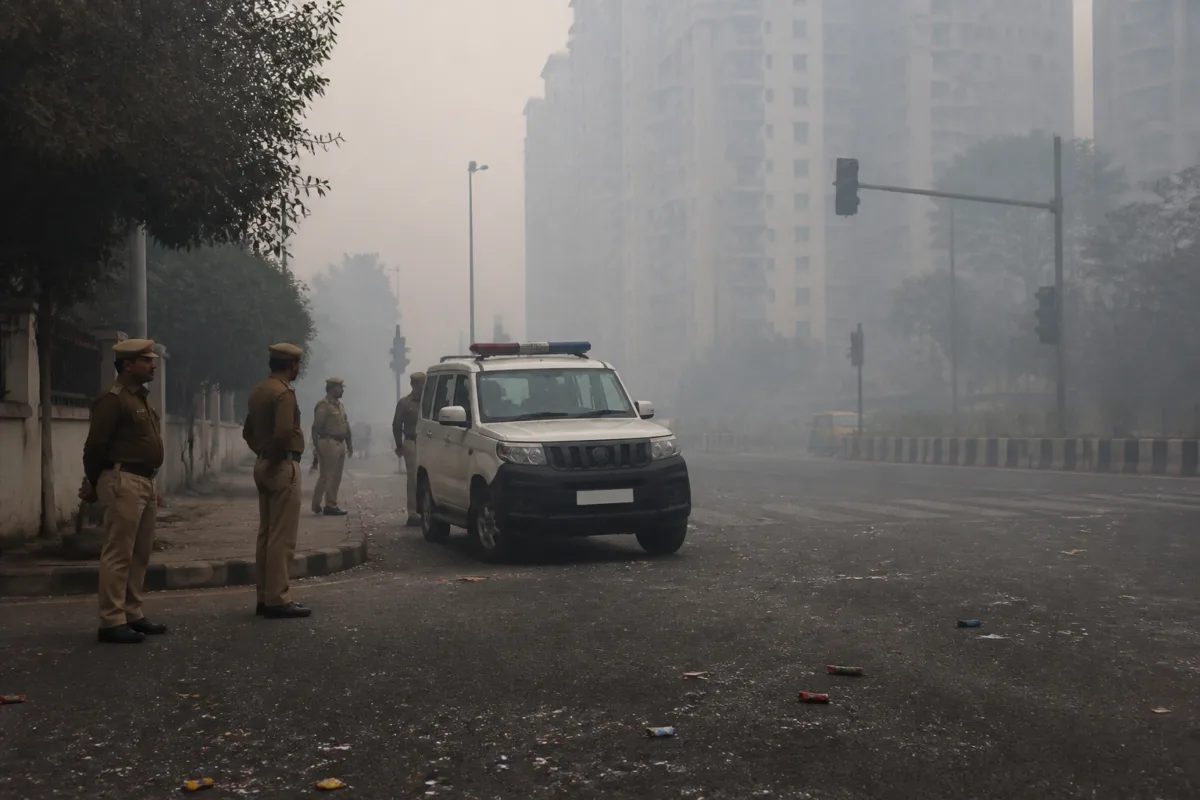
The Delhi firecracker ban is back in force after the permitted window for bursting crackers ended, with Delhi Police warning of legal action against anyone violating the restriction in the national capital. Police said crackers were allowed only during designated hours on November 7 and 8, and that their use is now prohibited.
In a post on X, Delhi Police said the permission to burst firecrackers in the national capital had expired. The force appealed to residents to follow the restriction and said strict legal action would be taken against those who continue to burn crackers or otherwise violate the rules.
The renewed enforcement comes after heavy firecracker-related pollution was recorded in Delhi during Diwali. According to figures attributed to the Indian Institute of Tropical Meteorology, firecrackers accounted for 71.1% of Delhi’s pollution on Monday and 29.8% on Tuesday. The report did not specify the full methodology or the monitoring locations behind the daily estimates.
The same report said vehicles accounted for 6.9% of Delhi’s pollution on Monday. The figures place the effect of firecracker emissions within a wider pollution episode that has affected the capital at the start of the winter season.
Air quality in Delhi worsened to the ‘very poor’ category on Wednesday morning, when the city recorded an Air Quality Index reading of 303. The 24-hour average AQI had stood at 299 on Tuesday, when the air was classified as ‘poor’. The Central Pollution Control Board has also identified stubble burning in neighbouring states as one of the factors contributing to the pollution load.
An analysis by the Centre for Science and Environment cited in the report found that Delhi-NCR’s pollution situation had deteriorated at the beginning of this winter. The average PM2.5 concentration during the week before Diwali was recorded at 236 micrograms per cubic metre, which the analysis said was 32% higher than the 179 micrograms per cubic metre recorded in 2024. The pre-Diwali average was described as the highest in three years.
Delhi’s pollution response therefore involves several overlapping sources and agencies, including firecracker enforcement by the police, air-quality monitoring and assessment by scientific and regulatory institutions, and action related to agricultural burning in neighbouring states. For residents, the immediate rule is that the permitted firecracker period has ended. Delhi Police’s warning indicates that enforcement will now focus on preventing further cracker use as the city’s air remains in the poor to very poor range.

