


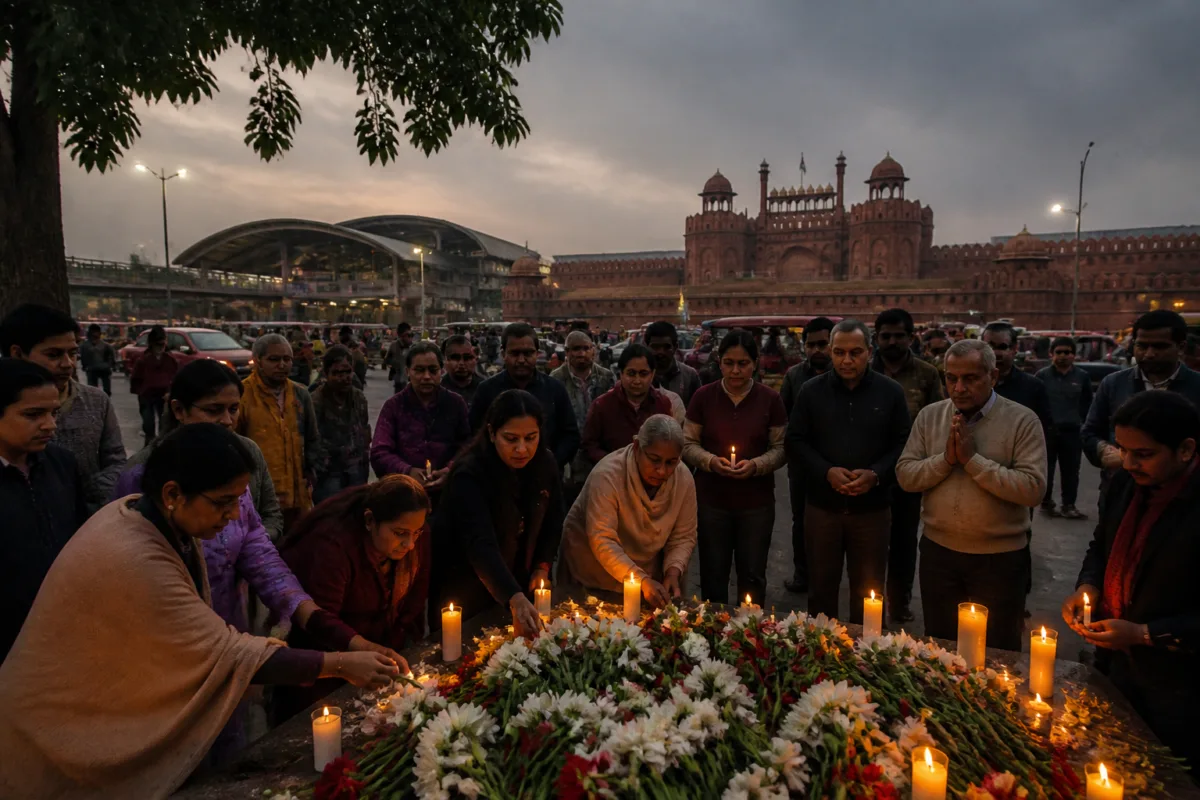
A year after the Red Fort blast, families of those killed and injured are still seeking compensation, employment support and assistance for vehicles destroyed in the incident. Their demands, raised at a memorial gathering near the Red Fort Metro station, point to a difficult but important question in urban governance: what happens to victims after the immediate security crisis has passed?
According to a report by Jagran – New Delhi, relatives of the deceased and injured people assembled for a remembrance meeting on the first anniversary of the blast. The gathering was not only an occasion to remember those who died. It also became a platform for families to say that their financial and legal difficulties remain unresolved.
The families’ demands include government jobs for a child or spouse of each deceased victim, adequate compensation for the families of those killed and for injured people, and financial assistance for cars, e-rickshaws and other vehicles that were burnt or destroyed in the blast. An additional demand is for two per cent reservation in government jobs for affected families.
These demands place rehabilitation alongside justice. The two are related but not identical. A criminal investigation or court process may address responsibility for an attack, while compensation, employment support and assistance for damaged property address how affected households survive after the event. The account reported by Jagran indicates that families believe both tracks remain incomplete.
The memorial meeting was attended by relatives of victims, including Nazma, the sister of deceased victim Mohammed Jumman, and Jagdish Kataria, the father of deceased victim Amar Kataria. They said that a government job for a child or spouse would help families manage their livelihoods and improve their financial circumstances. Their appeal reflects the continuing economic effect of a sudden death in a household, particularly when the deceased was a source of income or care.
Ashok Randhawa, president of the South Asian Forum for People Against Terror, called for adequate financial assistance for families of those killed and for injured victims. He also sought compensation for vehicles damaged or destroyed in the blast. The report attributes the demand for two per cent reservation in government jobs to the organisation.
The reported sequence of events also reveals an institutional gap. Randhawa said that a public interest litigation petition was filed in the Delhi High Court to seek justice and relief for victims. The court initially advised that the demands be placed before the government. The organisation subsequently submitted its demands to the government several times in writing, but, according to the report, no concrete action had followed by the first anniversary.
That account does not establish the status of the criminal investigation, identify the government department responsible for each demand, or record an official response to the families’ claims. It does, however, establish that the relief question has moved through more than one channel: a court petition, written representations to the government and a public appeal at a memorial gathering. The absence of a reported resolution across those channels is the central administrative issue.
For city residents, the case illustrates how urban safety incidents create consequences beyond the immediate site. The blast occurred near a major heritage and transit area, and the reported damage included privately owned vehicles as well as loss of life and injuries. When an incident affects a public place, the city’s response is not limited to policing or emergency action. It also involves victim identification, medical care, compensation decisions, livelihood support, property-loss assessment and communication with families.
Each of these functions may involve a different authority. The source report does not specify which department is handling compensation, whether any formal rehabilitation scheme has been activated, or whether the damaged vehicles have been assessed through a documented claims process. Those details matter because a general assurance can leave families uncertain about eligibility, deadlines, documents and the authority responsible for payment.
The demand for government employment also raises a specific policy question. A job is not the same as one-time compensation. It is a continuing livelihood measure, and any such arrangement would ordinarily require clear eligibility criteria, identification of beneficiaries and a decision on which rules or public service provisions apply. The report records the families’ demand but does not say that the government has accepted it or created a scheme.
The reservation demand is similarly reported as an appeal by the advocacy group, not as an announced government policy. Its implementation would require a formal decision and an administrative framework. The available report does not provide details on whether such a proposal has been examined by the government, whether it has a legal precedent in this case, or how beneficiaries would be identified.
Compensation for destroyed vehicles presents another layer of administrative complexity. The report mentions cars, e-rickshaws and other vehicles that were burnt in the blast, but does not provide the number of vehicles, the estimated value of losses, ownership details or the mechanism proposed for verification. Without those elements, it is not possible to determine the scale of the claim or whether any partial assistance has been offered.
The available evidence is therefore strongest on the existence of unresolved demands and weaker on the full institutional record behind them. The report contains statements from victims’ relatives and the advocacy organisation, as well as an account of the organisation’s court and government representations. It does not include a response from the government, the Delhi High Court, investigating authorities or any department named as responsible for relief. That limitation should remain explicit.
The anniversary is significant because it provides a measurable point at which to assess follow-through. The families say they are still waiting after one year. In that period, the central public question has shifted from immediate response to administrative closure: whether claims were registered, whether decisions were issued, whether payments were made, whether damaged property was assessed and whether victims were given a clear route to appeal or seek review.
This is a recurring challenge in urban disaster and violence response. Public attention is usually concentrated during the incident and its immediate aftermath. Longer-term support is less visible and can become fragmented among courts, government departments, welfare systems and civil society groups. The Red Fort blast victims’ demands, as reported, show how that fragmentation can be experienced by households: as repeated submissions without a clear outcome.
The case also underlines the importance of transparent responsibility. A relief process is easier for families to navigate when one authority publishes the applicable policy, the list of required documents, the status of claims and the next decision date. The supplied report does not indicate that such a public tracking mechanism exists in this case. It also does not establish whether all affected families have been formally included in the representations.
What the evidence confirms is limited but consequential. Families of those killed and injured have publicly sought justice, compensation, employment support and assistance for destroyed vehicles one year after the blast. A public interest petition was reportedly filed, the court advised the petitioners to approach the government, and the organisation says written representations have not produced concrete action. What remains unclear is the government’s official position, the current legal status of the case, the number of recognised beneficiaries and the value or structure of any relief already provided.
Those unanswered questions now form the next stage of accountability. Any future response would need to clarify which authority is responsible, how the families’ claims are being assessed and when a formal decision will be communicated. Until then, the anniversary has recorded not only remembrance, but also the continuing distance between a public tragedy and the completion of relief for those left behind.

