


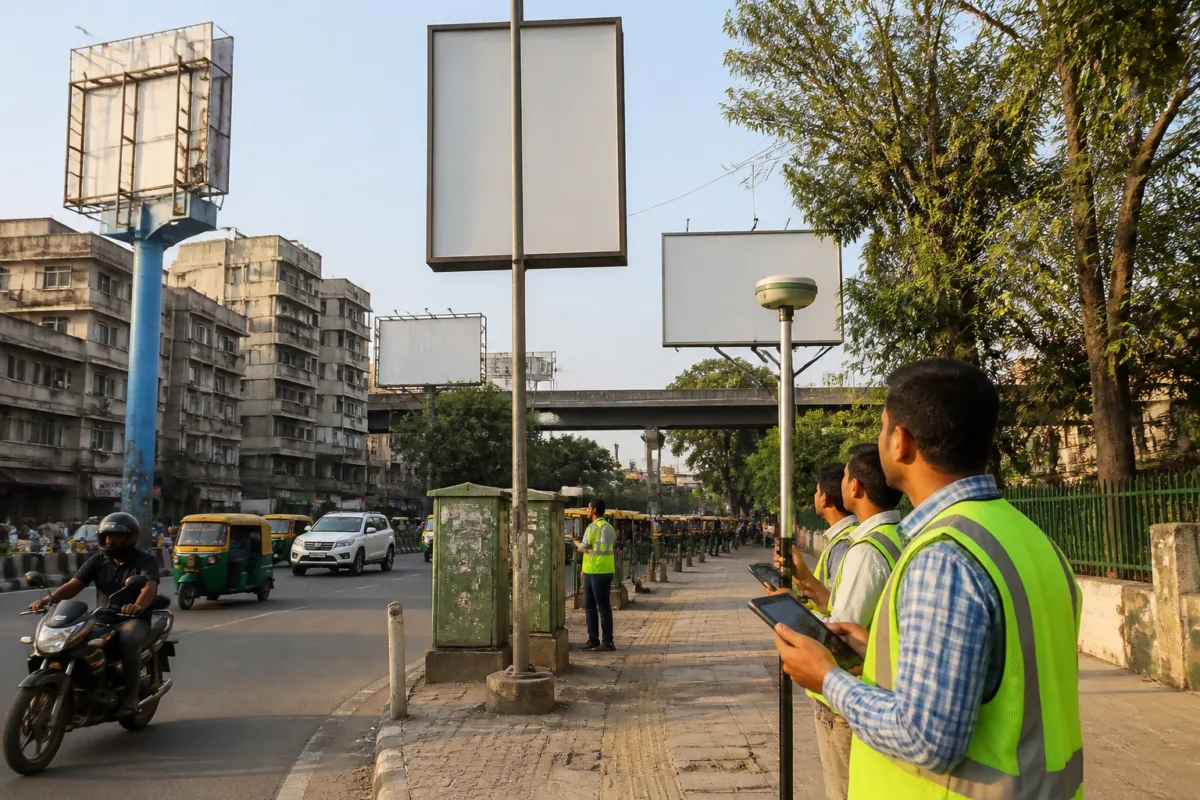
The Delhi Municipal Corporation’s plan to use artificial intelligence for outdoor advertising is being presented as a revenue measure, but its larger significance lies in how the civic body sees and manages public space. By proposing a digital inventory of hoardings, unipoles, kiosks and street furniture, the MCD is attempting to convert a fragmented advertising landscape into a measurable municipal asset.
The proposal comes as the corporation faces debt of around Rs 16,000 crore, according to the report by Jagran – New Delhi. The MCD intends to begin with the advertising department through a 180-day pilot project proposed with a private agency. The agency would conduct the survey, geotag advertising locations and prepare a GIS-based map at its own cost, meaning the corporation would not incur a financial expense for the proposed pilot.
That arrangement makes the initiative significant beyond its technology label. Municipal corporations often depend on several revenue streams, including fees, taxes, licences and commercial use of public assets. In this case, the MCD’s stated problem is not necessarily the absence of advertising opportunities, but the inability to establish a complete and reliable record of where advertising assets exist, whether they comply with rules and how much revenue they could generate.
The proposed digital mapping exercise is intended to address that information gap. According to the report, the MCD wants a digital record covering the location, size, lighting, photographs and regulatory compliance of each advertising site. A 360-degree virtual survey would create the source material, while GIS mapping would bring the information into a central database. Officials would then be able to monitor the inventory through dashboards and heat maps.
This is the basic institutional shift at the heart of the proposal: from treating advertising as a collection of individual permissions to treating it as a citywide, trackable system. Such a system could help officials identify unauthorised advertisements, compare available sites and prepare more consistent assessments for auctions and tenders. It could also provide a clearer basis for deciding which public locations have commercial potential.
The proposal’s use of AI is linked to a specific tool described in the report as a visual load index. The tool would analyse the number of advertisements, their visibility and the level of visual clutter on roads and in public places. The stated purpose is to identify advertising corridors with stronger commercial prospects while also assessing the visual impact of advertising on the urban environment.
That combination is important because advertising regulation is not only a revenue issue. Hoardings and other installations occupy public-facing locations, affect streetscapes and can influence how roads, junctions and civic spaces are experienced. A system that measures only visibility and commercial value could encourage the corporation to maximise advertising exposure. A system that also records rule compliance and visual clutter could, at least in principle, help the MCD balance income generation with public-space management.
The report attributes the proposal to Satya Sharma, chairperson of the MCD’s standing committee. Sharma said the corporation had several sources of revenue but was not able to use their full potential. She said technology could help assess the actual condition and commercial capacity of advertising assets, prevent revenue loss and bring greater transparency to advertising management.
The stated transparency benefit will depend on how the digital inventory is created, maintained and used. A map is not automatically a complete record. Its reliability would depend on whether the survey captures every relevant site, how frequently the database is updated and whether changes in permissions, contracts or site conditions are recorded promptly. The supplied report does not specify the proposed database’s update cycle or the standards that would be used to verify the information collected by the private agency.
The proposed private-sector arrangement also makes data governance a central part of the project. The agency would conduct the survey and create the mapping system, but the report says it could not share the information with a third party without written permission from the corporation. That condition addresses one aspect of control over the data. It does not, in the available information, establish how access would be divided between elected representatives, municipal officials, contractors, advertisers and the public.
Those questions matter because the digital record could influence auctions, valuations and tender processes. If the inventory becomes the basis for pricing advertising locations, errors in site size, visibility, lighting, compliance status or commercial classification could affect municipal revenue and private bidders alike. The report does not provide the proposed valuation formula, tender framework or audit mechanism, so the financial effect of the pilot cannot yet be assessed.
The 180-day timeline gives the proposal a defined testing period. During that period, the agency is expected to survey advertising sites, geotag them, create GIS-based maps and assess their characteristics through the visual load index. The MCD’s standing committee is expected to place the proposal before the corporation for approval. The report does not say whether the pilot has already received final approval or whether implementation has begun.
This distinction is important. The current development is a proposal for a pilot, not evidence that the MCD has already created a functioning AI-based revenue system. The likely value of the project will therefore be determined by the transition from mapping to municipal action: identifying unauthorised advertisements, recovering missed revenue, improving auction decisions and enforcing compliance. The supplied material confirms the intended functions but does not establish results.
The initiative also reveals how fiscal pressure is shaping municipal technology adoption. The MCD is not introducing AI primarily as a service convenience for residents. It is using technology to improve its visibility over an income-generating activity at a time when debt is a major concern. That makes the proposal an example of administrative digitisation driven by balance-sheet pressures rather than by a standalone technology agenda.
For Delhi’s urban governance, the broader question is whether digital mapping can make municipal assets more legible without reducing public space to commercial inventory. The proposed system is designed to identify both revenue opportunities and visual disorder, but the available report does not explain how those competing objectives will be weighted. Nor does it establish what public safeguards will govern the removal of illegal advertisements or the approval of new commercial sites.
The evidence currently supports a limited but meaningful conclusion. The MCD has proposed a privately funded, 180-day pilot to survey and digitally map outdoor advertising assets, use AI-based visual analysis and support enforcement, valuation, auctions and tenders. The project could address gaps in municipal information and revenue collection, but its success will depend on data completeness, transparent procedures, regular updates and clear accountability. The next material milestone is the corporation’s decision on the standing committee proposal and the subsequent implementation of the pilot.

