


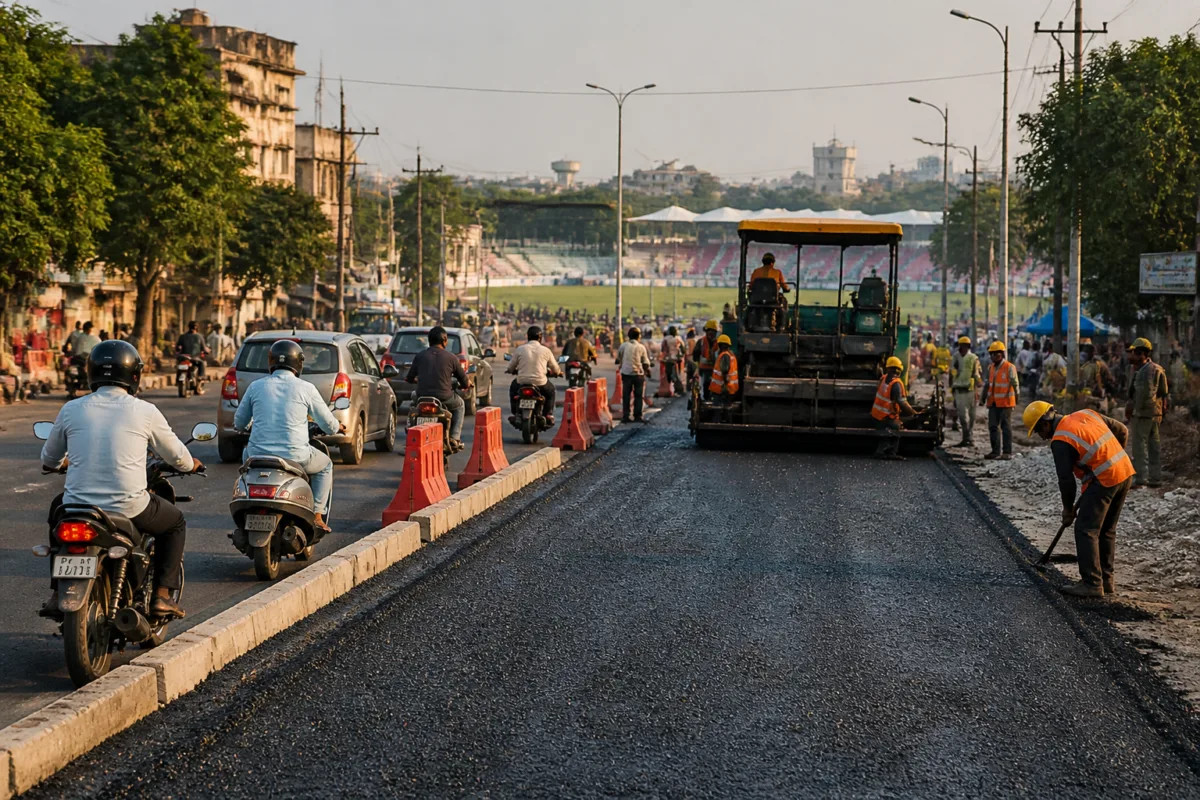
Bhopal’s planned Rs 4.23 crore road upgrade programme for the Army Day Parade 2027 is being presented as both an event-readiness measure and a wider investment in the city’s everyday mobility. At its centre is a 700-metre, two-lane road to a new helipad ground, but the package also covers several established road corridors, parking, additional helipads, approach routes, spectator pathways and temporary sanitation facilities.
The programme shows how a major national event can accelerate civic works that might otherwise move through a slower planning and procurement cycle. It also raises a more practical urban question: whether improvements designed around a fixed event can be integrated into Bhopal’s regular transport and public-space systems after the parade is over. The supplied report does not provide details of the tender conditions, design standards, maintenance responsibilities or post-event operating plan, so the long-term value of the works will depend on how those questions are resolved.
The Army Day Parade is scheduled for next January, and the MP Public Works Department has proposed completing the roadwork package by the end of the year. The 700-metre access road is intended to connect the new helipad ground and facilitate the movement of dignitaries, military personnel and visitors. Its immediate function is therefore logistical: providing a dedicated approach to a venue expected to receive high-profile traffic during the celebrations.
That road is only one part of the proposed intervention. The package includes renewal of the 1.5-kilometre Subhash Nagar Vishram Ghat–Raisen Road, the 2.4-kilometre Career College–ITI Road, the 3.2-kilometre Gurdwara Junction–Raisen Road and the 5.25-kilometre Habibganj–Barkheda Church Road. Roads near Savantika Petrol Pump, Hema School and Anna Nagar are also listed for proposed works.
Together, the named stretches cover at least 12.15 kilometres, excluding the additional roads whose lengths are not specified in the report. That distribution matters because it places the programme beyond a single parade ground or helipad. The works are spread across corridors used by residents and daily commuters, creating the possibility that an event-linked package could also address ordinary road-surface and connectivity problems.
However, the available information does not establish whether every listed corridor will receive the same type of intervention. “Renewal” and “improvement” can encompass different levels of work, from resurfacing to reconstruction or changes to junction access. The report also does not specify lane widths, drainage arrangements, footpath treatment, lighting, traffic management or provisions for pedestrians and public transport. Those details are important in determining whether the programme represents a durable mobility upgrade or a short-term visual and operational facelift.
The helipad approach road illustrates the tension between event infrastructure and routine urban infrastructure. During the parade, a dedicated two-lane connection could reduce conflict between ceremonial movements and regular city traffic. After the event, its usefulness will depend on how the helipad ground is used and whether the road connects effectively with the surrounding network. The report identifies improved access as a likely benefit but does not describe the road’s junctions, traffic capacity or future public use.
The wider plan includes parking facilities and dedicated spectator pathways near the parade ground. These elements indicate that organisers are planning for more than vehicle movement. Parking and pedestrian circulation are central to the functioning of any large public gathering, particularly where the event brings together dignitaries, military personnel and visitors. Yet the report does not state the expected attendance, the number of parking spaces, the location of pedestrian routes or how access will be managed for people living and working nearby.
The city’s civic preparation also includes temporary toilets. The Bhopal Municipal Corporation has separately floated a tender for these facilities under the Swachh Bharat Mission. This separation of responsibilities is significant. The PWD is associated with the proposed road package, while the municipal corporation is handling at least one sanitation requirement. The event therefore depends on coordination between agencies with different mandates, procurement processes and operating responsibilities.
The report does not identify the total value of the sanitation tender, the number of temporary toilets or the arrangements for servicing them during the gathering. It also does not say whether any of the temporary facilities will be retained, relocated or removed after the parade. These omissions do not negate the announced works, but they leave unanswered how temporary event demand will be reconciled with the city’s permanent sanitation system.
The institutional structure is similarly important for understanding the programme. The MP PWD has proposed the road works, while the Bhopal Municipal Corporation has initiated a separate sanitation tender. Officials have also referred to parking, additional helipads, approach roads and spectator pathways. The supplied report does not identify a single coordinating authority, a public project schedule or a unified budget covering all these components.
That distinction matters because event preparation is not only a construction exercise. Roads must be completed in sequence, access routes must remain usable during works, traffic diversions must be managed and civic services must be ready when the gathering begins. If agencies work to separate timelines, the completion of one component may not deliver a functioning event system unless the other components are operational at the same time.
The programme’s stated completion target is the end of the year, ahead of the parade planned for the following January. This creates a defined implementation window, although the report does not provide the date on which construction is expected to start or the milestones for individual corridors. It also does not state whether the road projects have received final administrative approval, whether contracts have been awarded or whether land and utility clearances are complete.
The available data is limited but still reveals the scale and distribution of the intervention. The package is estimated at Rs 4.23 crore and includes a 700-metre access road alongside four named corridors measuring 1.5 kilometres, 2.4 kilometres, 3.2 kilometres and 5.25 kilometres. The named stretches therefore amount to more than 12 kilometres of road corridors, while the separate helipad approach takes the identified length beyond that total. The report does not provide a cost breakdown, making it impossible to compare allocations between the corridors or determine the share devoted to the helipad road.
The absence of such a breakdown is relevant to how the project should be evaluated. A programme focused mainly on resurfacing may deliver quick improvements over a broad area. A programme involving reconstruction, drainage, junction redesign and pedestrian facilities would have a different cost and a different long-term impact. Without project specifications, the Rs 4.23 crore figure establishes the announced scale of expenditure but not the quality or durability of the infrastructure it will create.
The report presents the proposed works as potentially beneficial to residents and commuters in the affected areas. Better road surfaces and improved access could reduce the immediate inconvenience associated with deteriorated corridors. But a lasting urban benefit would require more than completion before the parade. It would depend on maintenance arrangements, the quality of construction, the treatment of drainage and edges, and whether new facilities are incorporated into routine municipal operations.
This is the central lesson of event-led urban planning. A national gathering can bring administrative attention, funding and deadlines to infrastructure that serves a wider population. At the same time, the deadline can encourage authorities to prioritise visible corridors and rapid completion. The supplied material confirms the investment and the list of proposed facilities, but it does not establish how priorities were selected or whether the works emerged from a broader city mobility plan.
Bhopal’s preparations will therefore be measured on two timelines. The first is the short operational timeline leading to the Army Day Parade: roads, helipads, parking, pathways and toilets must be ready for the event. The second is the longer civic timeline, in which residents and commuters should be able to use and maintain the upgraded assets after the national audience has left.
What is confirmed so far is a proposed Rs 4.23 crore road package, a 700-metre helipad access road, upgrades across several city stretches and separate municipal action on temporary toilets. What remains unclear is the detailed design, procurement status, agency coordination, cost allocation and post-event use of the facilities. The next milestones to watch are the award and execution of the road works, the publication of detailed project information, and whether the announced year-end completion target is met before the parade scheduled for next January.

