


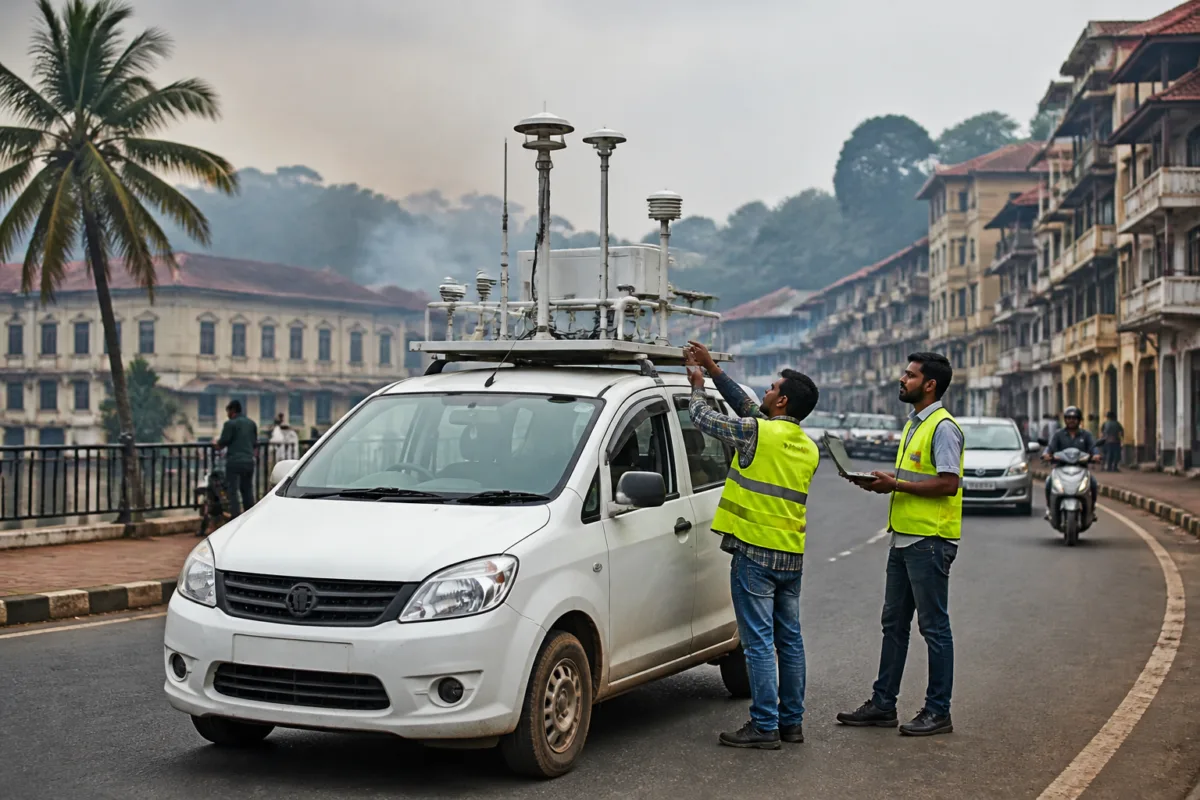
Panaji’s reported post-Diwali pollution spike has prompted the Goa State Pollution Control Board (GSPCB) to deploy a mobile air quality monitoring vehicle in the city, with verification results expected within 48 hours.
GSPCB chairperson Pradip Sarmokadam said the board ordered the assessment after elevated readings were reported and figures available on the online air quality monitoring platform AQI.in came to its notice. The mobile unit will independently assess conditions and establish the extent of the deterioration.
“We have deployed a mobile monitoring vehicle to the city to verify the reported deterioration in air quality. It is possible that it is due to crackers and other activities during Diwali, but we will have to verify it,” Sarmokadam told The Times of India. He said the board had instructed its team to undertake the necessary monitoring.
AQI.in recorded Panaji’s air quality index at 133 on November 8, placing it in the poor category. The reading rose to 155 on November 9, classified by the platform as unhealthy. The November 9 readings showed PM2.5 concentrations of 61 micrograms per cubic metre and PM10 concentrations of 86 micrograms per cubic metre. The platform also flagged smoky haze over the city.
The GSPCB chairperson said pollution levels had eased by November 10. PM2.5 was recorded at 64 micrograms per cubic metre and PM10 at 96 micrograms per cubic metre, with both described by the board as within permissible limits. Panaji’s online monitoring system will record air quality continuously for 24 hours, with monitoring scheduled to continue for another 24 hours.
The mobile assessment is intended to verify the online readings and help determine whether any further intervention is required. The episode also comes against a reported longer-term deterioration in Panaji’s Diwali air-quality readings on AQI.in. The platform recorded an AQI of 16 in 2020, 60 in 2021, 114 in 2022, 98 in 2023, 94 in 2024 and 87 in 2025, before the increase to 133 on November 8 this year.
The latest readings followed Goa’s traditional Narkasur celebrations. Effigies are erected through the night on Naraka Chaturdashi and burnt at dawn on the day preceding the main Diwali celebrations. This year, the effigies were burnt at dawn on November 8, followed soon after by the main Diwali celebrations.
The GSPCB’s next assessment will determine whether the reported post-Diwali increase is confirmed by mobile monitoring and whether additional action is necessary. The board’s online system is scheduled to continue recording conditions through the following 24-hour monitoring period.

