


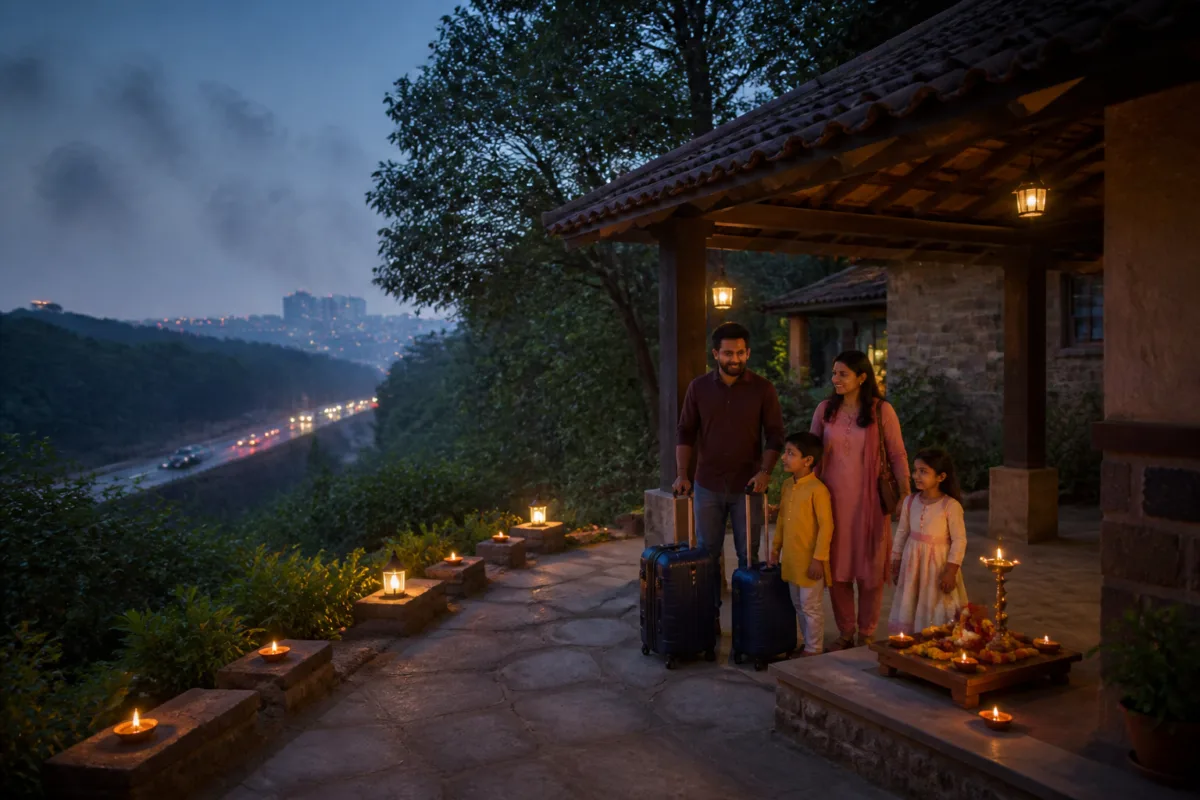
Nagpur’s Diwali pollution is beginning to influence where some residents spend the festival. Forest resorts near Pench and Tadoba are reporting a rise in bookings from people who want to avoid the deterioration in air quality associated with firecrackers, particularly those with breathing problems. The shift is more than a seasonal tourism trend: it shows how households with the money and flexibility to travel are creating private escapes from an urban environmental problem.
The report by Times of India – Nagpur describes resorts receiving guests before Diwali and retaining them for three to four days. Some visitors are booking at the last minute, specifically to leave the city when cracker-related pollution begins to rise. Resort properties do not permit firecrackers, giving guests an environment in which their respiratory symptoms are less likely to be aggravated by celebrations on the premises, according to the resort operators quoted in the report.
Gaurav Chouksey, director of a resort chain, said regular clients now check in a day before Diwali and remain with their families for several days. He said he had observed this pattern for about five years. The account points to a recurring, planned response rather than a one-off decision by a small number of travellers. It also suggests that some families now treat temporary relocation as part of their festival routine.
That response changes the meaning of a resort booking. Forest tourism is normally associated with leisure, wildlife experiences and a break from the city. During Diwali, however, some bookings are being shaped by the need for cleaner surroundings. A resort becomes not only a holiday destination but also a form of short-term environmental refuge for people who find the city’s festival conditions difficult to tolerate.
The distinction matters because the option is not equally available to all residents. Leaving Nagpur requires money, transport, advance planning or access to last-minute accommodation. People with respiratory problems who cannot travel, households that cannot afford resort stays and workers whose jobs tie them to the city remain exposed to the same urban conditions. The reported resort trend therefore does not represent a city-wide solution to pollution. It represents a private coping mechanism available to a limited section of the population.
The resort owners’ comments also reveal how the market is adapting to this demand. Chouksey said that Diwali eve had meant sluggish business around a decade ago, with very few guests. He now describes rooms being booked as soon as the season begins. Himanshu Bagde, an eco-tourism consultant in Tadoba, said Diwali had become one of the busiest periods, with safaris, resorts and homestays filling up.
The available report does not provide occupancy percentages, booking volumes, air-quality readings or year-on-year revenue figures. It therefore cannot establish the exact scale of the shift or measure how much of the increase is directly caused by pollution avoidance rather than general growth in festival travel. The pattern is nonetheless consistent across the named resort and tourism sources: Diwali demand is arriving earlier, and some of that demand is explicitly connected to the urban pollution experience.
The institutional issue is equally important. The reported resort rules address pollution inside private properties, where management can prohibit crackers and control the immediate environment. They do not address the source of city-wide exposure. Pollution generated across neighbourhoods can move beyond individual premises, while people living in dense urban areas remain dependent on public enforcement, local air-quality management and the behaviour of others.
This creates a contrast between controlled destinations and the city. At a forest resort, operators can set rules for a defined property and offer visitors a predictable setting. In Nagpur, managing Diwali pollution requires coordination across municipal authorities, police, pollution-control agencies, residential communities, markets and households. The report does not detail enforcement measures or official pollution-control plans, so it cannot be used to assess whether existing restrictions are being implemented effectively.
The reference to firecrackers being banned on resort properties also shows how environmental conditions are increasingly becoming part of the hospitality product. Guests are not abandoning Diwali rituals altogether. Sandeep Singh, who owns a resort in Pench, said visitors participate in the puja organised at the property and celebrate with their families without the same exposure to cracker pollution. The resort experience is therefore being marketed, implicitly or explicitly, as compatible with tradition while avoiding one of the festival’s most visible pollution sources.
For urban policy, that distinction raises a difficult question: should cleaner air during a festival be something residents can purchase through temporary travel, or a basic condition that cities must provide through public regulation? The reported bookings do not answer the question, but they make the inequality visible. Residents are responding to a perceived health risk through relocation because the city environment is not experienced uniformly by all households.
People with breathing problems are particularly sensitive to sudden changes in air quality, according to the accounts provided in the report. The article does not identify specific medical diagnoses, quantify symptoms or provide clinical evidence, so the health impact cannot be measured from this material alone. What can be established is that resort operators are hearing directly from guests who say cracker pollution worsens their respiratory problems, and that this concern is influencing their travel decisions.
The trend also links Nagpur’s urban economy to its surrounding forest tourism belt. Resorts and homestays in Pench and Tadoba are receiving demand generated partly by conditions in the city. Diwali pollution in Nagpur is therefore not only a public-health or regulatory issue; it is also redirecting seasonal spending towards destinations outside the urban boundary. Tourism businesses benefit from the additional occupancy, while the city loses some residents temporarily during the most polluted part of the festival period.
That movement should not be confused with a reduction in pollution. A family leaving the city may reduce its own exposure, but the decision does not remove emissions produced by firecrackers, nor does it protect residents who remain. It also shifts attention away from the collective task of making urban celebrations safer. Without official air-quality data and enforcement information in the supplied material, the broader environmental outcome remains unestablished.
The strongest evidence in the report is behavioural. A resort chain director describes regular clients returning for several years; a resort owner describes visitors seeking a quieter celebration; and an eco-tourism consultant reports full resorts, homestays and safaris during the period. Together, these accounts show that Diwali has become a significant demand window for forest tourism around Nagpur. They also show that pollution avoidance is becoming one reason some residents choose to leave the city.
The larger urban question is whether such escape routes will remain a niche lifestyle choice or become a recurring feature of festival planning for households concerned about health. If bookings continue to begin earlier and remain strong through Diwali, the pattern will be relevant to both tourism operators and city administrators. The supplied report does not establish future demand, but it records a change from weak Diwali occupancy around a decade ago to strong seasonal demand today.
What is clear is that Nagpur’s festival pollution is producing effects beyond the city’s streets. It is influencing household travel, resort occupancy and the timing of forest tourism demand. What remains unclear is the scale of the phenomenon, its relationship with measured air quality and whether public restrictions are reducing exposure for residents who cannot leave. Those are the questions that official pollution data, enforcement records and public-health monitoring would need to answer.

