


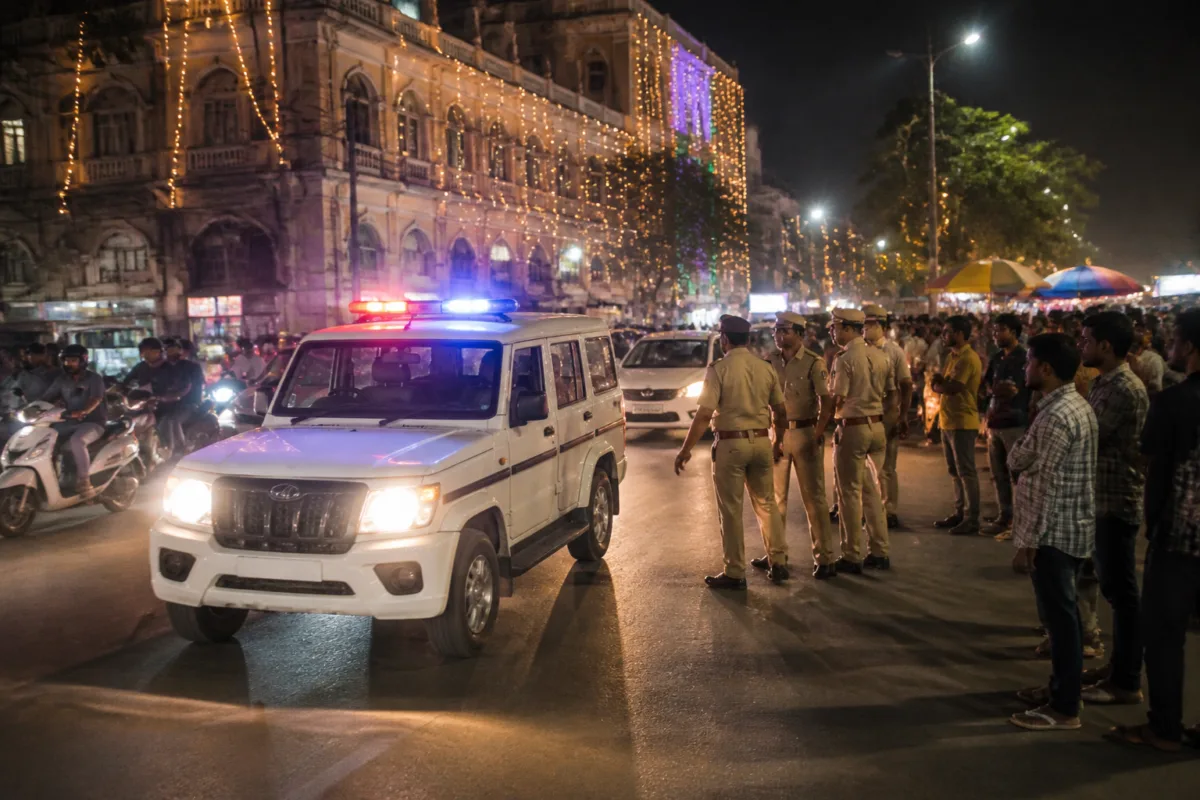
Lucknow’s 4,849 UP-112 distress calls during Diwali reveal how quickly a major festival can turn a city’s emergency-response network into a test of public safety, mobility and civic coordination. The calls recorded between the night of November 7 and November 9 covered far more than isolated law-and-order incidents: disputes and brawls, road accidents, medical emergencies, fires, traffic congestion, harassment complaints, missing persons and requests involving vulnerable residents all entered the same response system.
According to officials cited by the Times of India, almost 60% of the calls were related to disputes and brawls, making conflict the largest reported category. Requests for ambulance assistance and other medical emergencies formed another significant part of the workload. Police officials managing the UP-112 district control room said the average time taken to reach a location was a maximum of six minutes in all cases.
The figures matter because they show the emergency burden created by a festival not as a single incident, but as a distributed urban pattern. Calls came from across Lucknow and involved different kinds of risk unfolding simultaneously. A control room responding to a physical threat may, within the same period, also have to coordinate around a road accident, a medium-intensity fire, a medical request or traffic congestion. The challenge is therefore not only the number of calls, but the range of institutions and field services that may be required after each call is received.
UP-112 appears in the report as the first point of contact for this varied demand. The incidents listed by officials included property disputes, gambling, sexual harassment of women, animal-related emergencies, encroachments and traffic congestion. Other calls involved the Women Power Line 1090, senior-citizen services and 108 ambulance assistance. Complaints against police personnel, missing persons, disaster-related incidents and information about unclaimed persons or objects were also recorded.
This breadth makes the call data useful as a window into how residents experience the city’s emergency infrastructure. From the caller’s perspective, the immediate need may be simple: reach someone who can help. From the system’s perspective, however, the response may require classification, prioritisation and coordination between police, ambulance services, women’s support services and other agencies. The report does not provide a detailed account of how calls were distributed between these services, but the categories indicate that the control room handled a mixed civic workload rather than a narrowly defined policing function.
The dominance of disputes and brawls is the clearest signal in the available data. If almost 60% of the 4,849 calls fell into that category, the figure works out to roughly 2,900 calls, although the report does not provide the exact category-wise count. That concentration suggests that festival-period safety pressures were driven substantially by interpersonal conflict. It also distinguishes the emergency burden from the more visible risks commonly associated with large celebrations, such as fireworks, fires or traffic congestion.
At the same time, the numbers should not be read as a complete measure of crime, disorder or accidents in Lucknow. The report concerns calls received by UP-112 during the stated period, not a full account of every incident in the city. It does not say how many calls resulted in arrests, formal complaints, hospitalisation, fire-control operations or other outcomes. Nor does it compare the Diwali figures with an ordinary weekend, an earlier festival period or the same period in another year. The available evidence therefore establishes the scale and variety of demand, but not whether the burden was unusually high in a statistical sense.
The six-minute response figure is the strongest operational indicator in the report. Police officials said the average time taken to reach the spot was a maximum of six minutes, and that quick response prevented incidents from taking an ugly turn. This is an official assessment of response performance, not an independently audited outcome measure. The report does not specify whether the figure refers to every call, only dispatched cases, or the time between call receipt and arrival at the location. Even with that limitation, it points to the importance of proximity and dispatch speed when disputes, threats, accidents or medical emergencies are unfolding in public and residential spaces.
Response time also has a different meaning across incident types. A six-minute arrival at a dispute may help separate people before violence escalates. In a road accident, the same interval may matter for first response and traffic management. In a medical emergency, police arrival may need to be followed by ambulance support. For a missing-person report, an immediate response may initiate a different process altogether. The same headline metric therefore represents several types of urban coordination, each with its own outcome and resource requirement.
The report also shows how festival-period safety is connected to everyday municipal conditions. Encroachments and traffic congestion are not limited to celebratory events, while property disputes, missing persons and complaints against police personnel arise from the broader relationship between residents and public institutions. Fires, animal-related emergencies and unclaimed objects add further layers. During Diwali, these issues overlap with increased movement, gatherings and heightened activity, placing additional pressure on the city’s ability to receive and route information.
Women’s safety and the needs of senior citizens appear as separate elements in the call mix. The inclusion of sexual-harassment complaints, Women Power Line 1090 requests and senior-citizen services indicates that emergency access is not only about general policing. It also depends on whether specialised channels can be reached and connected to field-level assistance. The source does not provide the number of calls in these categories or explain the response arrangements, so the specific performance of those services cannot be assessed from the available information.
The same limitation applies to ambulance coordination. The report identifies requests for 108 ambulance services and other medical emergencies, but does not state how many calls were transferred, how quickly ambulances arrived or whether police and medical teams reached locations together. This distinction matters because a control room can register and route an emergency without being the final service provider. Understanding the full chain would require call-level or category-level data that is not included in the report.
What the figures clearly establish is the central role of emergency communication during a high-intensity urban period. Residents used one response network to report immediate threats, request assistance and seek information across a broad set of situations. The network’s effectiveness consequently depends on more than a fast police vehicle. It depends on accurate classification, clear hand-offs, availability of field teams and the ability of different services to work at the same time.
Lucknow’s Diwali experience also highlights the difference between visible festival management and the less visible infrastructure supporting it. Public attention tends to focus on crowd control, traffic diversions, fire safety and policing at major gathering points. The call figures show that the emergency system must also remain ready for disputes inside neighbourhoods, medical requests, harassment complaints, missing persons and incidents that do not fit neatly into a single department’s mandate.
The report does not establish whether UP-112 faced capacity constraints, unanswered calls, repeat calls or shortages of personnel during the period. It also does not provide the total number of calls received nationally or across Uttar Pradesh for comparison. These omissions prevent a wider assessment of Lucknow’s performance. They do, however, identify the information that would make the city’s emergency planning more transparent: category-wise call volumes, dispatch and arrival times, transfers to ambulance or specialised services, and the final disposition of cases.
For now, the evidence supports two conclusions. First, Diwali generated a large and diverse emergency workload across Lucknow, with disputes and brawls accounting for the largest share reported by officials. Second, the city’s integrated response system recorded a maximum average arrival time of six minutes, according to police officials. The next question is not simply how many calls were received, but how consistently each category was resolved after the first response. That assessment would require detailed official data beyond the figures currently reported.

