


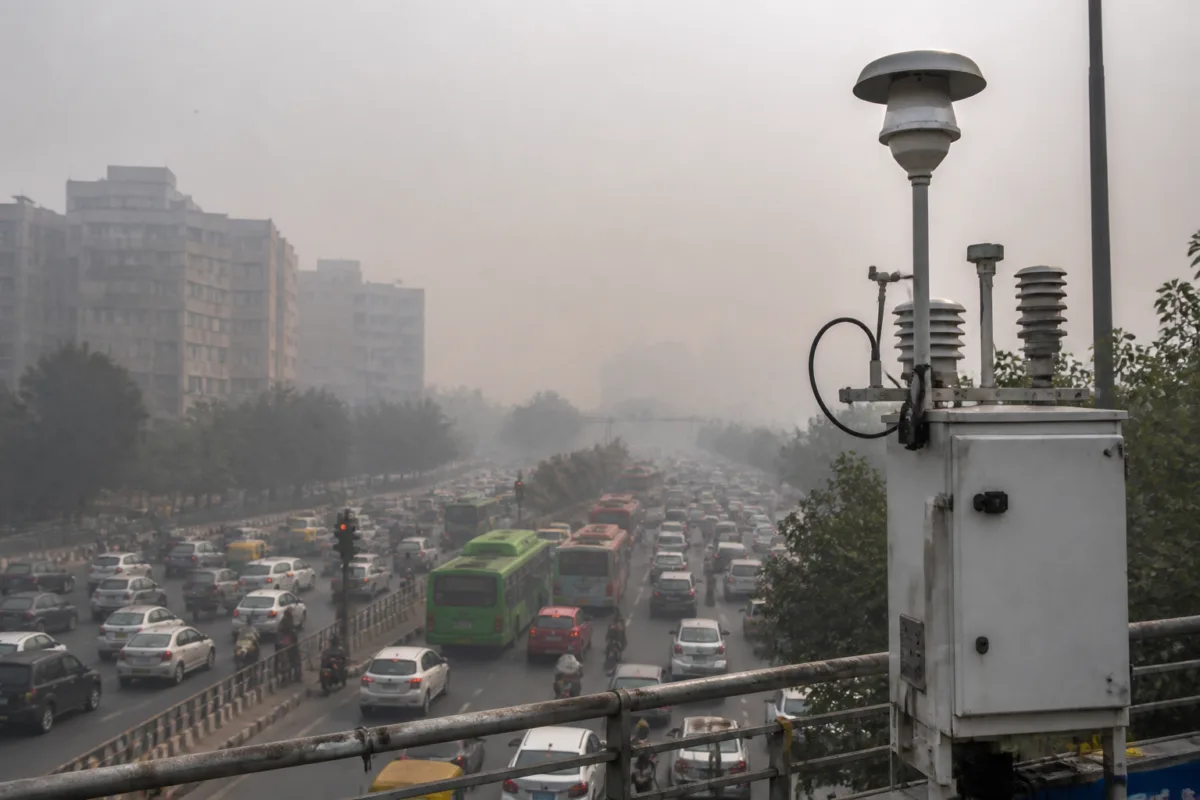
A dispute over Delhi air quality data has exposed a more consequential problem than the latest political exchange: residents can only judge pollution, emergency action and government performance when monitoring systems produce complete and credible records. The controversy followed missing readings from several monitoring stations around Diwali, including gaps in particulate matter data during a period when pollution levels were under intense public scrutiny.
Delhi Environment Minister Manjinder Singh Sirsa denied that air-quality data had been manipulated and said the city had recorded its cleanest air-quality index in a decade under the Bharatiya Janata Party government. He attributed the relatively lower pollution levels this year to favourable wind speeds and said air-quality monitoring stations were supervised by the Commission for Air Quality Management, or CAQM, which submits reports to the Supreme Court.
The minister also said that around 40 per cent of Delhi’s monitoring stations were operated by the state government, while the remaining stations belonged to the Centre. His argument places the controversy within a fragmented administrative structure in which different agencies collect, manage or publish parts of the information used to describe the capital’s air.
That structure matters because the reliability of an air-quality claim depends not only on the number displayed on a public dashboard, but also on whether the underlying readings are available, continuous and comparable across locations. The report said most of the missing data from Delhi Pollution Control Committee monitoring stations on Diwali night was later updated. Those updates showed alarmingly high concentrations of particulate matter in the early hours of Monday, with some readings several times above prescribed limits.
However, gaps remained. Some particulate matter readings were still unavailable, while data from Central Pollution Control Board monitoring stations was also missing, according to the report. Experts cited in the report questioned the completeness and reliability of the records. This creates a distinction that is often lost in political claims: an absence of data is not evidence of clean air, while a later data update can materially change the public understanding of the pollution episode.
The controversy therefore involves two separate questions. The first is whether the available readings were manipulated. Sirsa rejected that allegation and challenged those making it to approach the Supreme Court. The second is whether the monitoring record was complete enough to support definitive conclusions about the city’s air. The supplied report establishes that the second question remained unresolved when the political dispute was being reported.
The timing of the missing readings is particularly important. Diwali is a recurring period of concern because pollution can rise sharply after firecracker use, while weather conditions determine how quickly pollutants disperse. Sirsa cited a 40 per cent increase recorded after Diwali in 2023 and said this year’s comparatively lower pollution was linked to favourable wind speeds. That explanation identifies meteorological conditions as a factor, but it does not remove the need for complete station-level data. Weather can influence pollution; it cannot substitute for monitoring it.
The institutional chain described in the report also shows why accountability is difficult. CAQM supervises air-quality monitoring stations and submits reports to the Supreme Court, while DPCC and CPCB stations contribute to the wider monitoring network. Delhi’s environment minister said the stations were divided between the state and Centre. When readings are missing across agencies, responsibility for explaining the gap can become as fragmented as the system itself.
This fragmentation has direct consequences for residents. Air-quality readings influence decisions by households, schools, employers and public authorities. They shape whether people reduce outdoor activity, use protective measures or seek information about health risks. They also inform restrictions and emergency responses, although the supplied report does not specify which actions were taken in response to the readings discussed.
The competing political claims illustrate another problem. Aam Aadmi Party Delhi chief Saurabh Bharadwaj accused the BJP government of blaming Punjab for Delhi’s pollution and cited data from the Centre’s System of Air Quality and Weather Forecasting and Research, or SAFAR. He said the SAFAR website showed that stubble smoke accounted for around 5 per cent of Delhi’s pollution on the night before Diwali, while adding that the source could have been Haryana, Punjab or Uttar Pradesh.
That claim challenges a familiar explanation for Delhi’s seasonal pollution, but the source material does not independently establish the accuracy of the cited SAFAR figure or identify the precise origin of the smoke. It does, however, show how questions about data quickly become questions about responsibility. If the contribution from crop-residue burning is low on a particular night, attention shifts towards local sources and weather. If the contribution is higher, responsibility is distributed across the wider airshed. In both cases, the quality and completeness of the underlying data determine the credibility of the argument.
The dispute also exposes the limits of a single city-level AQI figure. Delhi is not a uniform exposure zone. Monitoring stations capture conditions at particular locations and times, while residents experience pollution along roads, near construction activity, in residential areas and across neighbourhoods with different levels of traffic and ventilation. Missing readings do not merely create a technical inconvenience; they reduce the ability to understand how pollution varies across the urban system.
The report does not provide the full station-by-station record, the duration of each data gap, the reasons for the missing readings or the methodology used to update them. It also does not independently verify the minister’s assertion that Delhi recorded its cleanest AQI in a decade. That claim remains attributable to Sirsa rather than an established conclusion in the supplied material. Similarly, the report records Bharadwaj’s interpretation of SAFAR data but does not provide the underlying dataset.
Those limitations should guide how the episode is understood. The available evidence supports reporting a dispute over missing and subsequently updated readings, competing explanations for pollution levels and a disagreement over the role of crop-residue burning. It does not support a definitive conclusion that the data was manipulated, nor does it establish that Delhi experienced its cleanest air in a decade.
The larger urban question is whether Delhi’s air-quality governance can maintain public trust when monitoring responsibilities are distributed across state and central institutions. A credible system requires more than headline AQI figures. It requires transparent station operations, timely publication, clear explanations for missing readings and a documented account of how revised data changes the assessment of an episode.
For now, the immediate record confirms that important readings were missing, many were later updated, and significant gaps remained. The next points that deserve scrutiny are the complete station-level data for the Diwali period, the reasons for the unavailable CPCB and particulate matter readings, and the official explanation of how the updated information was incorporated into pollution assessments. Until those details are available, the political claims surrounding Delhi’s air remain stronger than the evidence publicly described in the report.

