


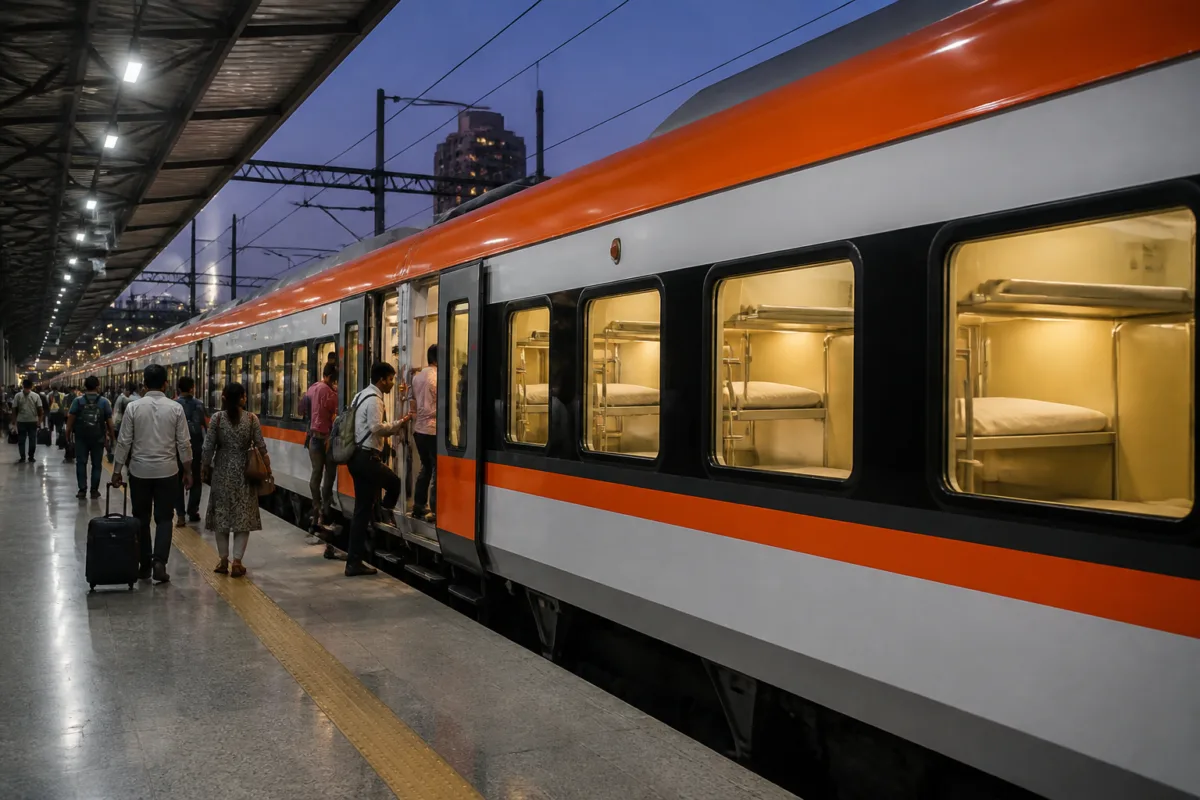
Indian Railways is preparing to roll out four more Vande Bharat sleeper train rakes after six trains were manufactured for services on three major routes, marking a further expansion of its overnight rail network. Two of the additional rakes are expected to be completed this month and the remaining two within the following two months, according to sources cited by The Times of India.
The sleeper services have been introduced on the Delhi-Varanasi, Mumbai-Bengaluru and Guwahati-Howrah routes. The Guwahati-Howrah service was launched earlier this year, while the Delhi-Varanasi and Mumbai-Bengaluru services were introduced a few days before the report was published.
The trains are fully air-conditioned overnight services designed to provide enhanced comfort compared with existing Rajdhani Express services while reducing journey times through higher average speeds. The Vande Bharat sleeper trains can run at speeds of up to 180 kmph and have been cleared to operate at 160 kmph, although their actual speed on each route will depend on the clearance available on individual sections.
BEML has received an initial contract to manufacture 10 Vande Bharat sleeper train rakes. Six have been manufactured, while four are in different stages of completion. The company has also been assigned an additional three rakes, for which procurement of supplies and raw materials has started.
The sleeper train design includes dedicated berths and toilets for passengers with disabilities, spacious luggage storage and vacuum-evacuation toilets. First AC passengers are to have access to showers with hot water. Charging facilities include three-pin sockets and Type A and Type C USB ports, while Wi-Fi connectivity is supported through an onboard router and access-point network.
The trains use an under-slung propulsion system and regenerative braking, which is intended to improve energy efficiency. Their aerodynamic design is meant to support smoother acceleration and reduce jerks during travel. The car bodies use austenitic stainless steel and comply with EN15227 crash standards, according to the details cited in the report.
Safety systems include the Train Collision Avoidance System, smoke and fire detection, disaster-management lighting, CCTV cameras and emergency push buttons. The trains also have fire-barrier doors, EN45545 HL3-grade fire-safety compliance, sensor-based intercommunication doors and a passenger communication system linking the driver, guard and coaches.
The expansion is part of a wider manufacturing programme. Indian Railways has awarded the Integral Coach Factory a contract to manufacture 50 Vande Bharat sleeper trains with more coaches. Around 200 additional 16-coach sleeper trains are also being manufactured by Kinet and Titagarh Wagons.
BEML is separately manufacturing India’s first high-speed bullet train for the Mumbai-Ahmedabad corridor. A section of that corridor is expected to become operational in the second half of 2027, according to the report. The next immediate milestone for the sleeper programme is the completion and rollout of the four rakes currently under production.

