


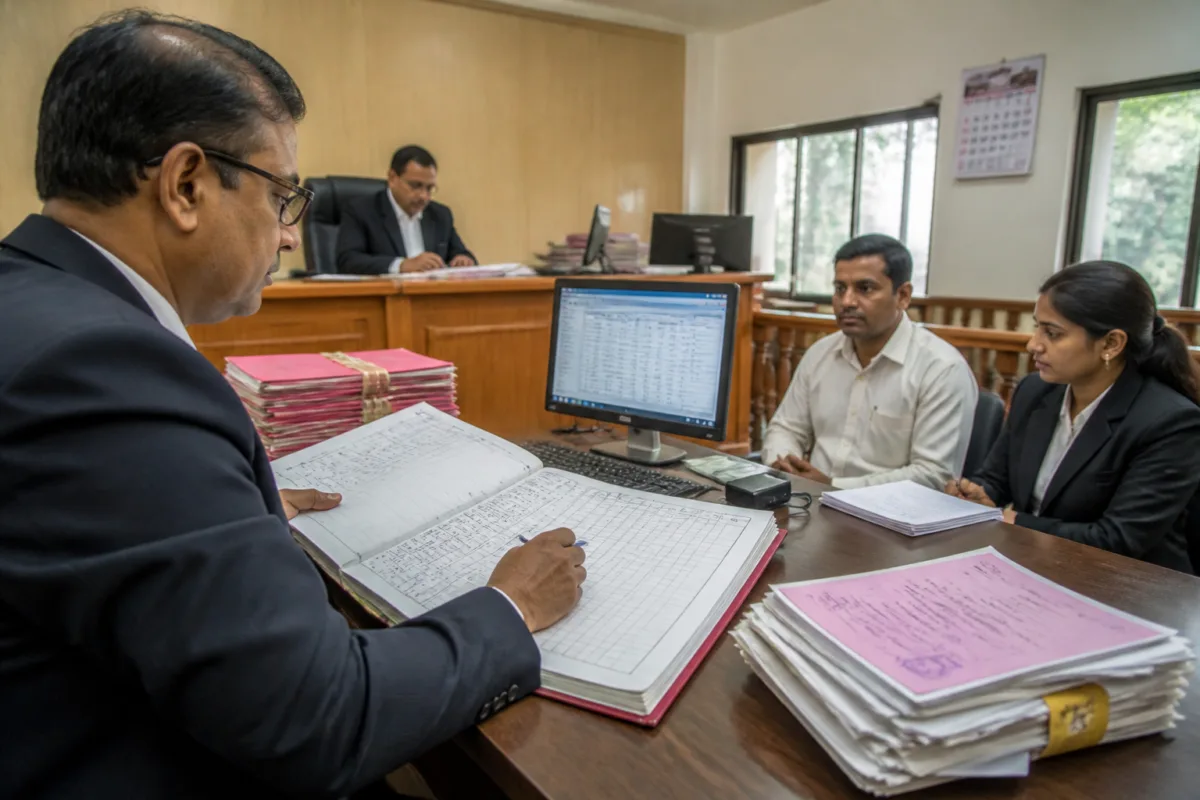
Maharashtra’s new Roznama rule addresses a basic but consequential weakness in the state’s quasi-judicial system: litigants may attend hearing after hearing without possessing a reliable record of what happened, which documents were filed or why a matter was adjourned. By making daily proceedings records mandatory across quasi-judicial and appellate authorities, the state has turned recordkeeping from an administrative practice into an accountability requirement.
The General Administration Department issued the circular on November 3 after the Nagpur Bench of the Bombay High Court criticised the handling of a case that had remained pending for approximately 14 years without a complete official Roznama. The High Court’s observations, recorded in an order dated October 7 in Writ Petition No. 4512 of 2026, became the immediate trigger for a uniform framework across Maharashtra.
The significance of the policy lies in the fact that it targets the administrative trail behind delay. A hearing date by itself does not show whether parties appeared, whether evidence was submitted, whether an authority issued directions or why the next date was fixed. Without such a trail, a litigant has limited ability to establish what happened in a proceeding or to challenge an unexplained adjournment. The circular attempts to close that gap by prescribing what every case record must contain.
Advocate Jamshed Mistry, an advocate and amicus curiae appointed by the Bombay High Court in several matters, described the circular as important for transparency in state tribunals and administrative bodies. He said that complete daily records would help litigants and that details of proceedings could be accessed through legal transcription. His comments place the measure within a wider legal principle: an authority’s functioning is more accountable when its decisions and procedural steps can be reconstructed from an authenticated record.
Under the new framework, each quasi-judicial and appellate authority must maintain a separate Roznama for every case. Each matter is to receive a unique registration number that can be used across physical and electronic archives. That requirement is not merely a filing reform. It creates a common identifier through which a case can be tracked, retrieved and matched with its procedural history, including when records exist in more than one format.
The prescribed entries cover the central components of a hearing. Authorities must record what transpired, identify the parties and representatives present, and list files and other documents submitted. Directions, instructions and interim orders must also be entered. The presiding officer’s name, the case number, the current and next hearing dates and the signatures of attendees are part of the required record. If a person is absent or a signature is missing, the reason must be stated.
The framework also addresses the credibility of the record itself. Entries must be authenticated by a competent officer, with any correction or alteration remaining traceable. At the time of filing, authorities must record valid postal addresses, email addresses and telephone numbers. The stated purpose is to preserve verifiable delivery records for electronic notices, linking the case file not only to what happened at a hearing but also to how parties were informed.
This is important in proceedings where the citizen is not dealing with a conventional court registry. Quasi-judicial authorities exercise statutory powers in areas that can have direct consequences for property, housing, land and administrative rights. The report cites the experience of a Navi Mumbai resident who said that his matter before MahaRERA had moved from one date to another without an effective remedy. It also cites an Ambernath homebuyer who said he had been waiting since 2014 and that an execution order passed by MahaRERA had remained unimplemented for five years.
These accounts do not establish the performance of every tribunal or the causes of either individual delay. They do, however, show the practical difference between an order existing on paper and a citizen being able to secure its execution. A detailed Roznama cannot by itself guarantee disposal or enforcement. It can make the sequence of hearings, filings, directions and absences more visible, allowing litigants to identify where a matter stands and what administrative step is pending.
The circular also links recordkeeping with periodic review and timely disposal under relevant laws. At the same time, the state has clarified that the 2005 Delay in Discharge of Official Duties Act cannot be used to impose arbitrary blanket deadlines on all quasi-judicial proceedings. That distinction matters. Different proceedings involve different evidence, parties and statutory procedures, so a universal deadline may not reflect the work required in each case. The state’s approach instead combines procedural documentation with review and accountability.
Administrative secretaries have been identified as responsible for audits and for enforcing disciplinary action where lapses occur. This places implementation above the level of individual presiding officers and gives the framework an institutional chain of responsibility. The measure will therefore be tested not only by whether authorities begin maintaining Roznamas, but by whether senior departments review their quality, completeness and accessibility.
The policy also exposes a recurring tension in administrative justice. Authorities may possess the legal power to decide a case, but that power becomes difficult for citizens to scrutinise when the underlying process is poorly documented. A missing or incomplete record can make it harder to distinguish a genuine procedural delay from an unexplained adjournment, determine whether a document was filed, or establish whether a direction was communicated. In that sense, the Roznama is not a clerical add-on. It is the basic evidence of how an authority exercised its power.
The state’s decision to require records in both physical and electronic archives reflects another practical concern: continuity. A unique registration number and authenticated entries can help connect older paper files with digital records. The circular, as described in the supplied report, does not establish the creation of a single statewide case-management platform or specify a public online portal for every authority. Its immediate focus is more fundamental: ensuring that a record exists, follows a consistent format and can be retrieved.
That limitation is also central to assessing what the rule can achieve. The circular can improve traceability, but the report does not establish how quickly records will be made available to litigants, whether authorities will publish them online, what audit standards will apply or how disciplinary action will be initiated. Nor does it show whether existing backlogs will be measured through a common system. These implementation details will determine whether the policy becomes a working transparency mechanism or remains a compliance instruction within departmental files.
The case that prompted the intervention demonstrates why such details matter. A proceeding can remain pending for years while its procedural history becomes difficult to reconstruct. When there is no complete Roznama, the citizen’s challenge is not limited to waiting for an order; it includes proving what has already occurred. The new framework responds to that institutional weakness by requiring a chronological, authenticated account that can be examined by parties, authorities and, where relevant, courts.
Maharashtra’s rule therefore represents a shift in the administrative meaning of delay. Delay is not only the number of years before a final decision. It is also the absence of an intelligible record explaining each stage of the journey. The circular does not replace statutory powers, hearing procedures or execution mechanisms, and the supplied evidence does not show its results yet. What it does is establish a statewide procedural baseline against which the functioning of quasi-judicial and appellate authorities can be examined.
The next measure of the policy will be its enforcement. Authorities must maintain separate records, use unique case numbers, authenticate entries, preserve contact details and explain missing signatures or absences. Administrative secretaries are expected to oversee audits and disciplinary action for lapses. Whether these requirements reduce unrecorded hearings and make delayed proceedings easier to challenge will depend on how consistently that oversight is carried out across Maharashtra’s tribunals and administrative bodies.

