


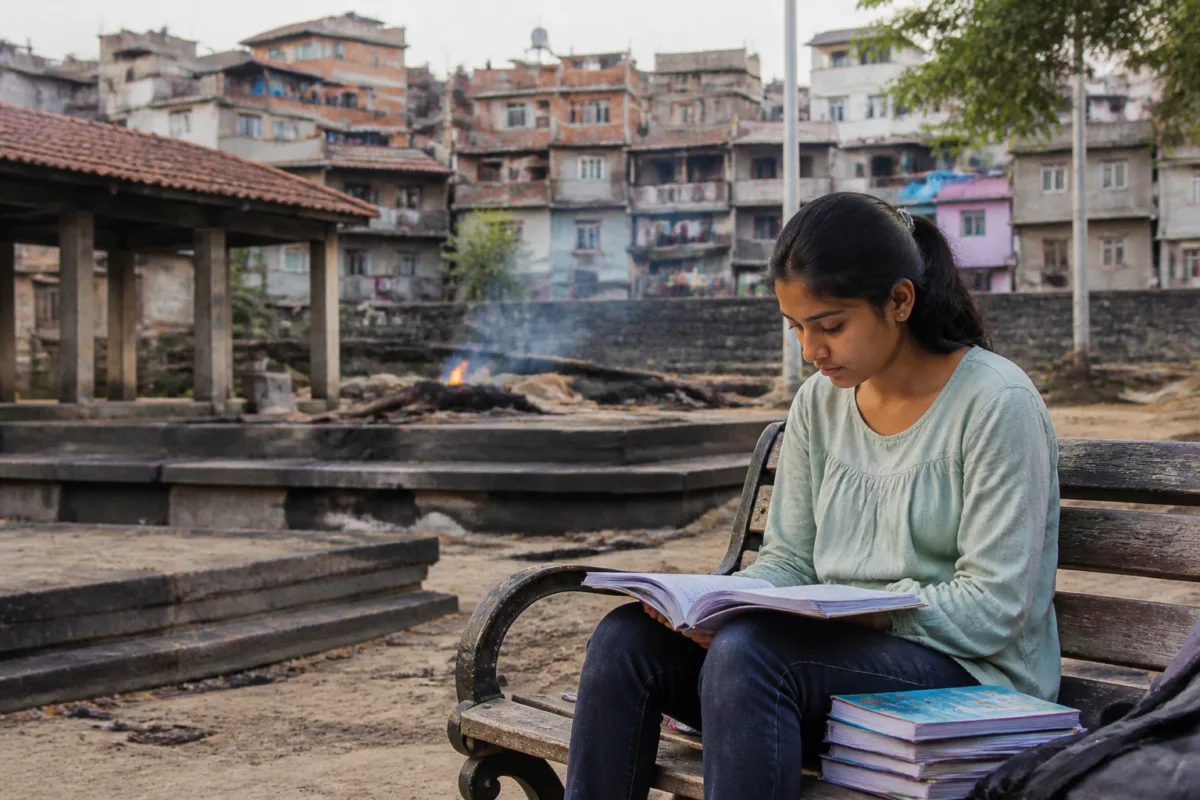
Reshma Pathan’s decision to study at a crematorium in Pune is not simply a story of individual determination. It is also an account of how the city’s poorest residents experience housing, public health and public space: when a home is too small and too noisy for sustained study, an institution meant for mourning can become the most accessible place for concentration.
Pathan, 25, lives in Kothrud’s Sainath Vasahat slum and is pursuing a master’s degree in public health at Savitribai Phule Pune University. Her route to higher education has included morning classes, night shifts as a Pune Municipal Corporation street sweeper and study sessions on Sundays or after college at a nearby crematorium. The arrangement reveals a gap that is rarely captured by formal measures of housing supply. A dwelling may provide shelter, but it does not necessarily provide the privacy, quiet or usable space required for education, rest and health.
The conditions she describes are central to understanding that gap. Houses in Sainath Vasahat are small, with some roofs made of tin sheets, and are built so closely that residents can hear one another’s conversations. The narrow opening between rows of homes serves as a setting for children’s play, arguments, drunken brawls and celebrations involving loud DJ speakers. In such an environment, the absence of quiet is not an occasional inconvenience. It is a permanent feature of the settlement’s built form and social life.
That distinction matters for public health. Pathan is studying the subject partly because she has seen how inadequate living conditions affect the health of slum communities. The report does not provide a health survey or quantify the effects of noise, crowding or poor housing on residents. It does, however, show how these conditions shape everyday choices. For Pathan, uninterrupted thought has become a scarce urban resource, and the search for it takes her outside the home.
The crematorium functions as an improvised study space because it offers features missing from her neighbourhood: open land, benches and relative quiet. This is not evidence that crematoriums are being systematically used as study facilities, nor does the report establish whether the city has failed to provide any formal alternative in the area. It does show how residents adapt when public institutions and neighbourhood design do not provide places for concentration. A space associated with death becomes useful for education because it is one of the few places where noise and crowding recede.
Pathan’s experience also connects housing conditions to the economics of education. She completed a Bachelor of Science degree in Microbiology with a first-class result in 2023, but further education remained out of reach for two years. This year, she joined SPPU, where the one-year course fee is about Rs 50,000. Her education therefore depends not only on academic ability, but also on the availability of paid work and a place in which to study.
During the Covid-19 pandemic, her father, Jahangir Pathan, an auto-rickshaw driver, began transporting people free of charge after connecting with a local non-governmental organisation. The family faced financial difficulty as he devoted much of his time to social service. Pathan then joined the PMC as a street sweeper in Jai Bhawani Nagar. She attended BSc classes in the morning and worked the night shift, combining education with municipal sanitation work.
That combination points to another institutional issue: the relationship between women’s employment and the organisation of municipal work. Pathan said she left the sweeper’s job three months ago after the PMC stopped allowing women workers to take night shifts. The report does not state the reason for the change, whether alternative shifts were offered or how widely the policy affected women employees. Those details remain important for understanding the employment consequences of the decision. In Pathan’s case, the change removed an income source at the same time that her postgraduate education created a new financial obligation.
The larger policy landscape is therefore spread across several systems rather than located in one department. Housing conditions in an informal settlement involve land, shelter, basic services and neighbourhood planning. Public health involves the impact of the physical and social environment on residents. Municipal sanitation work involves employment rules and shift arrangements. Higher education brings fees, access and the need for time and space to study. Pathan’s story brings these systems into one frame, even though the supplied report does not document how they are coordinated by the city or university.
The numbers in the report are modest but significant. Pathan is 25. She completed her undergraduate degree in 2023, spent two years unable to continue her education, and now faces an annual course fee of approximately Rs 50,000. Her daily schedule previously combined morning classes with night work. These figures do not describe Pune’s slum population as a whole, and they cannot be used to estimate the scale of the problem. They do, however, show how quickly the cost of education, the cost of living and the availability of work can collide in one household.
The report also raises a question about what counts as public infrastructure in a dense neighbourhood. Urban infrastructure is often discussed through roads, water supply, transport, sanitation and housing construction. The need for quiet space is less visible because it is difficult to count and is rarely treated as a standalone service. Yet for students, workers and families living in crowded settlements, access to a safe and usable place for reading, study or rest can affect whether education is realistically available.
Pathan’s complaint is specific: she does not understand why there is space, money and resources for DJ events, political functions and celebrations, but no quiet corner for students. Her statement is an account of her lived experience, not a citywide assessment of public spending or land allocation. It nevertheless identifies a tension in dense settlements. Community and cultural activity are part of urban life, but when there are few spaces and homes are tightly packed, noise can become a form of unequal access to the neighbourhood. Those with larger homes or better sound insulation can withdraw from it more easily than those living in small dwellings.
For planners and administrators, the issue is not only whether a slum settlement should be redeveloped or whether more housing should be built. It is also whether redevelopment creates homes and common spaces that support the full range of urban life. A dwelling designed only around minimum shelter may leave residents dependent on streets, religious sites, institutions or other informal locations for study, work and social activity. The supplied report does not provide details of any redevelopment plan for Sainath Vasahat, so the consequences of a future intervention cannot be assessed here.
What the evidence does establish is narrower and more powerful. Pathan has demonstrated academic achievement while navigating overcrowded housing, financial pressure and municipal work rules. Her decision to study at a crematorium is an adaptation to the absence of quiet at home, not a substitute for a documented public programme. Her search for part-time employment shows that access to higher education remains tied to household income even after admission is secured.
The next question for Pune’s institutions is whether stories such as Pathan’s are treated as exceptional accounts of resilience or as signals about the conditions in which urban residents live and study. The report does not answer how many students face similar constraints, whether SPPU or the PMC has offered assistance, or what employment options are available to her now. Those are the gaps that further reporting would need to examine. For the moment, her experience makes one fact visible: in a dense city, adequate housing must mean more than a roof over a family. It must also include the possibility of health, privacy, rest and learning.

