


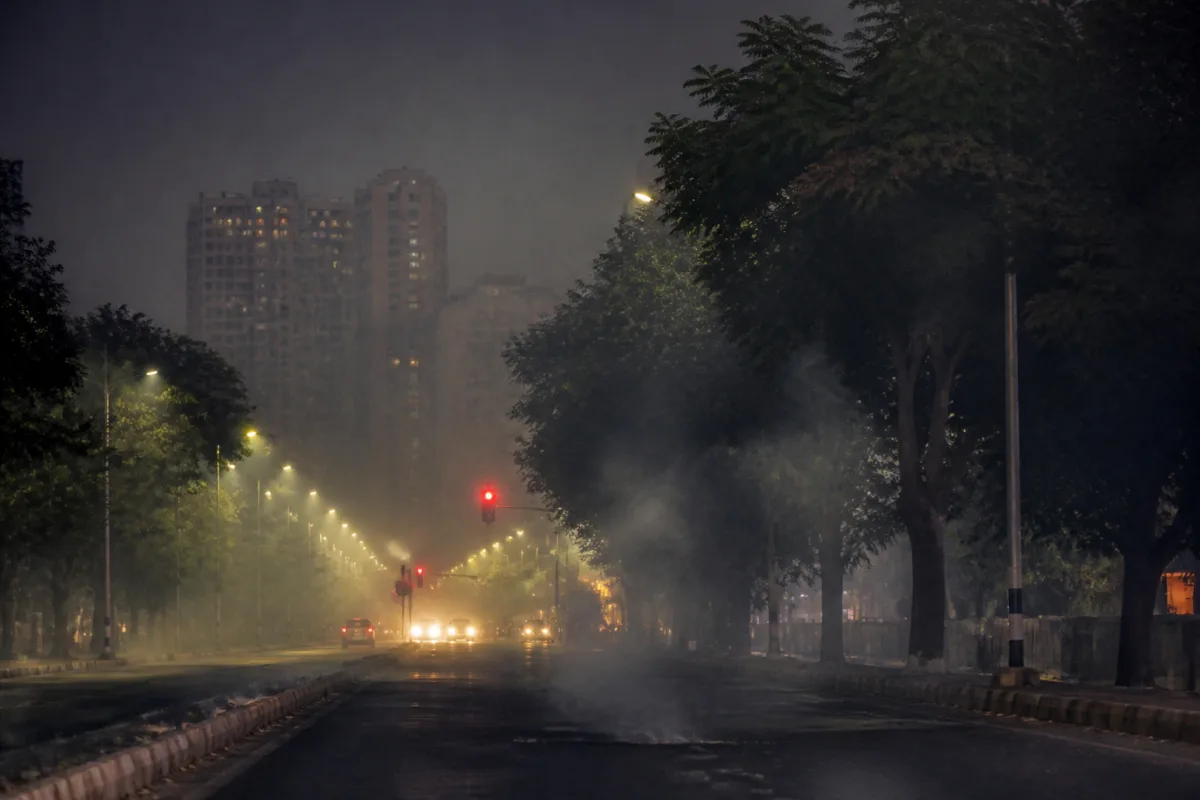
Pune’s air quality deteriorated sharply after Diwali fireworks, with the citywide Air Quality Index approaching 300 on Sunday night and several monitoring stations recording PM2.5 and PM10 concentrations above 400 micrograms per cubic metre, according to data cited from the Central Pollution Control Board (CPCB) by Lokmat – Pune.
The report said air quality across Pune remained normal until the afternoon of Sunday, November 8, but worsened rapidly after 9 pm as firecracker smoke spread through the city. Pollution levels continued to remain high on Monday because weak winds allowed the particles to remain suspended in the air.
At the Mhada Colony monitoring station, PM10 rose from 81.94 micrograms per cubic metre at 4 pm to 500 at 10 pm, the maximum figure reported in the station data. PM2.5 at the same location increased from 30.73 to 416.96 during the period.
Dhanakawadi recorded the highest PM2.5 reading among the listed stations, rising from 26.67 at 4 pm to 420.45 at 1 am. PM10 at the station climbed from 57.34 to 490 at 9 pm. In Hadapsar, PM2.5 increased from 20.83 in the afternoon to 415.66 at 9 pm, while PM10 rose from 66.28 to 336.33.
The impact continued into the early hours of Monday in Katraj. PM2.5 at the Katraj Dairy station reached 410.63 at 6 am, while PM10 touched 434.46 at 5 am. At Panchavati-Pashan, PM2.5 rose to 258.49 and PM10 to 333.86 at 11 pm. The Savitribai Phule Pune University station recorded a PM2.5 peak of 284.80 and PM10 of 119.67.
The city’s air quality remained in the ‘very poor’ and ‘poor’ categories on Monday. Dhanakawadi recorded an AQI of 321, followed by Hadapsar at 315 and Mhada Colony at 310, all classified as ‘very poor’ in the report. Panchavati-Pashan recorded 298, Katraj Dairy 280 and the university station 255, with each listed in the ‘poor’ category.
PM2.5 refers to fine particulate matter capable of penetrating deep into the lungs. The report said concentrations above 400 can pose serious health risks, particularly for children, senior citizens and people with asthma or other respiratory conditions. Reported symptoms included eye irritation, throat discomfort and chest congestion.
The report also noted that cold conditions and low wind speeds could allow the smoke layer to persist for another 24 to 48 hours. It cited World Health Organization guidelines that recommend an annual average PM2.5 concentration of no more than 5 micrograms per cubic metre and a 24-hour average of no more than 15 micrograms per cubic metre. The monitoring data cited in the report showed substantially higher short-term concentrations at several Pune locations after the fireworks.

