


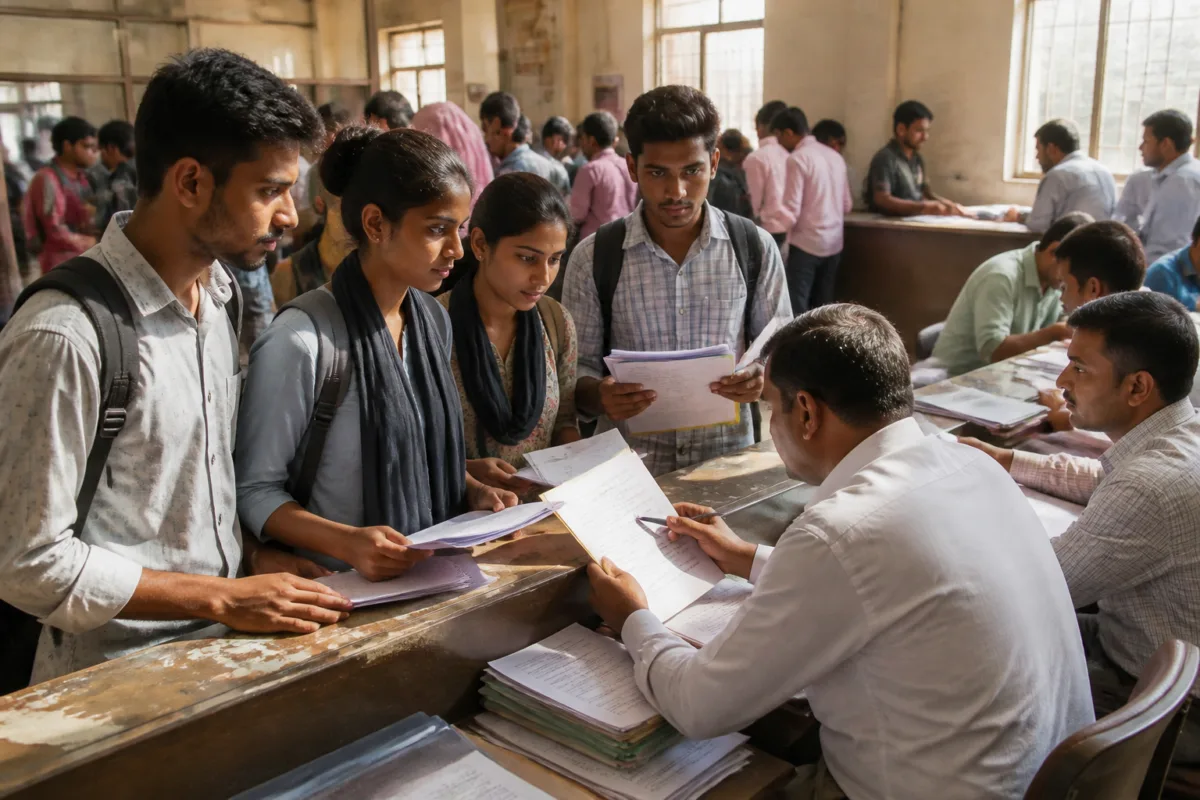
Maharashtra’s exam fee waiver for students in drought-declared areas has exposed a familiar problem in public administration: a relief measure can be announced for a broad group but reach a much smaller one once eligibility conditions are applied. The state has declared drought in 304 talukas, yet students and student organisations say exclusions linked to land ownership, scholarships and repeat examinations could leave many financially distressed households outside the scheme.
The Higher and Technical Education Department announced the waiver through a government resolution issued on November 3. According to the report by Sakal, the decision covers the examination fees for the current academic year, 2026-27, for students in arts institutions under the department’s jurisdiction. The government has approved expenditure of Rs 20,38,630 for the measure.
The announcement places the scheme within the state’s drought response, but the dispute is about how drought-related vulnerability is being identified. The reported conditions do not appear to assess only whether a household has suffered a fall in income. They also use administrative markers such as where the family lives, whether land is registered in the parents’ names, whether a student has received a scholarship and whether the student is appearing for an examination again.
That distinction matters because rural distress and household residence no longer fit neatly into one location. The report quotes students and student representatives as saying that families may retain agricultural land in a village while moving to a city for wage work or other employment. Land ownership, in such cases, does not necessarily mean that the land is generating income. Drought can reduce or eliminate farm earnings while the family continues to bear the costs of education in an urban location.
The condition relating to agricultural land is therefore at the centre of the objections. Students whose parents live in a city for employment or business but have farmland in a village are reportedly excluded from the fee waiver. Student representatives argue that this treats the existence of land records as proof of economic security, even where drought has made cultivation unproductive.
This is an institutional issue rather than only a disagreement over the amount of an examination fee. A government relief scheme needs an eligibility test that can distinguish between formal ownership and usable household income. When land records are used as a shortcut, the administration may be able to process applications more easily, but the same shortcut can exclude migrant, tenant, marginal and distressed rural households whose financial position is not visible through ownership records alone.
The source report also identifies a second exclusion involving students who have already received 50 or 100 per cent scholarships through the MahaDBT portal. Such students are reportedly excluded from the examination fee waiver, or denied the benefit on the grounds that they would otherwise receive duplicate assistance. The stated logic is to prevent overlapping benefits. The practical concern raised by students is that scholarship approval and scholarship payment do not always occur at the same time.
According to the objections cited in the report, scholarship payments can be delayed by one or two years. If a student has been approved for assistance but has not received the money during the current academic year, the scholarship may exist as an administrative entitlement without functioning as immediate support. The student may still have to arrange the examination fee at the time it is demanded.
This points to a wider delivery problem in welfare administration: eligibility, sanction and payment are separate stages. A student can be recorded as a scholarship beneficiary while remaining short of cash. If the fee waiver is denied solely because the student appears in a scholarship database, the system may count the same support twice even though the family has not received money twice. The source material does not establish how many students fall into this category, but it records the concern that the exclusion could affect students from drought-hit families during the current academic year.
The reported exclusion of external and repeater students creates another boundary around the scheme. The government decision, as described by Sakal, is intended for students’ examination fees in 2026-27, but the available report does not provide the full wording of the resolution or explain why these categories were excluded. Student representatives say that repeaters and external candidates are also facing financial hardship and should not be denied support merely because their examination status differs from that of regular students.
The distinction is important for how education systems handle disruption. A student who repeats an examination may have already paid fees in an earlier cycle without completing the course or clearing the examination. An external student may not follow the standard institutional route. The report does not provide data on the number of repeaters or external candidates affected, so the scale of this exclusion cannot be established from the available material. It does, however, show that a drought relief measure designed around a standard student profile may not cover all forms of participation in higher education.
The controversy also reveals the limits of a one-time financial announcement when the administrative process is not publicly explained in equal detail. The government has approved a specific expenditure of Rs 20,38,630, but the report does not state the number of eligible students, the average fee waiver per student, the application process, the deadline for claiming the benefit or the mechanism for students to appeal an exclusion. Without those details, it is difficult for students, institutions and the public to assess how widely the measure will operate.
The absence of these figures is not a minor information gap. A relief programme can be judged in at least three ways: by the size of the sanctioned budget, by the number of people classified as eligible and by the number who actually receive the benefit. These measures can diverge sharply when conditions are restrictive. A government may approve funds for a drought-related waiver, while the final number of beneficiaries remains low because land records, scholarship databases or examination categories narrow access.
The reported dispute also raises questions about the relationship between state-level decisions and institutional implementation. The Higher and Technical Education Department has issued the decision, but students will encounter the scheme through colleges, examination offices and administrative portals. Those institutions will need to determine which documents establish eligibility and how exclusions are communicated. The source does not specify whether colleges have discretion to review individual hardship cases or whether the conditions will be applied mechanically.
That implementation layer is where broad policy language becomes a direct experience for citizens. A student does not experience a government resolution as a budget approval. The student experiences it as a fee demand, a portal status, a document request or a rejection. If a family has migrated for work, owns drought-affected land or is waiting for a delayed scholarship, the outcome will depend on whether the system recognises the household’s actual financial position or relies on a single administrative category.
The strongest criticism in the report comes from Kuldeep Ambekar, founder of Student Helping Hand, who asks how many students will remain eligible after all the conditions are applied. His criticism is directed at the gap between the stated purpose of the scheme and its operational design. The report also quotes student Amol Shinde, whose family reportedly owns agricultural land in a village but has moved to the city for wage work because drought has eliminated farm income.
These accounts do not establish the total number of excluded students, nor do they prove that the government intended to restrict support unfairly. They do establish a documented conflict between the policy’s drought-relief objective and the way affected students say eligibility is being assessed. They also show why aggregate announcements are insufficient for evaluating social assistance. The relevant question is not only how much money has been sanctioned, but which households qualify and whether the support arrives when fees are due.
The available evidence leaves several issues unresolved. The full government resolution, the number of students covered, the number excluded under each condition, the timing of scholarship payments and the government’s response to the students’ demands are not provided in the report. There is also no information on whether the state will revise the conditions or create an appeal mechanism.
What the dispute confirms is narrower but significant: Maharashtra’s drought-related exam fee waiver is being tested at the point where public policy meets complex household realities. Students and organisations are demanding a blanket waiver for all students in drought-declared areas, while the reported scheme uses eligibility filters that may exclude students with land but no farm income, scholarship approvals but no current payment, or non-standard examination status. The next measure of the policy will be the government’s clarification of these conditions and the number of students who ultimately receive the waiver.

