


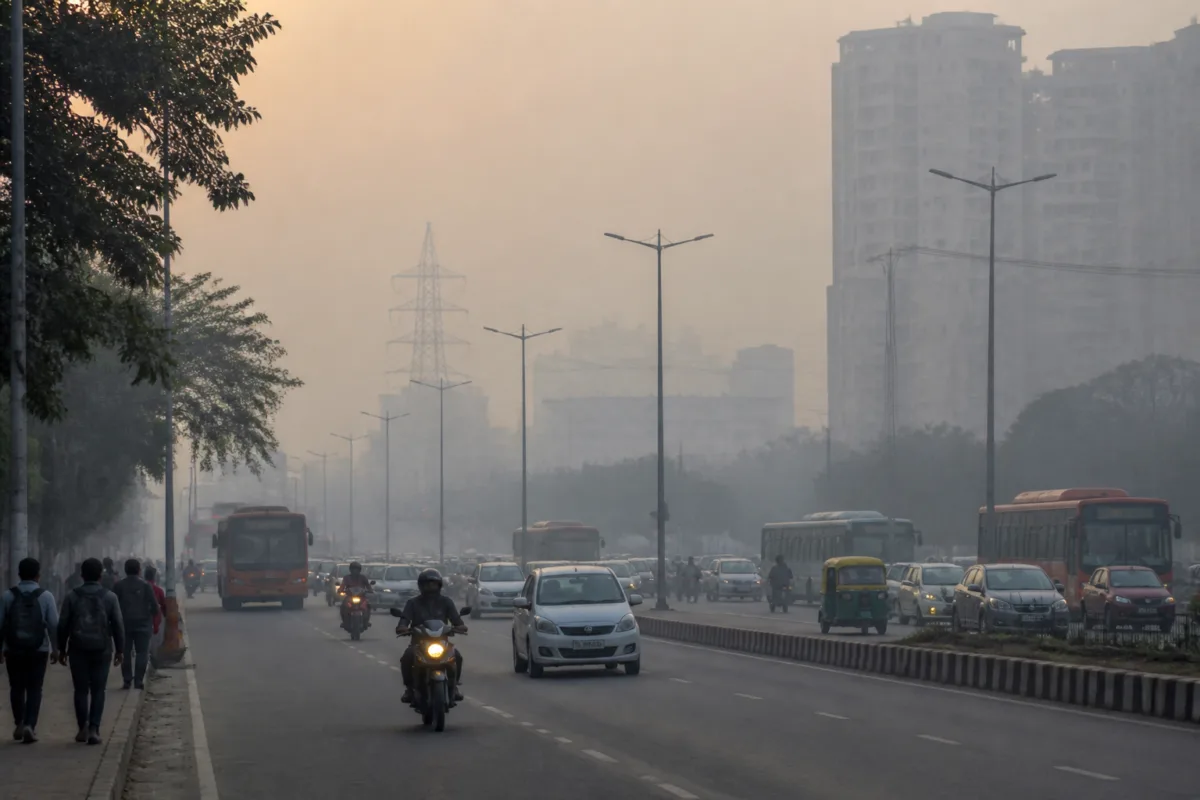
Delhi’s average Air Quality Index (AQI) stood at 307 at 8 am on Tuesday, placing the capital in the “very poor” category as fog and smog remained across the city, according to a report by Live Hindustan citing air-quality monitoring data.
The reading means Delhi’s air quality was above the threshold for the very poor category under the Central Pollution Control Board’s classification. The CPCB defines an AQI of 0-50 as good, 51-100 as satisfactory, 101-200 as moderate, 201-300 as poor, 301-400 as very poor and 401-500 as severe.
Several monitoring locations recorded readings well above the city average. Chandni Chowk recorded an AQI of 395, while the Commonwealth Games Village recorded 380. The readings at the Central Road Research Institute on Mathura Road and Jawaharlal Nehru University were both reported at 369. IIT Delhi recorded 364, while Aya Nagar recorded 354 and Punjabi Bagh 355.
Other locations also remained in the very poor range. Rajinder Nagar was reported at 328, Dwarka Sector 8 at 327, Bawana at 321, Burari at 309, Jahangirpuri at 305 and Rohini at 304. The monitoring data also showed lower readings at some locations, including Sri Aurobindo Marg at 175 and the cantonment area at 179, although these locations remained above the CPCB’s satisfactory range.
The report linked the conditions to a thick layer of fog and smog over the capital. It also said Delhi recorded its highest Diwali-day pollution level in five years, with an average AQI of 376. On the morning after Diwali, the city’s AQI reportedly fell from 382 to 371, a marginal improvement attributed in a Delhi Pollution Control Committee report to weather conditions and stronger wind speeds.
The DPCC report also recorded elevated noise levels during Diwali. Of the 26 monitoring centres assessed, 19 recorded higher noise levels than the previous year, while seven recorded a decline. Noise levels ranged from 57.5 decibels (A) in Najafgarh to 89.1 decibels (A) in Karol Bagh. Karol Bagh remained the loudest monitored location, despite recording a marginal decline from 89.2 decibels (A) the previous year.
The current citywide AQI reading does not represent identical conditions across every neighbourhood. Monitoring stations reported different levels, and some stations, including NSIT Dwarka, ITO and Najafgarh, were listed without an available reading in the report. The latest readings will continue to determine the air-quality category assigned to Delhi under the CPCB scale.

