


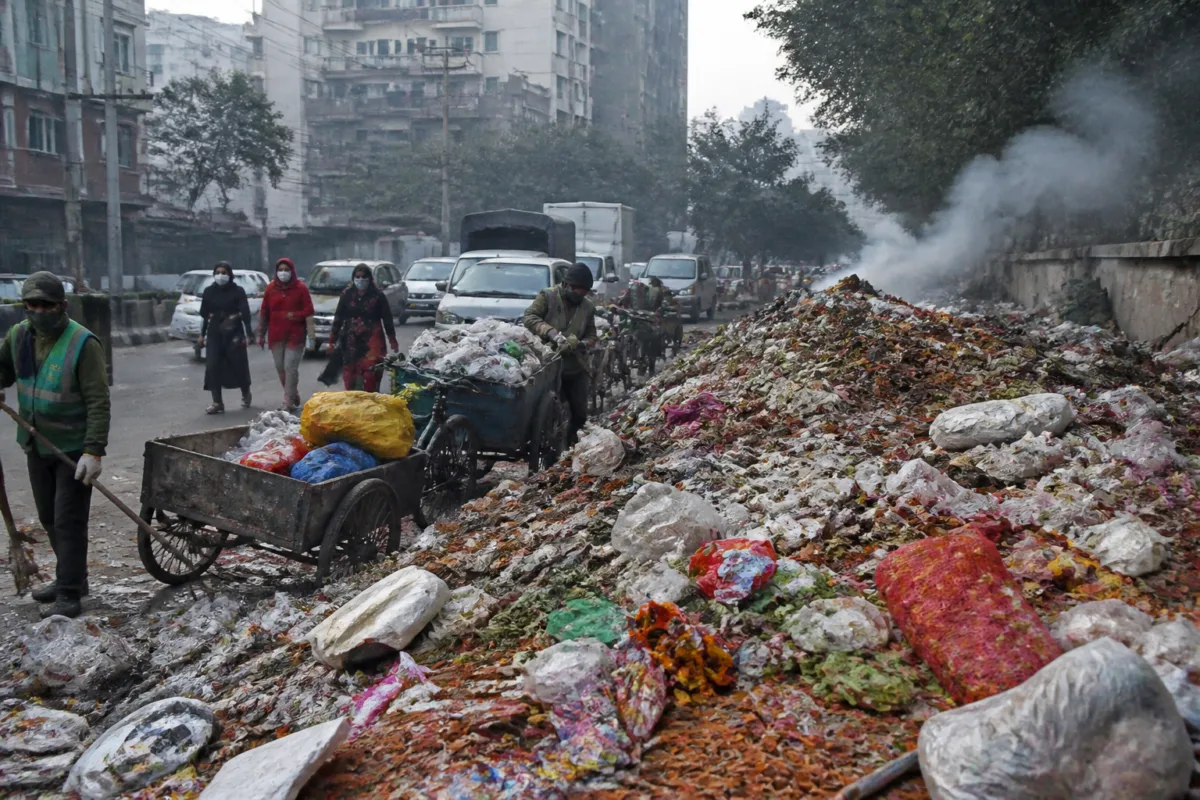
Delhi’s post-Diwali garbage crisis spread across residential colonies, markets and roads, with delayed waste collection leaving piles in several parts of the city and some garbage being set on fire amid restrictions under the Graded Response Action Plan. The resulting smoke has added to residents’ exposure to pollution, according to a report by Jagran – New Delhi.
The disruption followed the accumulation of household, market and street waste after Diwali. Along with regular municipal waste, large quantities of firecracker remnants were generated during the festival. Waste collection vehicles reportedly failed to reach several dumping points and vulnerable locations on time, allowing garbage to build up around open sites and residential lanes.
The affected areas listed in the report include Sadar Bazar, Qutub Road, Paharganj, Chuna Mandi, Vikram Nagar, Daryaganj, Patel Nagar and Karol Bagh in central Delhi. In east Delhi, waste-collection problems were reported in Mayur Vihar, Mandawali, Vinod Nagar, Joshi Colony, Laxmi Nagar, Master Plan Road, Geeta Colony, Karawal Nagar and Shiv Vihar. Rohini, Tri Nagar, Shakur Basti, Wazirpur, Kirari and Burari in outer Delhi were also identified among the affected areas.
The report said similar problems were seen in several parts of south and west Delhi. At some locations, garbage was reportedly burned instead of being removed. Open burning releases smoke and pollutants close to streets and homes, making a waste-collection failure an immediate neighbourhood-level air-quality problem. The incidents have also raised questions about compliance with pollution-control restrictions at a time when Delhi is already facing severe air-quality stress.
Delhi has more than 700 garbage dumping points and over 500 garbage vulnerable points, according to the report. These locations are particularly exposed to overflow when collection schedules are disrupted because waste is deposited in the open and can spread onto roads, footpaths and adjoining residential areas. The scale of the network also means that festival-related surges in waste require coordination between collection vehicles, sanitation workers, local field teams and disposal facilities.
The municipal corporation said waste collection and disposal were continuing. It attributed part of the delay to the process of separating firecracker remnants from ordinary waste, while also acknowledging the additional pressure created by the post-festival increase in garbage. The civic body said it expected sanitation arrangements to return to normal by Tuesday evening.
The episode puts the operational capacity of Delhi’s waste system under scrutiny during a predictable seasonal surge. The immediate question for residents is when accumulated waste will be removed and whether open burning will stop. The municipal corporation’s stated next step is to complete collection and disposal operations and restore regular sanitation services across the affected locations.

