


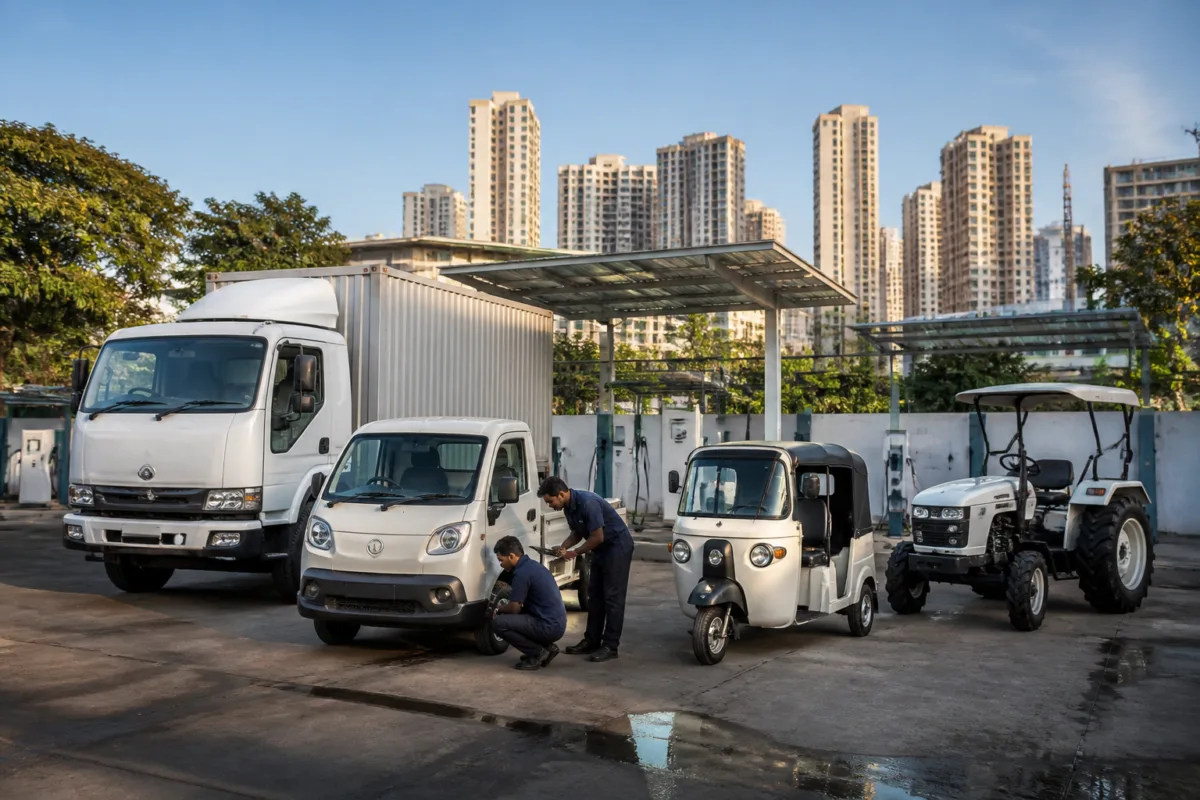
Murugappa’s electric mobility business is growing rapidly, but its next test is not simply selling more vehicles. TI Clean Mobility (TICM), the group’s electric vehicle subsidiary, is targeting EBITDA break-even in its electric truck business by the fourth quarter of FY27 and in two other businesses by the fourth quarter of FY28. The targets reveal the difficult economics behind India’s commercial EV transition: market share and revenue are rising, but battery, commodity and currency costs continue to pressure margins.
Tube Investments of India (TII), Murugappa Group’s engineering flagship, operates the electric mobility business through TICM. During TII’s Q2 FY27 earnings call, management said the business first needs to achieve EBITDA break-even at the organisational level, followed by profitability at the net profit level. The company has four electric vehicle businesses, although the fourth remains at a relatively nascent stage.
That sequencing matters. A business can expand sales and revenue while still losing money at the operating level if manufacturing, procurement, service and distribution costs rise faster than volumes. TICM’s stated focus on scale indicates that management sees higher production and sales volumes as necessary to absorb fixed costs and improve the economics of each segment. However, management also acknowledged that the scale required will differ across businesses.
The immediate financial pressure is coming from the cost structure of the vehicles. Rising battery cell prices, rupee depreciation and higher commodity costs have increased the bill of materials, or BOM, across TICM’s four businesses. For an electric vehicle manufacturer, the BOM directly affects the cost of the vehicle before expenses such as sales, service, financing and administration are considered. Higher input costs therefore make it harder to convert growing volumes into operating profit.
TICM’s response is built around five priorities: reducing BOM costs, improving service and after-sales support, identifying profitable end-use applications, launching products suited to market requirements and strengthening realisations. The company is considering selective price increases and better deal-by-deal pricing, while also working to reduce component costs. It is exploring longer-term procurement arrangements and supply contracts to manage input-cost volatility.
These measures show that the break-even plan is not based on volume alone. It depends on the company improving the contribution from every vehicle sold while controlling the cost of key components. Selective price increases may support realisations, but the scope for passing costs to customers is likely to vary by vehicle category and use case. The supplied earnings-call account does not establish how much of the higher cost can be passed on, making cost reduction and procurement discipline central to the plan.
## Murugappa EV business is strongest in commercial segments
TICM has established a relatively strong position in two of its four electric vehicle segments: trucks and small commercial vehicles, or SCVs. Management said the company held a market share of around 25% to 26% in each segment. Its share of electric tractor registrations was also around 25% in the first half of FY27, based on VAHAN data.
The market-share figures point to a concentration of strength in vehicles used for commercial and productive purposes. Trucks and SCVs are not primarily private consumption products; their adoption is linked to how operators assess operating costs, vehicle utilisation, service availability and the ability to earn revenue from each trip. TICM’s focus on profitable end-use applications reflects this commercial logic.
The weaker segment is electric three-wheelers. TICM’s market share in both passenger and cargo electric three-wheelers remains in the low single digits, according to management. This creates a clear gap within the portfolio. The business has scale and market presence in trucks and SCVs, but it still needs to strengthen its competitive position in a segment where volumes can be important for overall growth.
Sales in Q2 FY27 show the different sizes of these businesses. TICM sold 311 electric trucks, 2,242 electric three-wheelers, 483 electric SCVs and 50 electric tractors during the quarter. In the previous quarter, sales stood at 86 electric trucks, 1,924 electric three-wheelers, 347 electric SCVs and 22 electric tractors. The quarterly comparison indicates growth across all four reported categories, although the figures alone do not establish whether the increase was driven by sustained demand, product availability, timing or other operating factors.
The contrast between volumes and market share is important. Three-wheelers recorded the highest quarterly sales among the four categories but still had a low-single-digit market share. Trucks recorded fewer units but held a much stronger market position. This suggests that volume leadership and competitive strength are not the same thing. TICM’s profitability plan will therefore have to balance the number of vehicles sold with the economics and strategic position of each segment.
## Revenue has scaled, but profitability remains the next hurdle
TICM’s combined EV revenue more than doubled to Rs 715 crore in the first half of FY27 from Rs 313 crore in the year-ago period. The company has also reiterated its target of generating Rs 1,000 crore in EV revenue by 2030. The growth rate indicates that the business is moving beyond an early-stage revenue base, but revenue expansion has not yet removed the need for a break-even plan.
That distinction is the central financial signal in the earnings-call update. A larger top line can improve operating leverage, but only if costs are controlled and the product mix produces adequate margins. TICM’s simultaneous emphasis on scale, BOM reduction, service support, pricing and procurement suggests that management is addressing several parts of the profitability equation rather than relying on a single intervention.
The company’s funding position provides another part of the picture. TII invested Rs 250 crore in the EV business through compulsorily convertible preference shares during Q2. TICM had cash reserves of around Rs 315 crore, which management said would be sufficient to meet its funding requirements for FY27. The need for additional funding in FY28 will be decided later.
The funding structure indicates that the business is still in an investment phase even as it moves towards operating break-even. Capital is required to support product development, manufacturing, inventory, service networks and market expansion, but the supplied information does not break down how the funds will be deployed across these areas. The company’s ability to reach break-even will therefore be watched alongside its cash requirements and the timing of any further capital infusion.
## The policy and market question is execution at scale
The update places commercial EV manufacturing within a broader urban and infrastructure question: whether electric mobility businesses can reach sustainable scale while serving the operating needs of transport and logistics users. TICM’s portfolio spans trucks, SCVs, three-wheelers and tractors, linking the company to goods movement, passenger transport, agriculture and small-business mobility. Each application has different usage patterns and market requirements.
For cities, the significance is not limited to the number of vehicles registered. Commercial EV adoption depends on whether vehicles are available for the right use cases, whether after-sales support can keep them on the road and whether operators can manage the purchase and operating economics. TICM’s stated priorities on service, profitable applications and product-market fit directly address these conditions, although the earnings-call material does not provide detailed performance data on uptime, charging, financing or customer operating costs.
The company’s market-share position in trucks, SCVs and tractors gives it an established base from which to pursue break-even. At the same time, the low-single-digit share in electric three-wheelers shows that the portfolio remains uneven. The fourth business being at a nascent stage adds another limit to any assumption that growth will be uniform across segments.
The evidence currently supports a measured conclusion. TICM has achieved rapid revenue growth, reported higher quarterly volumes across its four categories and built a meaningful position in three segments. Yet the business remains exposed to battery and commodity costs, currency movements, competitive pressure and the need to improve its weakest segment. Management’s break-even timetable is therefore best understood as an execution benchmark rather than an indication that profitability has already been secured.
The next developments to monitor are whether the electric truck business reaches the targeted EBITDA break-even point by Q4 FY27, whether the other two businesses meet their Q4 FY28 targets, and how the company’s funding needs evolve in FY28. The progression of BOM costs, pricing, service capability and segment-level market share will determine whether rising EV revenue translates into a financially sustainable mobility business.

