


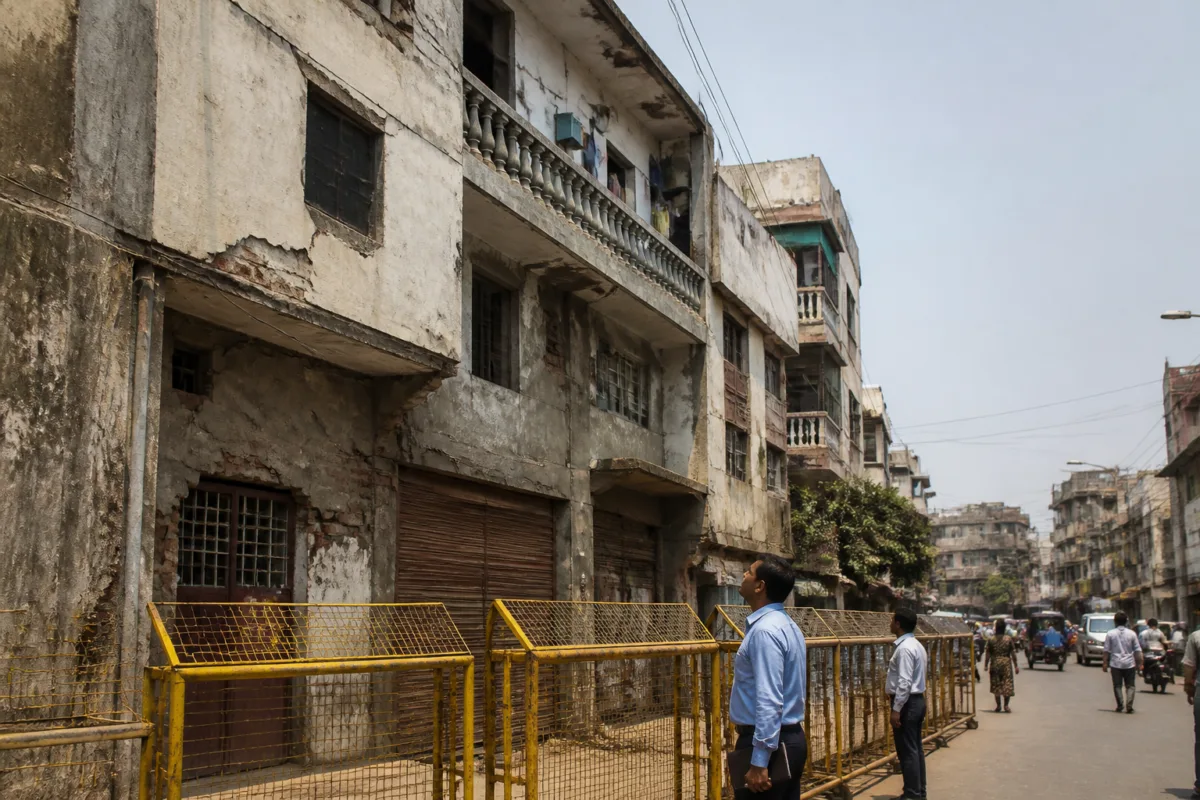
The Delhi High Court’s direction to the Municipal Corporation of Delhi (MCD) to consider sealing, repairs or controlled demolition of structurally unsafe buildings has shifted the focus from identifying hazards to acting on them. The order highlights a recurring urban governance problem: a municipal notice may formally record danger, but it does not by itself make a building safer for residents, neighbours or passers-by.
Justice Saurabh Banerjee issued the direction while taking suo motu cognisance of structurally unsafe buildings in the capital. The court directed the MCD commissioner, in consultation with the Delhi chief minister, to constitute a high-powered committee within a week. The committee is expected to devise alternatives for buildings found to be structurally unsafe during the GRAP period, including sealing, repairs or controlled demolition.
The court’s intervention is significant because it addresses the gap between municipal inspection and municipal enforcement. According to the order, the MCD had issued notices in several cases involving buildings described as dilapidated, ruinous, dangerous or likely to collapse. The court observed that in several instances the corporation had nevertheless failed to take effective steps for a considerable period.
That distinction is central to the safety question. An inspection can identify a risk. A notice can communicate that risk to an owner or occupier. Neither step, by itself, prevents a collapse, restricts access to a dangerous structure or ensures that urgent repairs are carried out. The court’s criticism was that the MCD could not meet its responsibility by conducting inspections or issuing notices while leaving the underlying danger unaddressed until an unfortunate incident occurred.
The order therefore points to a decision-making problem inside the municipal system. Once a building is considered unsafe, the authority must determine what happens next. Sealing may restrict occupation or access. Repairs may preserve the structure if the damage is addressable. Controlled demolition may be required where the risk cannot be managed through repair. Each option carries consequences for residents, property owners, adjoining buildings and the surrounding street. The proposed high-powered committee is intended to consider these alternatives rather than allow a notice to become the endpoint of the process.
The case arose from an application by Mohd Asif and others seeking an early hearing of their petition concerning a property against which the MCD had issued a notice under Section 348 of the Delhi Municipal Corporation Act, 1957. The source report does not set out the complete condition of that property, the relief sought by the applicants or the technical findings behind the notice. What it does establish is that the court treated the issue as part of a broader concern about unsafe buildings, rather than as an isolated dispute between one property and the civic body.
Section 348 is relevant to the institutional chain because it provides the legal basis under which the MCD can act when a building is considered dangerous or at risk of collapse. But the court’s observations show that the existence of statutory authority is not the same as effective implementation. The practical question is not only whether a notice can be issued. It is whether the responsible authority has a defined process for assessment, communication, evacuation or access control, repair supervision and, where necessary, removal of the structure.
The direction to involve the MCD commissioner and the Delhi chief minister also indicates the administrative weight the court has attached to the matter. The order does not merely ask for another inspection. It requires a high-powered committee to develop alternatives for dealing with structures identified as unsafe during the GRAP period. The source material does not specify the committee’s membership, reporting format, budget or enforcement powers. Those details will determine whether the exercise produces an operational mechanism or remains another layer of review.
The reference to the GRAP period adds an environmental and administrative context, although the supplied material does not explain the precise reason for linking unsafe-building action to that period. The court’s direction is limited, on the evidence available, to buildings found structurally unsafe during the relevant period. It does not establish a citywide inventory, identify a total number of dangerous buildings or announce a universal demolition programme.
That limitation matters. The order creates a framework for considering action, but it does not by itself establish that every building carrying an MCD notice will be sealed, repaired or demolished. Nor does the available material state how residents will be protected during repairs, how displaced occupants will be accommodated, who will pay for structural work or how disputes over a building’s condition will be resolved. These questions are not peripheral. They determine whether enforcement is safe, lawful and workable on the ground.
For residents, the difference between a notice and an intervention can be immediate. Occupants may continue living in a building that has been identified as dangerous. Neighbours and pedestrians may remain exposed to falling material or structural failure. Owners may face uncertainty over whether they must undertake repairs, vacate the property or allow municipal action. The court’s intervention brings these consequences into the municipal accountability conversation, even though the order as reported does not record the circumstances of each affected building.
The issue also reveals why unsafe structures are difficult for city administrations to manage. A building is not an isolated object once it becomes dangerous. It is connected to households, tenancy arrangements, adjacent properties, roads, utilities and local economic activity. Any decision to seal or demolish it can affect people who are not the legal owners. Conversely, delaying action can expose a larger group to risk. The court’s emphasis on alternatives recognises that the administrative response must move beyond paperwork without treating enforcement as a purely technical exercise.
The high-powered committee could become the mechanism through which those competing concerns are assessed, but the supplied order does not yet show how it will operate. Its first test will be whether it can convert the court’s broad alternatives into time-bound decisions for specific buildings. A meaningful process would need to distinguish between structures requiring immediate access restrictions, those that can be repaired and those where controlled demolition is necessary. The source material does not say whether such a classification system already exists within the MCD.
The case also places attention on the relationship between judicial oversight and municipal administration. The High Court has not taken over the MCD’s technical role. Instead, it has questioned whether the corporation is fulfilling its existing obligation after identifying dangerous structures. This is a familiar form of institutional accountability: the court’s order presses the executive agency to act, while the agency remains responsible for technical assessment and implementation.
The evidence available at this stage is therefore concentrated in the court’s observations rather than in a broader dataset. No figure is supplied for the number of unsafe buildings in Delhi, the number of notices issued under Section 348, the average time between notice and action, or the number of buildings sealed, repaired or demolished. Without those figures, it is not possible to measure the scale of the problem or compare performance across MCD zones. The order nevertheless establishes that the court found delays significant enough to require a new administrative response.
The next institutional milestone is the constitution of the committee within a week of the order. The matter is scheduled for hearing on January 20 next year. That hearing should clarify whether the committee has been formed, what alternatives it has considered and whether the MCD has moved from identifying unsafe buildings to managing the risks they present. Until then, the court’s central message is clear: an unsafe-building notice is not a completed safety intervention.

