


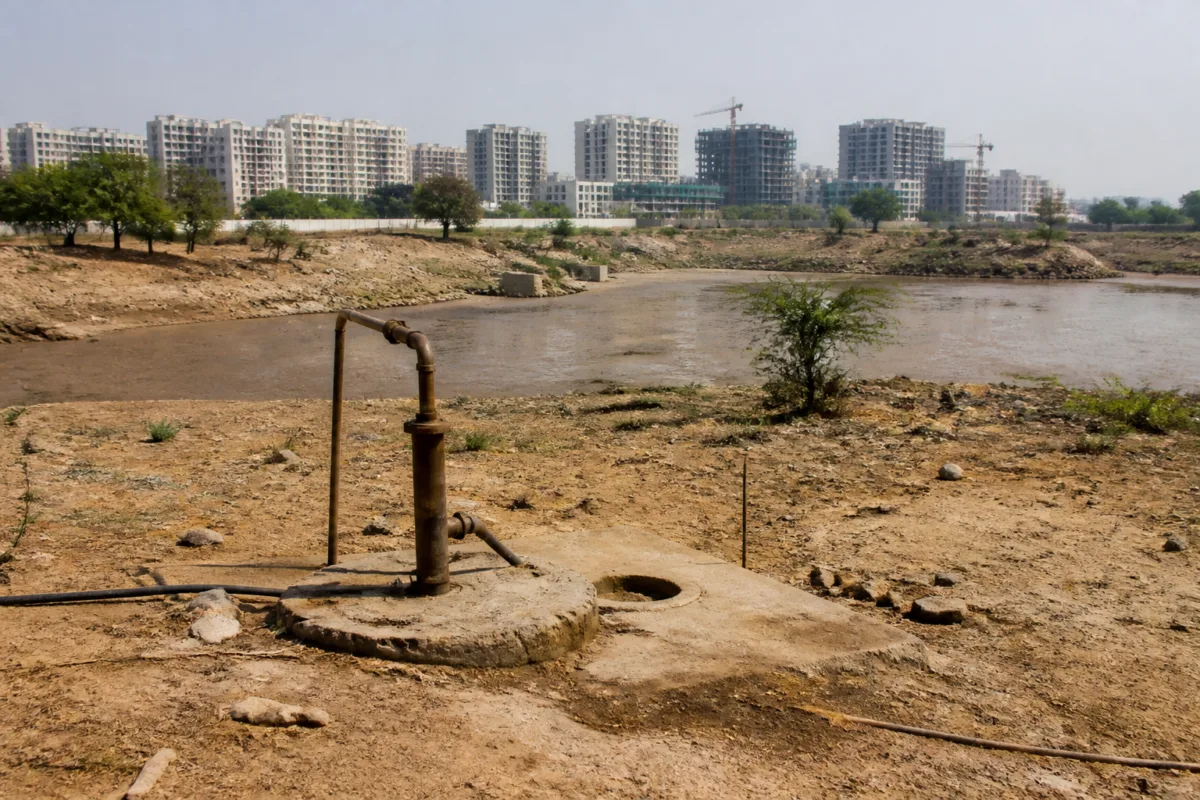
Telangana groundwater is falling across most of the State, and the decline is exposing a weakness that conventional water planning often hides: cities, villages and farms are drawing on the same underground reserves without maintaining the landscapes and infrastructure that replenish them. According to figures cited from the Telangana Groundwater Department’s October report, groundwater levels have declined in 554 of Telangana’s 621 mandals. The State’s average water table stands at 7.77 metres below ground level, two metres lower than in the previous October.
The numbers describe more than a seasonal fluctuation. They point to a water system under pressure from two forces operating together: deficient rainfall and continued extraction for irrigation, drinking water and industrial use. Rainfall determines how much water can enter the ground, while pumping determines how quickly stored reserves are removed. When recharge falls and extraction continues, the result is a deeper water table, drying wells and a greater dependence on expensive and uncertain borewell drilling.
The crisis is particularly relevant to urban policy because groundwater is not only a rural resource. It supports household supplies, construction activity, institutions and industries, directly or indirectly. As cities expand over areas that once absorbed rainfall, paved surfaces and built-up plots can reduce the opportunity for water to percolate into the soil. The consequences are rarely visible when rain falls, but become evident later through declining wells, tanker dependence and rising costs for households and farms.
The October figures cited by Telangana Today show how sharply the pattern has changed. The area where groundwater is found at depths exceeding 20 metres has expanded from 478 square kilometres to 2,040 square kilometres compared with the ten-year October average. That is more than a fourfold increase in the extent of deeper groundwater. Groundwater has declined in 89 per cent of mandals, suggesting that the problem is spread across the State rather than confined to a few drought-prone pockets.
The rainfall data provides an important part of the explanation. Between June 1 and October 31, Telangana normally receives 831 millimetres of rainfall, but the period recorded only 628 millimetres, a deficit of 24 per cent. Of the State’s 33 districts, only one received normal rainfall, while 22 recorded a deficit. Jogulamba Gadwal had the highest deficit at 50 per cent, followed by Narayanpet at 44 per cent and Nagarkurnool and Nalgonda at 42 per cent.
Rainfall deficit, however, should not be treated as a complete explanation. A dry monsoon can reduce recharge, but the effect on groundwater also depends on how much rain is captured, how quickly it runs off and how much water is extracted afterwards. The supplied report links the decline to the combined impact of lower rainfall, rapid urban expansion, disappearing recharge areas and excessive consumption. This distinction matters because rainfall is a variable outside the control of local administrations, while land use, tank maintenance, recharge structures and extraction practices are shaped by public policy and institutional decisions.
The Hyderabad region illustrates this interaction between urban growth and groundwater stress. In Greater Hyderabad, the average groundwater level reportedly fell by 7.17 metres in one year. In Hyderabad district, the average depth was recorded at 10.62 metres, compared with 6.12 metres in the previous year, a decline of 4.50 metres. These figures do not establish that urban expansion alone caused the fall, but they show why the city’s water security cannot be assessed only through its formal piped-water network.
A city’s water balance includes the water entering its catchments, the water stored in tanks and aquifers, the water supplied through networks and tankers, and the water removed through borewells. If one part of this system weakens, pressure moves elsewhere. A decline in groundwater can increase demand for surface-water transfers or private tanker supply. It can also raise the cost of maintaining buildings, institutions and construction sites that rely on local sources. For residents, the impact may appear as a failed borewell, a longer wait for a tanker or higher household expenditure rather than as a clearly identified groundwater crisis.
The district-level figures show that this is also an economic question. Suryapet recorded the highest annual decline at 6.05 metres, followed by Vikarabad at 5.39 metres, Narayanpet at 5.25 metres, Mahabubnagar at 5.01 metres and Medchal-Malkajgiri at 4.99 metres. The present groundwater depth was cited at 12.80 metres in Medchal-Malkajgiri, 12.44 metres in Medak and 11.90 metres in Rangareddy. In farming areas, a falling water table can turn a functioning borewell into a failed investment. Farmers may respond by deepening existing wells or drilling new ones, increasing financial exposure while adding further pressure to the aquifer.
This creates a collective-action problem. A single farmer may deepen a borewell because the immediate alternative is crop loss or inadequate drinking water. But when many users respond in the same way, the water table can fall further. Individual coping strategies then produce a regional problem. The cost is distributed unevenly: households with more capital may drill deeper, while smaller farmers and poorer families face earlier losses or greater dependence on shared and public supplies.
Telangana’s experience with tanks provides an important institutional context. The article identifies Mission Kakatiya as a major effort during the previous government’s tenure to revive tanks and ponds through desilting, bund strengthening, channel clearance and increased storage capacity. It also refers to watershed development, recharge pits, check dams and rock-fill dams as measures intended to retain rainwater and improve recharge. Such infrastructure can connect surface-water management with groundwater recovery, but its effectiveness depends on location, maintenance, rainfall and the continued protection of catchments.
That last condition is central to the urban dimension. A tank cannot recharge surrounding groundwater if its feeder channels are blocked, its catchment is built over or its storage capacity is reduced by accumulated silt. A recharge pit cannot perform indefinitely without cleaning and upkeep. The report’s observation that a desilted tank will accumulate silt again and a recharge pit will lose effectiveness without maintenance underlines a common weakness in public infrastructure: the visibility of construction is rewarded more readily than the less visible work of operation and renewal.
The policy challenge is therefore not simply to announce more water projects. It is to manage groundwater as part of a connected system involving rainfall, land, tanks, drainage, agriculture, buildings and household consumption. The supplied article points to rooftop rainwater harvesting, vegetation, tree roots, crop choices, drip irrigation and more disciplined water use as complementary measures. These interventions operate at different scales, but they share a requirement for regular monitoring and enforcement.
For urban administrations, the implications include protecting recharge areas, maintaining lakes and feeder channels, and ensuring that development does not eliminate the surfaces through which rainwater enters the ground. For rural administrations, the challenge includes aligning cropping and irrigation practices with local water availability. For households and institutions, conservation measures can reduce demand, but they cannot replace public management of common aquifers. Groundwater is shared underground even when extraction happens through individually owned or privately installed borewells.
The comparisons in the source article with Marathwada, Rajasthan, California and parts of the Middle East show that groundwater depletion is not unique to Telangana. But comparisons also need to be read carefully because geology, rainfall, cropping patterns, regulation and urban form differ across regions. The common lesson is narrower and more defensible: groundwater decline becomes harder to reverse when extraction expands faster than recharge and when maintenance is treated as an occasional activity.
The evidence supplied here confirms a broad and serious decline, including deeper groundwater across a much larger area, substantial rainfall deficits and pronounced falls in parts of Hyderabad and surrounding districts. It does not establish the precise contribution of each cause, nor does it provide a current assessment of the performance of individual conservation projects. Those questions require detailed aquifer-level monitoring, land-use data and transparent reporting on extraction and recharge. What is already clear is that Telangana’s water security cannot be separated from the condition of its tanks, open spaces, drainage networks, farms and built-up areas. Groundwater conservation will have to function as permanent urban and rural infrastructure rather than as a short-term response to a failed monsoon.

