


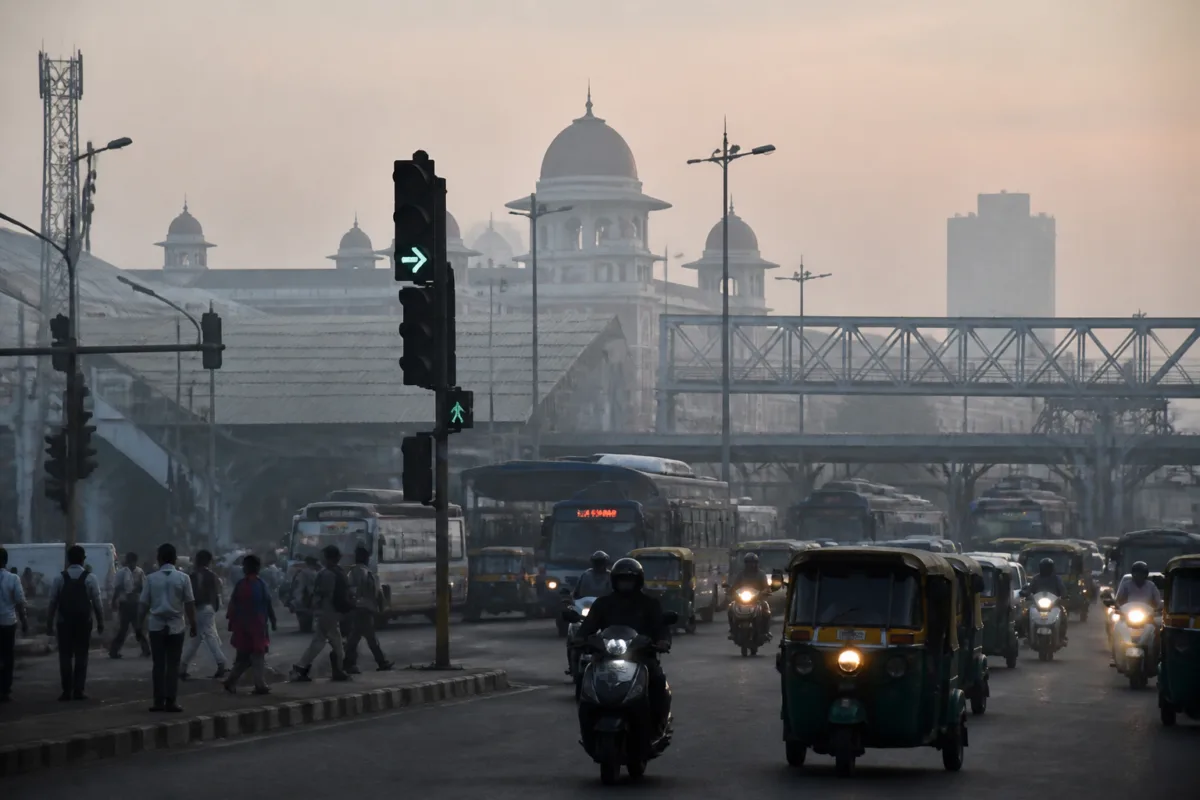
Bengaluru’s air quality moved from the satisfactory to the moderate category after Deepavali fireworks, with the citywide Air Quality Index rising from 53 on Saturday to 129 on Monday and reaching 228 at KSR railway station in Majestic. The readings show that the festival’s pollution impact was not evenly distributed: transport hubs, congested junctions and dense neighbourhoods recorded substantially worse conditions than the citywide average.
The deterioration also exposes a recurring urban difficulty. Bengaluru’s relatively favourable wind and rainfall conditions can disperse pollutants faster than in some other cities, but that does not remove the short-term exposure faced by people living, working or travelling close to busy roads and crowded public spaces. The available data indicates that local conditions, rather than only the citywide average, are central to understanding the risk.
According to data from the Central Pollution Control Board’s Air Quality Portal, Bengaluru’s AQI stood at 74 at 8pm on Sunday, when the permitted cracker-bursting window began. It rose to 85 by 10pm, when the official window closed, then continued worsening after the stated deadline. The reading crossed 93 by 11pm and reached 102 at midnight, moving the city into the moderate category.
The AQI continued to climb through the night, rising by about three to four points every hour before reaching approximately 133 around noon on Monday, according to the report. The citywide reading later reported for Monday was 129. That progression matters because it shows that the pollution load did not peak when the permitted window ended. It continued accumulating or remained elevated during the following hours.
The comparison with the previous Deepavali provides another measure of the change. On the first day of the festival in 2025, Bengaluru’s AQI was recorded at 82, while this year’s reading reached 102 at midnight. The report describes this as a nearly 25% increase. The city’s AQI had otherwise remained largely stable during the first week of November, fluctuating between 53 and 74 after touching 91 on November 1.
The most severe readings were recorded at specific urban locations. At 8am on Monday, KSR railway station in Majestic recorded an AQI of 228, with PM10 as the dominant pollutant. Silk Board, one of the city’s busiest junctions, recorded 152 based on PM2.5. Hombegowda Nagar registered 139, Jayanagar 5th Block 135 and Hebbal 121, with PM10 dominant at Hebbal.
These figures underline the limitations of relying on a single citywide AQI number. Bengaluru’s overall reading can remain substantially below Delhi’s peak of 370 while residents at a railway station, major junction or traffic corridor experience conditions in the poor category. A citywide average can therefore conceal sharp differences in exposure between neighbourhoods and daily travel routes.
The locations in the CPCB readings also connect the festival pollution episode to the way Bengaluru functions. Majestic is a major railway and public transport hub. Silk Board is a heavily congested junction. Hebbal is a traffic corridor. The data does not establish that traffic alone caused the readings at these places, but it shows that the worst recorded conditions were concentrated around places where large numbers of people move through or spend time in the open.
Air-pollution expert Dr Manisha Mishra, assistant professor at Azim Premji University, said fine particles released from crackers and other combustion sources remain harmful to human health, particularly for people living or travelling near busy traffic corridors. Her comment places the readings in a ground-level context: exposure is shaped not only by the city’s overall air quality but also by where people are when pollution levels rise.
The pollutant mix varied by location. PM10 was dominant at Majestic and Hebbal, while PM2.5 was dominant at Silk Board, Hombegowda Nagar and Jayanagar 5th Block. The supplied data does not provide separate concentration values for each pollutant or establish the precise contribution of fireworks, traffic and other combustion sources at each monitoring station. It does, however, show that particulate pollution was the defining feature of the post-Deepavali readings.
The official response points to an enforcement problem as much as an environmental one. Karnataka forest, environment and ecology minister Ramalinga Reddy told The Times of India that pollution levels were relatively low in 2025 because it had rained and fewer people burst crackers. He also said police, who had the mandate, should have acted against people bursting crackers beyond the permitted hours.
That account is consistent with the time-based pattern in the CPCB data. Air quality worsened after the official window closed, although the available material does not identify how many fireworks were used after the deadline or how many enforcement actions were taken. The evidence therefore supports a clear sequence of readings but does not by itself measure the effectiveness of policing or establish that late bursting was the sole reason for the continued rise.
Karnataka State Pollution Control Board chairperson B Shivanna described the enforcement challenge in broader terms. He said strict restrictions could lead to accusations that authorities were anti-tradition or anti-religious, while also arguing that the city as a whole contributes to the problem and that no single person can be blamed. His comments reveal the institutional tension between regulating a one-day activity and securing compliance across a large, dense city.
Unlike a pollution source that can be traced to one industrial facility, fireworks are dispersed across thousands of locations and time periods. That makes accountability more difficult. It also means that enforcement depends on public compliance, police presence, clear operating windows and the capacity to respond when violations occur. The material supplied does not provide enforcement figures, ward-level action reports or details of the penalties imposed, leaving those parts of the administrative response unmeasured.
The episode also complicates the idea that weather can protect Bengaluru from festival pollution. The report notes that wind and rain help disperse pollutants faster than in other cities. Yet the rise from 53 to 129 in the citywide AQI, along with the 228 reading at Majestic, demonstrates that favourable dispersion conditions do not prevent significant short-duration pollution episodes. They may influence how long pollutants remain concentrated, but they do not make the emissions harmless.
Bengaluru’s comparison with Delhi should therefore be treated cautiously. The city’s readings were lower than Delhi’s peak, but that comparison does not answer whether Bengaluru’s own air was safe at the locations where people were most exposed. The relevant urban question is not simply whether one city performed better than another. It is whether public authorities can prevent predictable, seasonal spikes from reaching poor levels in transport hubs and neighbourhoods.
The available evidence confirms three points. First, Deepavali fireworks coincided with a significant deterioration in Bengaluru’s air quality. Second, the impact was especially severe at selected urban nodes, including Majestic, Silk Board and Hebbal. Third, the pollution continued to worsen after the permitted bursting window, raising questions about compliance and enforcement that the supplied data does not fully answer.
Further assessment would require ward-level monitoring, detailed enforcement records and pollutant readings over a longer period before and after the festival. Until those are available, Bengaluru’s post-Deepavali data offers a precise warning without supporting broader claims about the city’s annual pollution burden. The immediate administrative milestones are the continued monitoring of the affected locations and the enforcement response to fireworks used beyond the permitted hours.

