


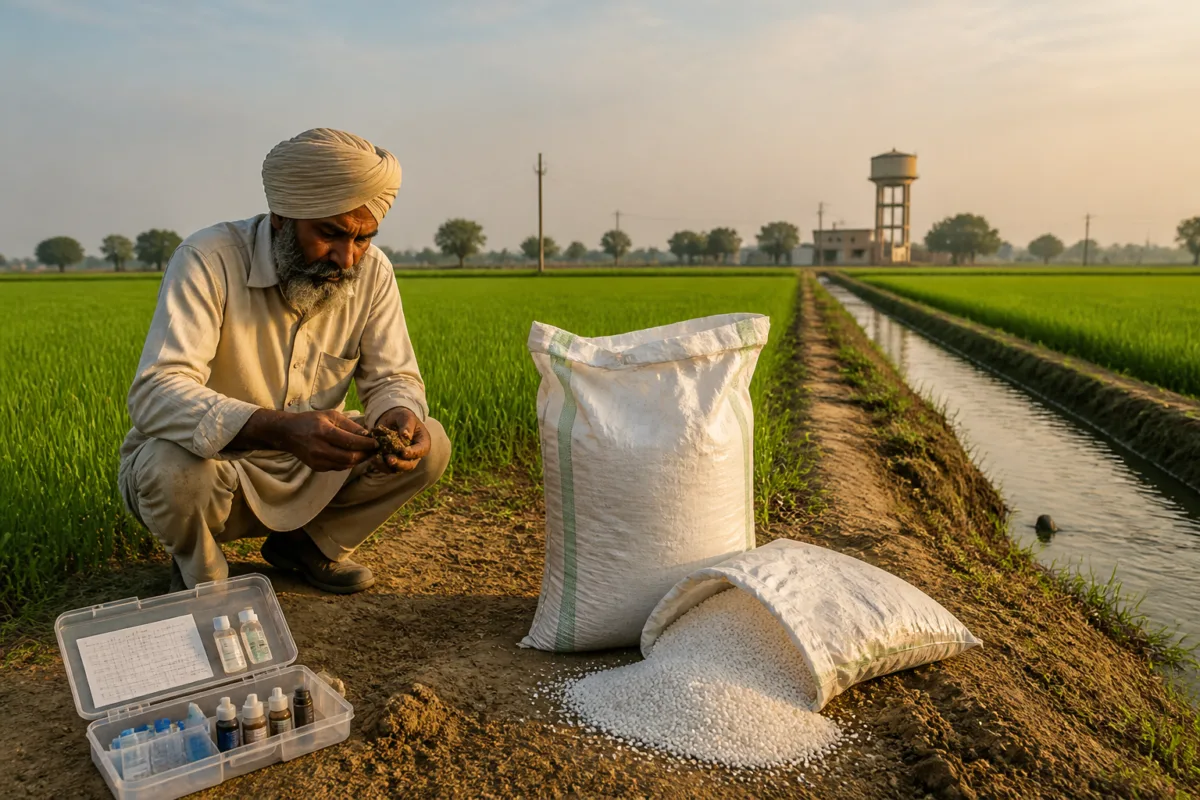
India’s fertiliser subsidy system is designed to keep farm inputs affordable, but a new Climate Trends study argues that the policy is shifting substantial costs away from farmers and onto the public exchequer, the environment and the country’s energy system. Its findings connect an artificially low fixed price for urea with declining fertiliser efficiency, soil degradation, groundwater contamination and exposure to global fuel and geopolitical shocks.
The study, titled ‘The Economics of Cultivation’, examined fertiliser-intensive wheat and paddy cultivation across eight states. It found that, in every wheat case studied, the social return was 36% to 182% lower than the direct financial benefit to farmers after fiscal and environmental costs were included. In two of the five wheat cases, the social return became negative.
That distinction is central to understanding India’s fertiliser challenge. Farmers are responding to the price structure created by policy rather than independently choosing an economically irrational input. Because urea remains artificially cheap, nitrogen application is encouraged even when the wider costs of production, import dependence, greenhouse gas emissions, soil deterioration and groundwater damage are not reflected in the price paid at the farm gate.
The result is a subsidy system that protects one visible part of cultivation economics while leaving other costs dispersed across government budgets, natural resources and future agricultural productivity. The Climate Trends report does not argue that chemical fertilisers should simply be eliminated. Instead, it presents fertiliser use as a question of pricing, efficiency and transition support.
The evidence cited in the report points to a long decline in the productivity of fertiliser use. The quantity of grain produced per kilogram of fertiliser applied fell from 13.4 kg in 1970 to 2.7 kg in 2015. The figures indicate that higher or continued input use has not produced a proportionate increase in output. The study also cites national soil-testing results showing low nitrogen levels in 97% of samples and low organic carbon levels in 85% of samples, despite widespread nitrogen over-application.
This apparent contradiction—more nitrogen use alongside low soil nitrogen readings—reflects the difference between applying an input and maintaining soil health. Fertiliser can supply a crop with nutrients during a growing cycle, but the condition of the soil also depends on organic carbon, nutrient balance and the way water and nutrients are retained. The supplied report does not establish that fertiliser alone caused every soil result, but it presents the findings as evidence that current application patterns are not delivering durable efficiency.
The groundwater dimension adds a public-health and infrastructure concern. Nitrate levels above the BIS drinking-water limit have been recorded in groundwater in Punjab, Haryana, Rajasthan, Uttar Pradesh and Tamil Nadu, according to the report. Once groundwater quality deteriorates, the consequences extend beyond the farm. Rural water systems, treatment requirements and household access to safe drinking water can all be affected, although the supplied study does not quantify those costs.
The policy problem is also tied to the global energy market. Synthetic nitrogen fertiliser depends heavily on natural gas, making production costs sensitive to international fuel prices and disruptions in energy corridors. Shreya Jai, energy lead at Climate Trends, described India’s fertiliser challenge as an energy-security issue because domestic production capacity does not remove exposure to fuel price volatility, geopolitical disruption or import dependence.
The report uses the Strait of Hormuz to illustrate that vulnerability. When the waterway effectively closed in February 2026, urea prices rose 53.7% in one month to around US$726 a tonne, a four-year high. India obtains 41% of its crude oil, 55% of its liquefied natural gas and up to 90% of its liquefied petroleum gas through the Strait of Hormuz, according to the report. Fertiliser plants were capped at 60% to 70% of normal gas supply, while domestic urea output fell by 0.8 million tonnes in March.
India avoided a shortage by drawing down stockpiles and adding 6.9 million tonnes of domestic urea and 1.8 million tonnes of imports within three months. However, the report says the cost was absorbed by the exchequer without reducing import dependence. The episode therefore exposed a distinction between availability and resilience: supplies can be maintained in the short term through inventories, production adjustments and imports, while the underlying vulnerability to energy shocks remains.
A similar pattern appeared in 2022, when the Russia-Ukraine war disrupted global nitrogen and potash supplies. The comparison matters because it shows that the issue is not limited to one geopolitical event. Fertiliser prices and subsidy requirements can become unstable when energy and shipping systems are disrupted, even if Indian farmers continue to receive inputs at controlled prices.
Palak Balyan, the study’s lead author and research lead at Climate Trends, said the hidden costs of chemical fertilisers included soil degradation, declining soil health, environmental damage, energy dependence and the fiscal burden on the exchequer. Aarti Khosla, founder-director of Climate Trends, said the response should involve greater awareness, efficient application and a gradual shift towards bio-based inputs and organic farming rather than the elimination of fertiliser use.
That distinction is important for policy design. A sudden removal of support could increase cultivation costs and create risks for farm incomes and food production. But maintaining a price signal that encourages excessive nitrogen use also carries costs that are not visible in the retail price of urea. The policy challenge is to alter consumption patterns without transferring the entire burden of adjustment to farmers.
The report presents partial organic substitution as one possible route rather than treating full conversion as the only alternative. It cites international evidence that organic production is 22% to 35% more profitable after accounting for price premiums, despite yield losses of 10% to 18%. It also says the premium required to break even can be as low as 5% to 7%. These figures are presented in the supplied report as international evidence, and their applicability would depend on crop, market and certification conditions in India.
The timing of the transition is a practical obstacle. Costs begin when a farmer changes cultivation practices, while any certified organic price premium may arrive only after a two- to three-year certification period. This creates a gap that markets alone may not close. Farmers who cannot absorb lower returns during the transition may continue using the existing input system even if alternative methods offer better long-term economics.
Indian trial data cited in the report provides a more incremental example. An ICAR-IIFSR experiment at Modipuram found that plots using 50% to 75% organic substitution matched the yields of fully organic plots, outperformed fully chemical plots and generated Rs 53,200 more profit per hectare than chemical plots. The result, as reported, supports a mixed transition rather than an immediate requirement for farmers to become fully organic.
The institutional implications extend beyond the agriculture department. Fertiliser pricing and subsidy decisions sit alongside energy procurement, import management, soil testing, groundwater monitoring and climate policy. A subsidy that is assessed only through the quantity of fertiliser supplied or the immediate benefit to farmers will not capture the full system cost identified by the study.
The report’s findings also connect rural production with wider urban concerns. Cities depend on stable food supply chains, public budgets and reliable water systems. If fertiliser shocks raise cultivation costs, the effects can move through food prices and government expenditure. If nitrate contamination expands, the burden can reach drinking-water infrastructure and household treatment systems. These links do not mean that the study quantifies an urban cost, but they show why fertiliser policy is part of the broader built and environmental system rather than a narrowly agricultural issue.
The data does not establish that every form of chemical fertiliser use produces a negative social return, nor does it provide a complete fiscal comparison of all possible alternatives. It does, however, identify a recurring mismatch between private farm economics and public costs. The strongest evidence concerns wheat and paddy cultivation, selected states, declining fertiliser efficiency, reported groundwater nitrate exceedances and exposure to energy disruption.
The larger question is whether India’s subsidy framework can move from making fertiliser cheap to making cultivation resilient. The Climate Trends study suggests that the present system is protecting an immediate price signal while leaving energy, environmental and fiscal risks outside the calculation. The next policy milestones will be whether fertiliser consumption is rationalised, whether transition support reaches farmers before certification premiums arrive, and whether soil and groundwater indicators are incorporated into decisions that have traditionally focused on input availability and crop output.

