


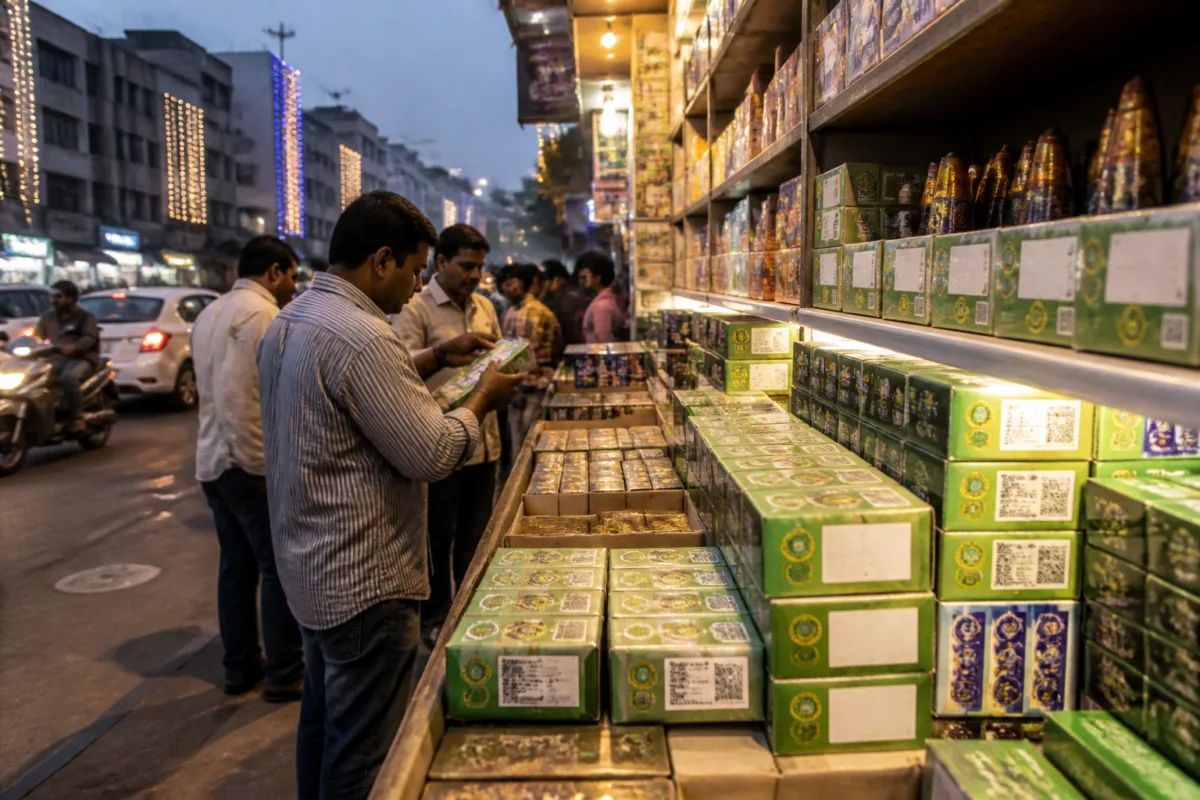
Delhi’s estimated ₹300 crore Diwali-season cracker market has exposed a problem that cannot be solved through court orders alone: the absence of a reliable system to verify what consumers are actually buying and burning. The Chamber of Trade and Industry, or CTI, said licensed shops sold crackers under the green-cracker requirement, while traders and buyers still faced difficulty distinguishing certified products from conventional ones.
The issue matters because the legal framework depended on a chain of institutions and commercial checks working at the same time. The Supreme Court permitted only CSIR-NEERI-certified, QR-coded green crackers in Delhi-NCR. Retailers were expected to source products from registered brands and consumers were expected to identify legal products through packaging and QR codes. But according to the report, the system did not provide buyers in Delhi with a testing facility that could independently verify those claims.
That gap left the most important part of the regulation—the identity of the product—largely dependent on labels and supply-chain assurances. CTI chairman Brijesh Goyal said packages carrying descriptions such as “green”, “eco-friendly” and “pollution-free” were found at ground level, while consumers had no practical method to test whether the products were genuinely compliant. The distinction between a certified green cracker and a conventional cracker therefore became difficult to establish at the point of sale.
The reported sales estimate also shows the scale of the administrative challenge. CTI estimated that crackers worth approximately ₹300 crore were sold in Delhi during the Diwali season. Most traders reportedly ran out of stock a day before Diwali, and buyers travelled to Gurugram, Noida, Faridabad, Ghaziabad and Sonipat after supplies in Delhi were exhausted. The movement of buyers across the National Capital Region made enforcement a regional issue rather than one limited to Delhi’s municipal boundaries.
The report also said traders recorded sales around 30 per cent higher than the previous year. That figure is presented as a trader estimate, not as an independently audited market statistic. Even so, the reported shortage is important because it shows how demand can quickly overwhelm a tightly restricted and time-bound supply chain. When permission and licensing arrive late, compliant stock may not reach shops in sufficient quantities before the short festival sales window closes.
This is where the difference between regulation on paper and regulation in the market becomes visible. A rule can specify the permitted product, but enforcement also requires timely permissions, licensed sellers, traceable manufacturers, adequate inventory and a verification tool that works for ordinary consumers. The CTI account suggests that several of these links were weak or delayed during the season.
The legal requirement appears to have influenced consumer behaviour. According to the report, many buyers specifically asked for green crackers with QR codes because they knew these were the only legally permitted products. This indicates that the court’s direction was not invisible to the market. Consumers were responding to the rule, and licensed retailers were attempting to sell within it. The difficulty was that awareness did not automatically provide certainty.
Traders told the publication that they were sellers, not chemists. They said they purchased from NEERI-registered brands and checked the QR code on the packet. That approach places considerable reliance on the upstream supply chain and on the authenticity and usability of the packaging. It also reveals an institutional mismatch: retailers may be responsible for selling only approved products, but they may not have the technical capacity to validate the chemical composition or certification status of every item.
The problem was further complicated by the continued use of conventional crackers. The report cited a survey according to which around half of the families in Delhi-NCR who burst crackers used both green and traditional varieties. The survey details, including its sample size and methodology, are not provided in the supplied material, so the figure cannot establish the overall scale of non-compliant use. It does, however, point to a central enforcement difficulty: partial compliance can coexist with substantial demand for products outside the permitted category.
The distinction between Delhi and the wider NCR is also significant. Buyers reportedly travelled to neighbouring cities after Delhi shops ran out of stock. Delhi, Gurugram, Noida, Faridabad, Ghaziabad and Sonipat operate as a connected urban market even though licensing and enforcement responsibilities are divided across jurisdictions. A restriction applied in one administrative area can therefore be weakened if supply, purchase or use is easily shifted across the metropolitan region.
That does not by itself prove that products bought outside Delhi were illegal, nor does it establish that all such purchases avoided the green-cracker requirement. The supplied report does not provide seizure figures, inspection data, laboratory results or an official account of cross-border enforcement. What it does show is that the market geography is broader than the territory governed by a single agency.
The season’s sequence, as described by CTI, also raises a planning question. The organisation attributed the disorder to a short sales period, delayed licensing, late permissions, inadequate stock and the absence of QR verification. If those conditions recur, the outcome may again depend less on the formal standard than on how early the system begins preparing for demand. Licensing is not only an enforcement instrument; it also determines how much compliant supply can legally enter the market and how long retailers have to distribute it.
There is a further accountability question around the ₹300 crore estimate. CTI said the figure represented total cracker sales in Delhi, while acknowledging that there was no officially audited breakdown showing how much was certified green and how much was conventional. This means the headline number cannot be used to measure either legal compliance or the volume of emissions. It is a market estimate, not an environmental audit.
The absence of an audited product-level record limits what policymakers can conclude. Without reliable information on the volume sold, the proportion certified, the number of inspections, the number of violations and the results of laboratory testing, it is difficult to assess whether the regulation reduced the use of conventional crackers or merely changed the language on packaging. The report does not supply those figures, and they should not be inferred from sales estimates alone.
The episode therefore highlights three separate responsibilities. Courts can define the permitted standard. Government agencies can issue permissions, licences and enforcement directions. Manufacturers, distributors and retailers must ensure that the products entering the market match the prescribed certification. Consumers can look for the required markings, but they cannot compensate for the absence of an independent verification mechanism.
The regulatory design also has to account for timing. The report says demand rose sharply after the court order and that traders saw a clear rush for green crackers at licensed shops. A late decision or late licensing process compresses procurement, transport and retail into a narrow period. That can produce empty shops even when demand is legal, while encouraging consumers to search for supplies elsewhere. The result is a system in which shortages and weak verification appear together.
Delhi’s Diwali cracker experience does not establish the environmental effect of every product sold during the season. It does establish a governance problem identified by the available evidence: the public was asked to make a legally important distinction, but the market did not provide a simple and independently verifiable way to make it. The next test will be whether authorities publish clearer licensing timelines, strengthen QR verification and create a traceable record of certified sales before the next festive season begins.

