


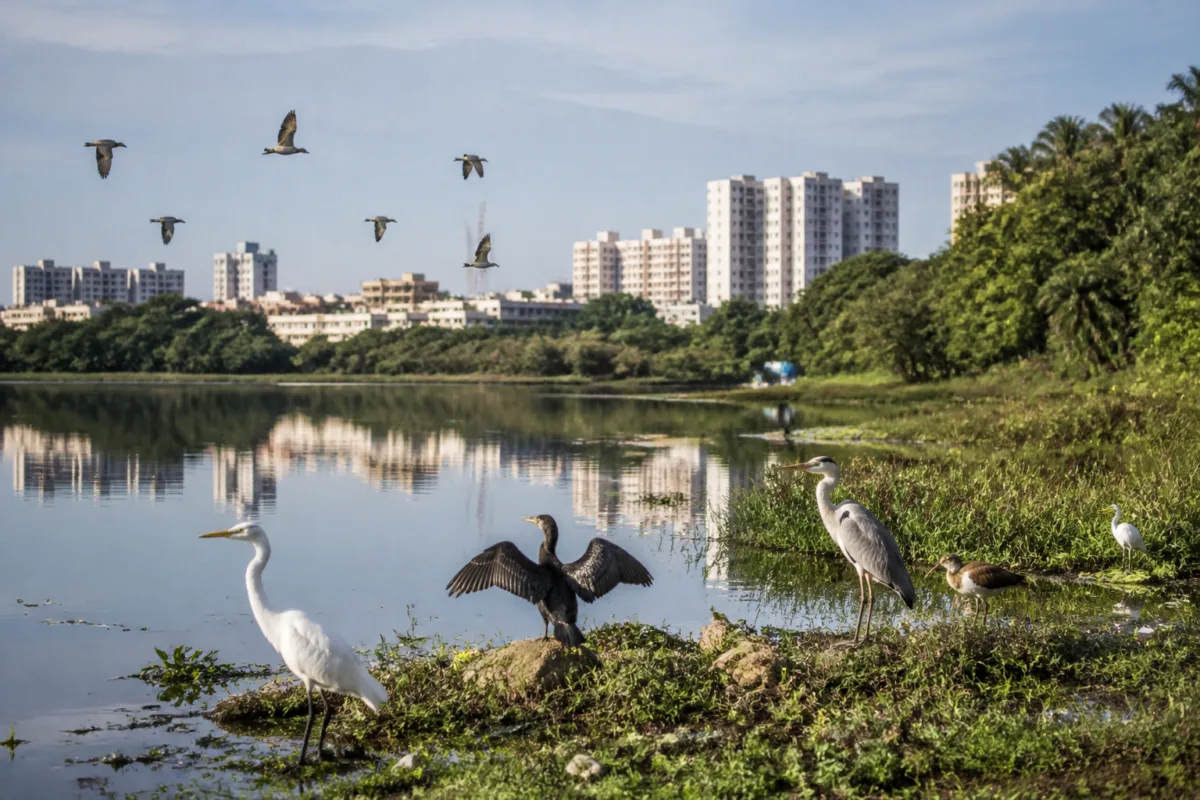
The Karnataka Rajyotsava Bird Count has produced a more complicated picture of Bengaluru than the familiar description of a city overwhelmed by concrete. Bengaluru Urban recorded 241 bird species during the four-day exercise, placing it third among Karnataka’s districts and regions behind Uttara Kannada and Mysuru. The result does not erase the city’s environmental losses, but it shows that substantial bird diversity continues to exist within and around one of India’s fastest-growing urban centres.
The count, which concluded on November 2, was organised by Bird Count India and the Karnataka Bird Monitoring Network in collaboration with the Karnataka forest department and eBird India. It brought together 2,252 birders who submitted 8,223 checklists through the eBird portal. Participants were asked to spend at least 15 minutes watching birds and upload their observations as complete checklists.
That design matters because the exercise was not simply a list prepared by a government department or a professional research team. It was a distributed observation system, relying on citizens to record what they saw across different districts and habitats. The resulting numbers therefore combine ecological presence with the geography and intensity of public participation. Bengaluru Urban had the highest number of birders, at 341, and the highest number of checklists, at 788.
The statewide count recorded 407 bird species. Uttara Kannada recorded the highest district count, with 300 species, followed by Mysuru with 260 and Bengaluru Urban with 241. Kodagu recorded 235 species, Chamarajanagar 237, Udupi 239 and Chikkamagaluru 229. These figures reflect the range of landscapes represented in the exercise, from forested and biodiversity-rich districts to urban and peri-urban areas.
For Bengaluru, the most important finding is not that the city has retained a particular ranking. It is that birds continue to use a fragmented urban region containing waterbodies, tree cover, institutional campuses, residential neighbourhoods, agricultural edges and forest landscapes beyond the built-up core. Vignesh Bhat, one of the coordinators of the count, attributed Bengaluru’s bird diversity partly to waterbodies on the outskirts and the forest landscape along Bannerghatta and Kanakapura Road.
This distinction is central to understanding what a bird count can and cannot establish. A record of 241 species demonstrates that different habitats in Bengaluru Urban still support a wide range of birds. It does not, by itself, show that all those habitats are secure, evenly distributed or ecologically healthy. Nor does it measure how many birds of each species are present, whether populations are increasing or declining, or how development has altered their range over time. The exercise is a snapshot of observed diversity, not a complete assessment of urban biodiversity.
Yet snapshots become valuable when they are repeated and made comparable. The first KRBC creates a baseline against which future counts can potentially be assessed. If similar exercises are conducted with consistent methods, changes in species presence, distribution and participation may help identify which habitats remain important and where ecological pressures are becoming more visible. The supplied findings do not establish such trends yet, but they create the foundation for tracking them.
The count also demonstrates the importance of the urban fringe. Bengaluru’s environmental systems do not stop at municipal or district boundaries. Waterbodies on the outskirts and forested areas along major growth corridors can support species that may not survive in dense neighbourhoods. At the same time, these areas are exposed to the pressures that accompany urban expansion, including land conversion, infrastructure construction and changing patterns of water use. The bird data places these transitional landscapes within the city’s wider ecological geography.
The species recorded during the exercise reinforce this diversity. Common birds documented across Karnataka included the Asian koel, ashy prinia, grey heron, great egret, greater coucal, green sandpiper, house sparrow, cormorants, Indian paradise flycatcher, Indian peafowl, Indian roller and rock pigeon. Their presence spans different habitat types, from built-up areas and gardens to wetlands and open land.
Other species were recorded only in select districts. Bengaluru Urban was among the locations where the orange-breasted green pigeon was documented. Bengaluru Rural recorded the eastern marsh harrier, while Chamarajanagar recorded the Indian nuthatch. Udupi and Uttara Kannada accounted for several species found in only one district, including shorebirds, wetland birds and occasional migrants. These observations underline how the state’s ecological variety is distributed unevenly and why a single statewide number cannot describe every landscape.
The count identified 52 species across all 30 eBird regions in Karnataka, with Ballari and Vijayanagara treated as one region. These were described as Karnataka’s “everyday birds”, reflecting their widespread presence and ability to adapt to different habitats. In contrast, 32 species were reported in only one district each. The contrast between widespread and restricted records is one of the most useful analytical features of the exercise: it shows that some birds are relatively adaptable, while others depend on particular ecological conditions or appear only occasionally.
Participation itself is another part of the urban story. Bengaluru Urban produced the highest number of checklists, but the exercise also saw strong engagement from districts outside the state’s largest city. Tumakuru submitted 686 checklists and Chamarajanagar 613. This suggests that citizen monitoring can extend beyond established urban birding communities when it is organised around a defined period, a simple observation requirement and a common digital platform.
The method also brings limitations. More checklists can mean more opportunities to detect species, which may partly explain why Bengaluru Urban led the participation table and recorded a high number of species. A district with fewer observers may have fewer recorded species even if its habitats are diverse. The preliminary results therefore need to be read alongside the distribution of observers, the locations they visited and the habitats covered. The supplied report does not provide a standardised effort-adjusted comparison, so the rankings should not be treated as a definitive league table of ecological health.
Still, the institutional structure behind KRBC is significant. Bird Count India, the Karnataka Bird Monitoring Network, eBird India and the forest department brought together public participation, a digital reporting system and an official conservation institution. This arrangement can make urban biodiversity more visible to agencies that typically plan around roads, buildings, drainage, water supply and land use. A bird observation cannot substitute for ecological assessment, but aggregated observations can help identify places that deserve closer attention.
For city governance, the broader issue is whether biodiversity information is connected to decisions about land and infrastructure. The count identifies the presence of birds, while planning systems determine the future of waterbodies, tree cover, road corridors and urban edges. The report does not say that the observations have been incorporated into development approvals or local planning. That link remains unestablished in the supplied material. However, the exercise makes clear that the city’s ecological assets are not confined to formally protected areas.
The Bengaluru result also challenges a binary view of urban nature. The city is neither an intact habitat nor an ecological blank space. It contains surviving and adapted bird populations alongside intensive construction and vegetation loss. That coexistence can be misunderstood in two opposite ways: a high species count can be used to minimise environmental damage, while the image of a concrete jungle can obscure the ecological value of remaining waterbodies, forest edges and everyday habitats.
The evidence supports a narrower but important conclusion. Bengaluru Urban remains capable of supporting substantial bird diversity, and citizens can document that diversity at scale. The 241 species recorded during KRBC provide a baseline and a public record of ecological presence. They do not establish that the city’s habitats are protected, that bird populations are stable or that development pressures have been resolved.
The next value of the exercise will depend on continuity. Bird Count India and the Karnataka Bird Monitoring Network expect the event to attract wider participation in the future, according to coordinator Sahana M. Repeated counts, clearer information about observation effort and closer integration with habitat and planning data would make the findings more useful for urban governance. For now, the first count has shown that Bengaluru’s urban landscape still contains a living ecological network—and that network is visible when the city’s residents are equipped to look for it.

