


Manipur’s deepening mental health crisis is unfolding inside relief camps that were created as temporary shelters but have become long-term living spaces for tens of thousands of people displaced by violence. The Times of India’s reporting from Kangpokpi, Imphal, Mandap and Akampat shows that psychological distress is inseparable from the loss of homes, land, livelihoods, privacy, family networks and any reliable sense of return.
The report, published as the conflict enters its fourth year, describes camps where children are growing up, women are managing households and families are trying to rebuild daily routines in overcrowded halls and makeshift shelters. The central urban question is not only how displaced people are coping with trauma. It is how a relief system designed for emergency accommodation has become a substitute for housing, neighbourhoods, schools, healthcare and livelihoods without the conditions needed to perform any of those functions adequately.
According to the Manipur Commission for Protection of Child Rights, an estimated one in eight people in the state is battling mental illness. The figure is cited in the Times of India report and is presented alongside accounts from officials and a former senior psychiatrist at the Regional Institute of Medical Sciences in Imphal. The report does not establish a separate prevalence rate for displaced residents, but its testimonies indicate that displacement has intensified the pressures facing families already affected by violence and loss.
A senior official in the Imphal administration told the newspaper that people in the camps had stopped hoping and looking forward. A health department official also described rising drug abuse among young people and said that people from relief camps were found intoxicated on roads. The official said authorities tried to help rather than take action against them. These accounts point to a crisis that extends beyond clinical mental-health treatment: distress is appearing in public spaces, in family finances, in substance use and in the ability of young adults to imagine a future.
Dr RK Lenin Singh, former head of psychiatry at RIMS, told the newspaper that children were clinging to parents, waking from nightmares and drawing burning houses on hillsides. He described post-traumatic stress disorder, depression, anxiety and insomnia among displaced people, and said unemployed men in their twenties and thirties were increasingly turning to alcohol or self-medication. His account connects psychological injury to the material conditions of displacement, particularly unemployment and the loss of dignity.
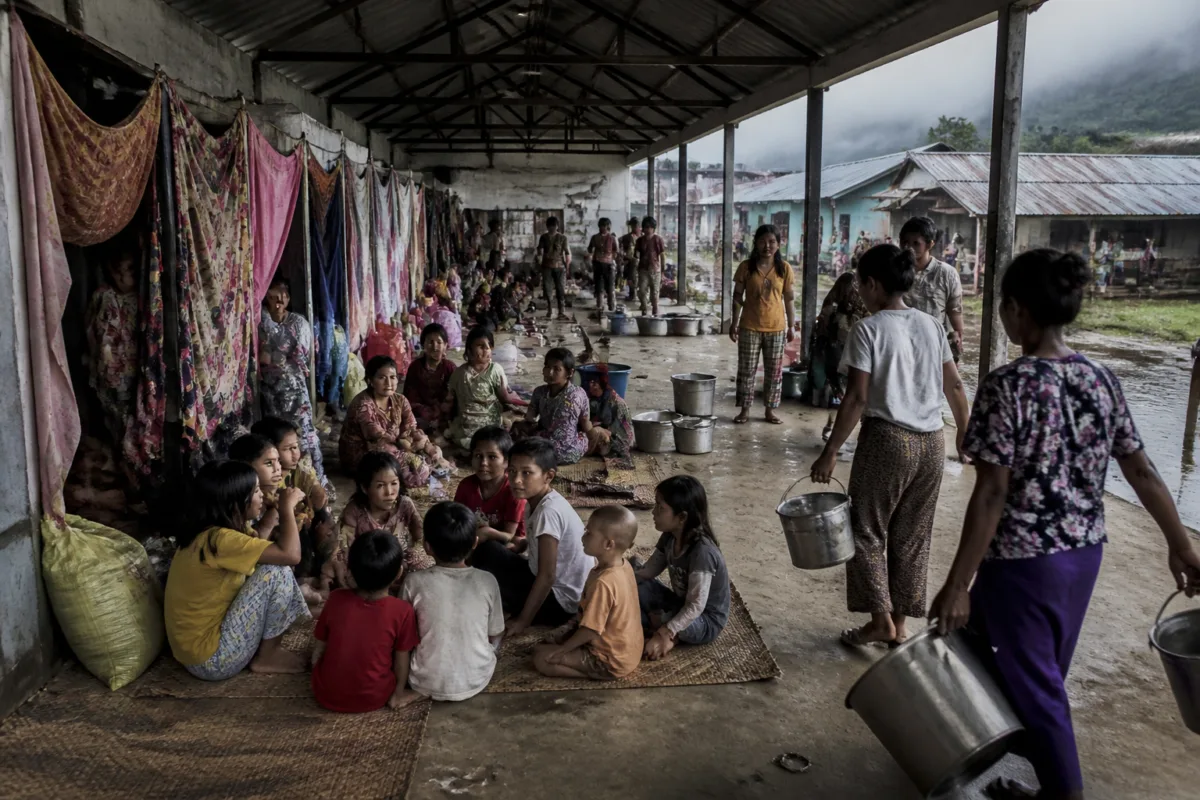
That connection is visible in the camps described by the report. At Mandap, more than 200 displaced Kuki people were living with six toilets. The shelters had sanitation problems and recurring infections, including diarrhoea, while the monsoon worsened conditions. Children attended nearby schools, played together and formed friendships, but families had limited privacy and little space for studying. One child reportedly preferred the camp to field work, while another resident described children being born inside the shelter.
These details matter because a relief camp is not simply a roof over a displaced family. It is also a sanitation system, a water-access system, a childcare environment, a school-access point and a place where people must preserve some degree of safety and privacy. When these functions are weak, the effects accumulate. Poor sanitation can create illness; overcrowding can remove privacy; the absence of work can undermine household income; and prolonged uncertainty can make trauma harder to recover from.
The physical design of the camps described in the report reinforces their temporary character even as residents remain for years. In one Kangpokpi shelter, daylight entered a hall without electric lights, while curtains served as doors. A small Rs 20 lock became the subject of jokes about guarding a home that no longer existed. The image captures the gap between the language of shelter and the lived reality of housing loss. Security is reduced to a symbolic lock, while the residents’ original homes, belongings and neighbourhood relationships remain inaccessible.
The report also shows how displacement has disrupted livelihoods. Phalneivah, a 38-year-old mother of four from Chaningpokpi, left furniture and belongings in her rented Imphal home. Her husband, who had operated small businesses, was now jobless. She said her parents’ house had been burnt and that she had witnessed a relative being beaten to death. Her account also described the collapse of earlier social relationships across the ethnic divide, leaving her unable to return to her former neighbourhood.
This loss of livelihood and social trust is significant for mental health because recovery depends on more than counselling. A person who has lost a home may also lose tools, documents, customers, farmland, employment and access to familiar institutions. A family that cannot return may have no clear information about where it can settle permanently. The supplied report does not provide details of a rehabilitation policy, compensation framework or return timetable. That absence leaves the long-term administrative status of the displaced unresolved in the evidence available here.
The experiences at Akampat, where 115 displaced Meitei families were living at the Ideal Girls College campus, show that the crisis crosses the conflict’s ethnic fault line. Residents there were living in burning tin sheds, collecting water, carrying utensils and working on handlooms outside. A young resident said camp life was harder for women. The observation reflects how displacement reorganises household labour: women must secure water, manage children, maintain food and household routines, and cope with insecurity while living in spaces without ordinary domestic infrastructure.
The camp’s older residents faced an additional burden. Soram Sachi, in her seventies, had lost a daughter who died at the camp after a heart problem. Her son-in-law had been killed in clashes at Moreh, and her daughter-in-law had died in 2024 after the family mortgaged paddy fields for treatment but could not take her to Guwahati. Two children were left without their mothers. Sachi sold candles and incense sticks for Rs 10 each, while her husband, unable to work, depended on their son’s cleaning and daily-wage jobs.
These accounts show that the mental-health crisis is also a care crisis. Bereavement, illness, orphanhood and unemployment are being managed inside camps that have limited space and scarce resources. Families are not only processing violence; they are also caring for children, older people and people with medical needs while trying to earn an income. The report records families who have lost land, mortgaged agricultural fields and depended on informal or low-paid work. It does not establish how many residents have access to psychiatrists, counsellors, medicines or structured psychosocial support.
The institutional response described in the article appears divided between immediate assistance and a problem that has become permanent. Health officials are responding to intoxication and trying to help people found on roads. A former psychiatry chief is documenting symptoms among displaced residents. Camp residents are sending children to nearby schools and creating small livelihoods where possible. But the evidence supplied does not indicate that the camps have been integrated into a broader, publicly detailed plan for permanent housing, employment, healthcare, sanitation and social recovery.
That institutional gap is central to understanding the crisis. Emergency administration can distribute food, provide temporary shelter and manage basic services. Long-term displacement requires a different framework: durable housing, reliable water and sanitation, access to healthcare, education continuity, livelihood restoration and protection for people who cannot safely return. Without those elements, relief camps risk becoming places where the consequences of conflict are stored rather than resolved.
The numbers in the report underline the scale of the problem without providing a complete measurement of it. More than 200 displaced Kuki people were living at Mandap with six toilets. Akampat housed 115 displaced Meitei families. The MCPCR estimate put mental illness at one in eight people in Manipur. The report also records several deaths, children born in camps, recurring infections and rising substance abuse among young people. Together, these figures describe a crisis that combines population displacement with pressure on essential urban and social infrastructure.
Yet the available evidence also has limits. It does not provide a state-wide count of people living in relief camps, a time series of suicide deaths, the number of mental-health professionals serving displaced families, or a comparison of camp conditions across districts. It does not establish whether mental illness has increased by a specific percentage since the conflict began. The accounts are therefore powerful evidence of lived conditions and institutional strain, but they should not be treated as a complete epidemiological assessment.
The broader lesson is that displacement changes the meaning of infrastructure. Toilets, electricity, water points, schools, healthcare facilities and secure doors are not secondary amenities when people live in temporary accommodation for years. They determine whether a camp functions as a safe home, a place of recovery or an overcrowded holding space. In Manipur, the reported mental-health crisis is emerging from the interaction between violent loss and these everyday failures of permanence.
The evidence confirms that residents on both sides of the ethnic divide are experiencing intertwined losses of home, livelihood, family members, dignity and future certainty. It also shows that children are growing up in camps and that some families have already spent several years there. What remains unclear from the supplied report is the scale of formal mental-health provision and the government’s long-term plan for rehabilitation or return. Those questions will determine whether relief remains an interim response or becomes an indefinite condition of life.

