


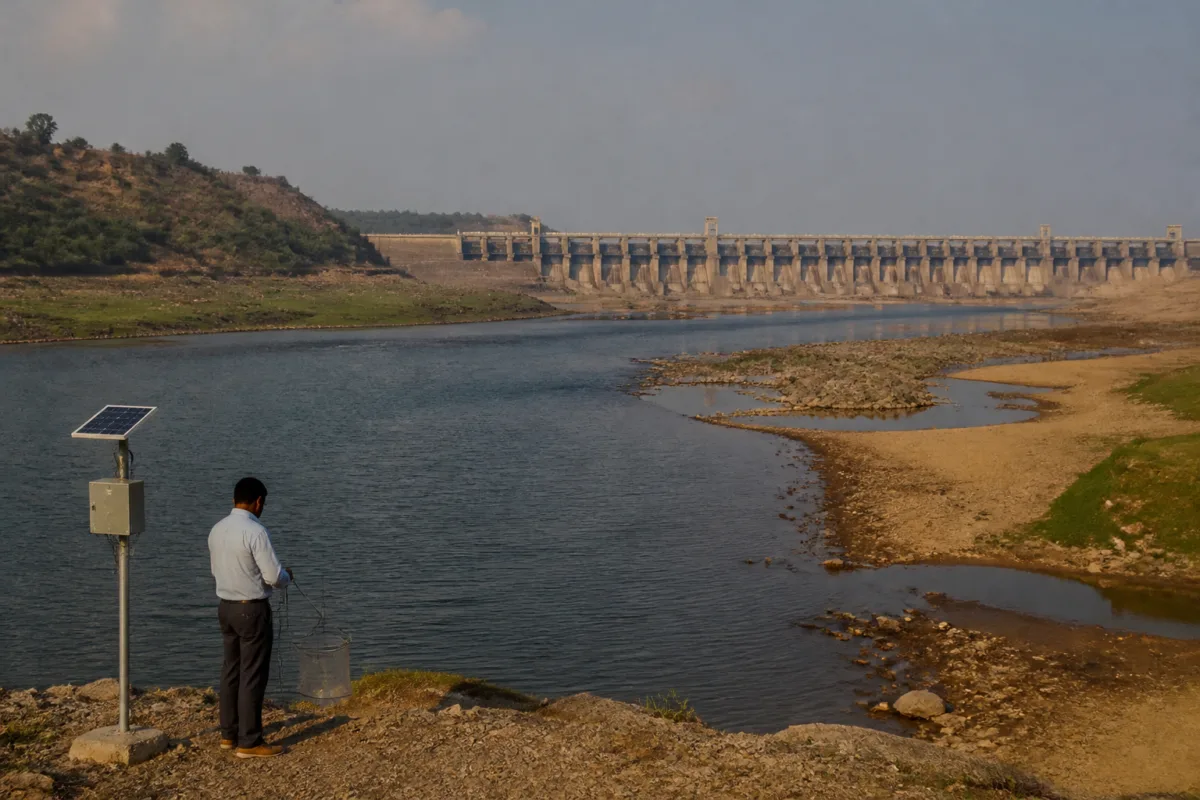
The Mahanadi water dispute has missed the Diwali settlement deadline announced by Odisha, but the negotiations have moved into a more consequential phase: the two states are now examining a Central Water Commission formula that could determine how the river is shared and how much water remains available outside the monsoon season.
Odisha’s technical team met on Saturday to scrutinise the CWC’s draft proposal for sharing Mahanadi waters with Chhattisgarh. A senior Odisha government officer said the states were nearing an amicable settlement, although another 15 days to a month could be required. The official cautioned that the timeline would depend on how quickly the CWC and Chhattisgarh process the proposal.
The missed deadline is significant because it was not an informal expectation. Odisha Chief Minister Mohan Charan Majhi had said on October 1 that a settlement could be reached by Diwali, repeating a timeline he had first indicated on July 30. His statement followed a meeting in Delhi attended by Union Home Minister Amit Shah, Union Jal Shakti Minister C R Patil, Chhattisgarh Chief Minister Vishnu Deo Sai and senior officials.
That meeting placed the dispute within a high-level political and administrative process rather than leaving it only to the tribunal route. Majhi described the talks as a possible model for resolving inter-state river disputes and said the eventual settlement would protect the interests of both Odisha and Chhattisgarh. Shah reviewed the progress made by the CWC, considered the positions of both states and advised them to work towards an amicable agreement.
The present stage, however, shows why an agreement on an inter-state river cannot be reduced to a single deadline. The draft formula is reportedly likely to use Mahanadi flow data cited in the 1948 Detailed Project Report prepared for the Hirakud reservoir, along with certain updates. The flow recorded in that document was estimated at 48 million acre-feet.
Using an older planning document as the basis for a contemporary sharing formula raises a central institutional question: how should historical hydrological records be adapted when states are negotiating present and future water requirements? The supplied report does not specify the proposed allocations or the precise updates to the historical data. That absence is important because the allocation formula, rather than the announcement of an agreement, will determine how the settlement operates in practice.
Odisha, according to sources cited in the report, has largely no reservation over the proposed sharing formula. Its principal concern is adequate non-monsoon flow. This shifts the dispute beyond the question of how much water each state receives in aggregate. It places seasonal availability, river ecology and downstream conditions at the centre of the negotiations.
Non-monsoon flow matters because a river is not only a reservoir input or an irrigation source. Odisha’s stated concern is that sufficient water must continue moving through the river during the drier months to sustain the Mahanadi’s flora and fauna. The report does not provide a proposed minimum flow, ecological assessment or monitoring framework, so it remains unclear how this concern would be translated into enforceable terms under the draft formula.
That gap also illustrates the limits of headline-level settlement language. An amicable agreement may reduce litigation and improve coordination, but its urban and regional consequences will depend on the operating rules that follow. These could include the data used to measure flows, the timing of releases, the agencies responsible for monitoring and the process for responding when actual flows differ from estimates. None of those details has been made public in the supplied material.
The dispute has already lasted a decade, indicating that the challenge is not simply the absence of political contact. It involves competing interpretations of river flows, project requirements and downstream interests, along with the institutional role of the Union government and the CWC. The current process attempts to combine political negotiation with a technical formula, while the Mahanadi Water Disputes Tribunal continues to hear the case.
The tribunal is scheduled to hear the matter next on November 16. That creates a parallel track for the dispute. Odisha and Chhattisgarh are exploring an out-of-tribunal settlement, but the tribunal proceedings remain active. Until an agreement is finalised and its legal and administrative status is clarified, the negotiated process does not replace the formal dispute-resolution mechanism.
The involvement of the CWC is also central to understanding the proposal. The commission is preparing or facilitating the technical basis on which the states are expected to negotiate. Yet the final outcome will require political acceptance by both states and clarity on implementation. A technically acceptable formula can still face delays if either side seeks changes to the underlying data, allocation principles or operational safeguards.
The reported 48 million acre-feet figure from the Hirakud reservoir’s 1948 DPR provides a historical reference point, but the source does not establish whether that estimate reflects current river conditions or how it would be reconciled with present demands. The proposal’s reliance on that figure, with updates, makes the quality and transparency of those updates a major part of the settlement’s credibility.
The Mahanadi water dispute therefore exposes a wider federal challenge in river governance. Inter-state rivers cross administrative boundaries, while their impacts are experienced locally by farmers, communities, ecosystems and settlements. Decisions made through state-level negotiations must account for both the rights claimed by upstream and downstream jurisdictions and the river’s seasonal behaviour.
For Odisha, the immediate concern is not merely whether negotiations produce a document before the next tribunal hearing. It is whether the settlement protects non-monsoon flow in a way that can be measured and maintained. For Chhattisgarh, the significance lies in securing a formula that reflects its position in the dispute and can be implemented without repeated contestation. For the Union government, the talks are a test of whether political mediation and technical assessment can produce a durable inter-state arrangement.
The missed Diwali deadline does not establish that the negotiations have failed. The reported position is that the states are close to a settlement and that a further 15 days to a month may be sufficient. But the delay confirms that the difficult work lies in resolving the finer details rather than announcing a broad political understanding.
What the available evidence confirms is that Odisha is reviewing the CWC’s proposal, that its main stated concern is non-monsoon flow, that the formula may draw on the 1948 Hirakud DPR with updates, and that the tribunal hearing remains scheduled for November 16. The next decisive development will be whether the two states accept a clearly defined sharing arrangement and explain how its ecological and operational safeguards will be implemented.

