


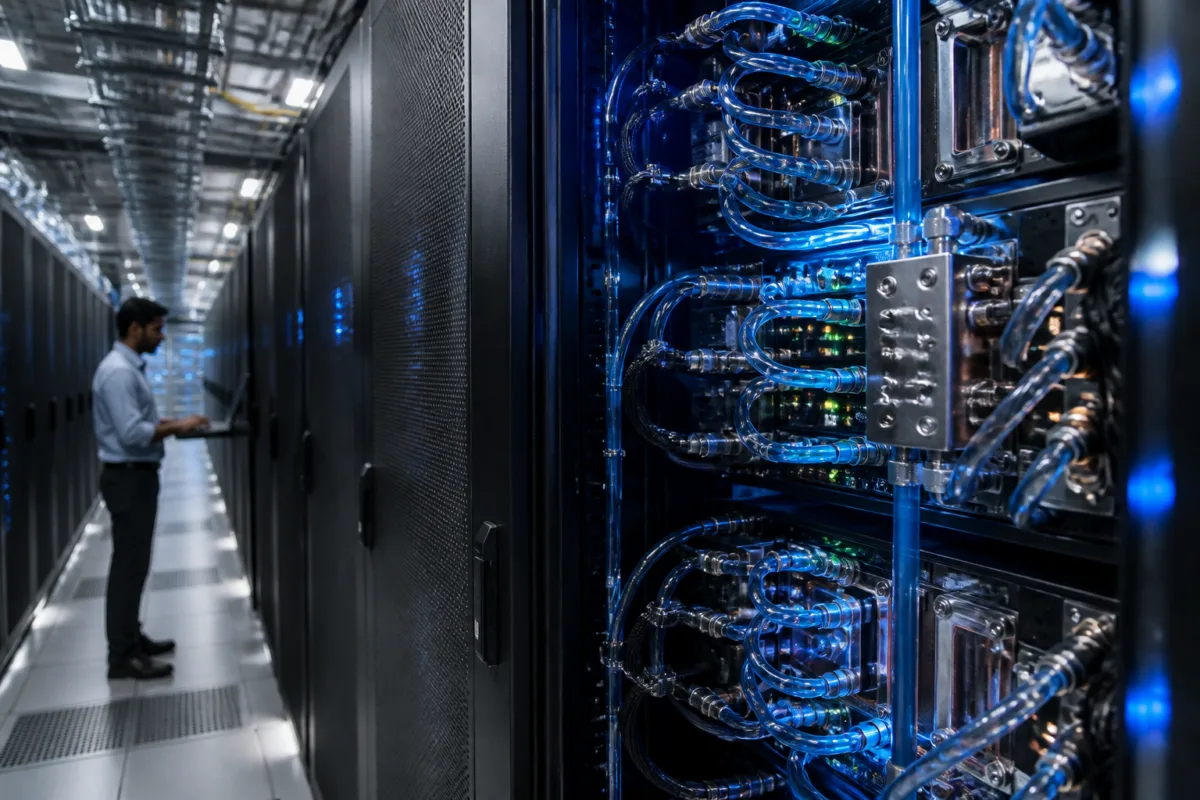
The National Stock Exchange of India has deployed direct-to-chip liquid cooling at its on-premises data centre as it expands the high-density computing infrastructure needed for artificial intelligence applications. The exchange plans to increase its GPU capacity to more than 80 units during the current quarter, while the new cooling system has been designed to support up to 224 GPUs across high-density racks.
The deployment, described by the NSE as a first-of-its-kind installation in Indian capital markets, is intended to support the exchange’s growing use of GPU-based computing across its organisation. Unlike conventional air-cooling systems, direct-to-chip liquid cooling places the cooling mechanism close to the heat-generating computing components, allowing infrastructure to handle higher computing density, according to the exchange’s description of the deployment.
The system has been installed at the NSE’s on-premises data centre, giving the exchange direct control over its AI data, computing resources and access. The NSE said this approach would support its security governance and alignment with applicable regulatory and compliance requirements as the use of AI expands.
The exchange has already deployed multiple GPUs and will scale the environment beyond 80 GPUs in the current quarter. Its cooling infrastructure is planned with a larger capacity of up to 224 GPUs, providing room for future expansion of high-density computing within the data centre.
The move reflects the physical infrastructure requirements created by AI workloads. The NSE said the growing adoption of AI was increasing demand for computing density, power and cooling. Sampath Manickam, chief technology officer at the exchange, said the direct-to-chip liquid cooling system would provide a scalable and energy-efficient foundation for high-density GPU computing and strengthen the NSE’s readiness for the next generation of AI workloads.
Viral Mody, executive director at the NSE, said the exchange’s technology investments were focused on building resilient, scalable and future-ready market infrastructure. He said the liquid-cooling deployment was intended to strengthen operational efficiency, support evolving computing requirements and promote a more energy-conscious technology ecosystem.
The NSE said the installation forms part of a broader effort to build infrastructure for the responsible adoption of emerging technologies at scale. The exchange also said it would extend the direct-to-chip liquid-cooling technology to its co-location data centre in the near future, depending on the requirements of market participants.
The planned expansion places cooling and power management alongside computing capacity as key considerations for the exchange’s AI infrastructure. For the NSE, the immediate milestones are the expansion beyond 80 GPUs during the current quarter and the later extension of the cooling technology to its co-location data centre, subject to market-participant needs.

