


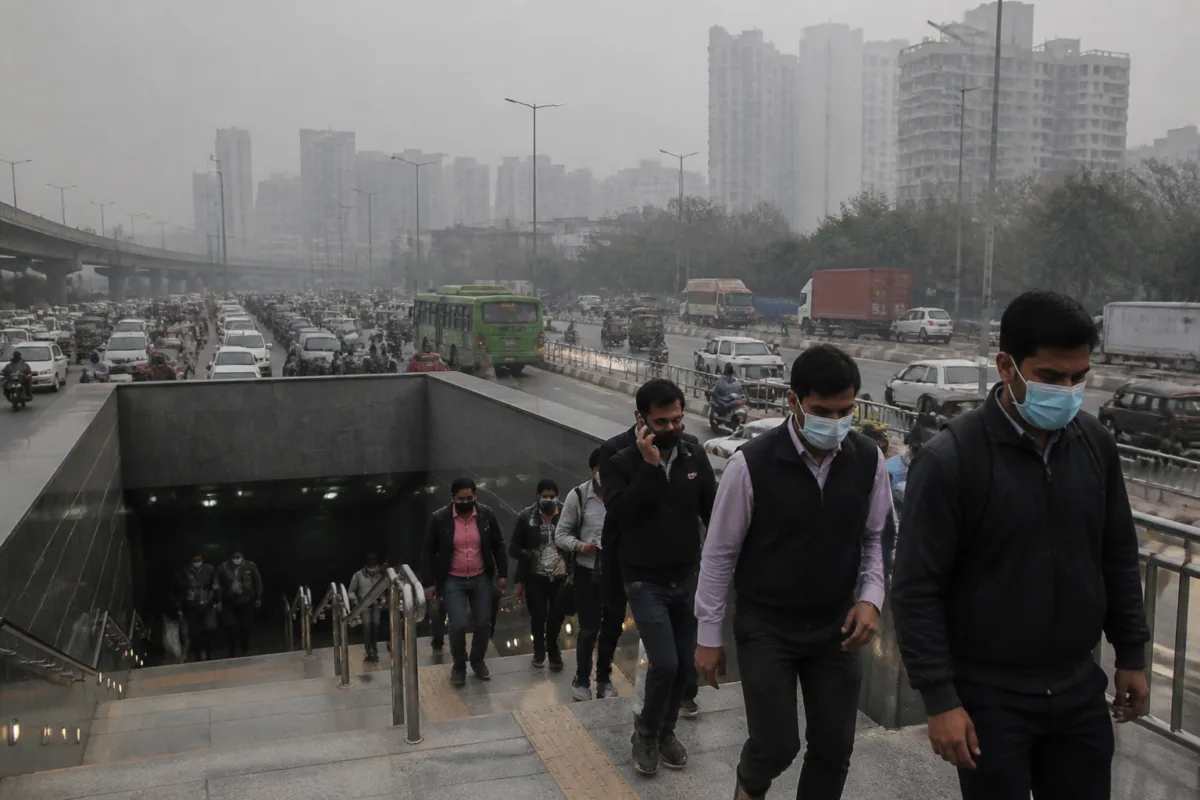
Air pollution is no longer only a public-health emergency for India’s cities. The evidence assembled by the Economic Times shows how hazardous air is increasingly functioning as an urban economic tax, reducing retail footfall, disrupting freight movement, delaying construction and raising operating costs across businesses. The pattern is especially visible in Delhi-NCR, where emergency restrictions are imposed after air quality deteriorates, but the underlying problem extends across cities and regions.
The economic damage does not arrive as one visible shock. It accumulates through shorter trading hours, fewer restaurant visits, delayed deliveries, construction stoppages, lost working time and additional compliance or transport costs. For businesses, this makes pollution different from a one-time disruption. It becomes a recurring operating risk that can affect sales and margins without appearing in company accounts as a single identifiable line item.
The first channel is consumer behaviour. During the previous winter’s peak pollution period, Shoppers Stop managing director Kavindra Mishra told the Economic Times that elevated pollution in northern India had contributed to flat sales in the October-December quarter. Lifestyle International also reported weaker footfall and sales growth in North India. These examples indicate that air quality can influence demand even when shops remain open and supply is available.
Restaurants face a similar problem because dining out requires people to travel and spend time outdoors. A Gurugram-based restaurant-chain founder told the Economic Times that poor air quality was affecting business. Deliveries rose by roughly 15%, but that increase was not enough to compensate for the overall decline in footfall. The figure relates to the previous winter, and comparable numbers for the current year were not available in the report. It nevertheless illustrates the limits of shifting consumption indoors: delivery can replace only part of the value lost when customers stop visiting restaurants.
The consequences extend beyond organised retail and large hospitality companies. During a particularly severe pollution spell in the previous season, Delhi traders told The Times of India that the number of shoppers travelling from other parts of the National Capital Region to the capital had dropped from around 3-4 lakh a day to about 1 lakh. Such a decline affects neighbourhood markets, malls, entertainment venues, high-street retailers and restaurants at the same time. Discretionary businesses are especially exposed because customers can postpone shopping trips and leisure activities. Discounts used to attract them back can then put additional pressure on already fragile margins.
The second channel is the movement of goods. Pollution-control measures can include restrictions on older commercial vehicles, truck entry and inter-state transport. These interventions may be necessary during severe episodes, but they also affect the urban logistics system that moves agricultural produce, food products, construction materials and consumer goods into markets and warehouses.
Delhi’s scale makes the disruption significant. The city handles about 10 lakh tonnes of freight each day through 1.93 lakh vehicles, according to 2025 data cited in the Economic Times report. When transport restrictions interrupt this network, the impact is not confined to truck operators. Small transporters, market traders, retailers, food businesses and consumers can face delayed deliveries, higher last-mile costs or reduced availability of goods. Fresh produce and other time-sensitive supplies are particularly dependent on reliable movement through the city.
This reveals an institutional problem in the way pollution is managed. The same urban system that depends on large volumes of daily freight is often asked to reduce emissions quickly through movement curbs. Without sufficient alternative arrangements, the response transfers part of the environmental cost to businesses and workers. The restrictions may reduce activity temporarily, but they do not by themselves resolve the conditions that make the restrictions necessary each year.
Construction is another major transmission point. Delhi-NCR construction bans affect more than developers and large contractors. Cement, steel, bricks, tiles, paint, glass, electrical fittings, sanitaryware, equipment operators, transporters and building-material suppliers all depend on activity at construction sites. When work stops, daily-wage workers and small contractors lose income, while equipment and labour may remain idle.
The disruption can continue after a ban is lifted. Developers need time to bring workers and machinery back to sites, and project schedules may not restart immediately. Delays can raise project costs, disturb delivery commitments and increase financial pressure across the chain. This matters in a region where construction is connected to housing supply, commercial development, manufacturing of building materials and urban employment.
The construction example also exposes the limits of blanket restrictions. A ban that treats all sites or activities alike may reduce dust-generating work, but it can also stop projects that may be complying with pollution-control requirements. The Economic Times report points to an alternative approach based on continuous dust monitoring, covered materials, mechanised cleaning and significant penalties for violations. It also identifies the possibility of exemptions for verified non-polluting construction or industrial activities where restrictions are unavoidable.
The wider pollution cycle is produced by several sources: vehicle emissions, industrial activity, construction dust, waste burning and crop-residue burning. Weather conditions such as low wind speeds and temperature inversions can trap pollutants close to the ground. This combination creates a recurring sequence: air quality deteriorates, emergency curbs are imposed, economic activity is disrupted, and the cycle returns in the following season.
The scale of the economic risk is reflected in a recent FICCI-EY report cited by the Economic Times, which estimated that air pollution could cost India as much as 9.5% of GDP annually when productivity losses, healthcare spending and premature deaths are considered. The report does not present this as a direct measure of the losses caused by a single pollution episode. Rather, it captures the broader economic burden of poor air quality and shows why the issue cannot be addressed only through short-term city restrictions.
The policy response currently combines the Graded Response Action Plan, vehicle restrictions, construction bans, road-dust controls and action against polluting industries. These measures are designed to respond to worsening conditions, but the report identifies gaps in enforcement and coordination between states. A city’s air does not follow administrative boundaries, and freight, industry, transport and agricultural activity are distributed across regions. Measures taken by one authority can therefore be weakened by decisions or enforcement failures elsewhere.
This is particularly important for Delhi-NCR. The region’s transport and construction economy is integrated across Delhi, Haryana, Uttar Pradesh and Rajasthan, while pollution sources can originate beyond the boundaries of the city where the effects are most visible. Coordinating restrictions, enforcement and source-specific interventions requires institutions to work across jurisdictions rather than treat each pollution episode as a local emergency.
The evidence also points to a mismatch between crisis management and infrastructure capacity. A lasting clean-air strategy would require better public transport, cleaner commercial vehicles, expanded electric-vehicle charging infrastructure and peripheral logistics hubs that can keep a larger share of freight traffic away from dense urban areas. It would also require improved waste processing, cleaner industrial fuel, crop-residue management and sustained enforcement.
These interventions are not substitutes for one another. Public transport can reduce dependence on private vehicles, but freight still requires efficient commercial movement. Logistics hubs can reduce the number of heavy vehicles entering dense areas, but they require land, connectivity and reliable transfer systems. Construction controls can reduce dust, but only if monitoring and enforcement are continuous rather than activated during the worst episodes. The urban response therefore depends on coordinated investment in transport, waste, industry, logistics and construction regulation.
The central lesson is that pollution controls have an economic design problem as well as an environmental one. Emergency restrictions are blunt instruments when the underlying sources are not identified and managed throughout the year. They can impose costs on businesses and workers while leaving the structural drivers—vehicle emissions, dust, waste burning, industrial pollution and crop-residue burning—largely intact.
India’s pollution crisis is consequently becoming a test of urban governance. The available evidence confirms that poor air quality is affecting how people shop, dine, travel and work, while also disrupting the movement of goods and the delivery of buildings. What remains less established in the supplied material is the precise annual loss for each sector or city. The developments that warrant monitoring are whether authorities improve inter-state coordination, strengthen year-round enforcement and replace broad emergency bans with verified, source-specific controls.

