


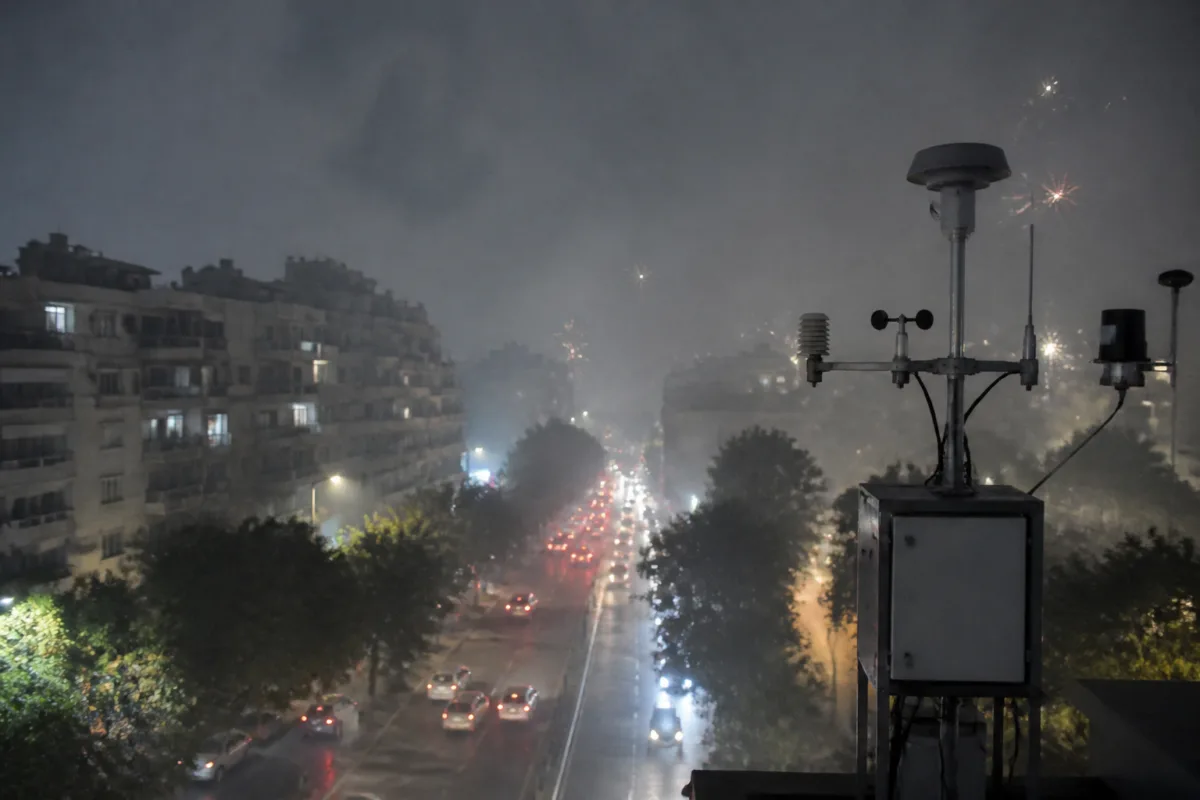
Delhi’s air quality reached its worst point around Diwali, with the Air Quality Index crossing 400 in several areas on the following morning. At the same time, real-time readings from multiple monitoring stations on the Delhi Pollution Control Committee website stopped appearing for several hours, according to a report by Jagran – New Delhi. The overlap has turned a pollution episode into a question about the reliability and transparency of the systems meant to show residents how dangerous the air has become.
The reported interruption involved stations in R K Puram, Nehru Nagar, Mundka, Sonia Vihar and Dwarka. Jagran said the data disappeared from the website on Sunday evening, after readings from some locations had shown pollution rising rapidly. The report also identified R K Puram and Nehru Nagar, near Lajpat Nagar, as among the most polluted areas at about 9 pm. By Monday morning, several parts of Delhi-NCR were recording AQI levels above 400, while dense smog and fog reduced visibility.
The central issue is not only that Delhi’s air deteriorated after fireworks. It is that the public’s ability to observe the deterioration may have weakened at the same time. In a city where pollution warnings influence decisions about travel, outdoor work, school activities and exposure to hazardous air, real-time monitoring is an essential public utility. When data from residential areas disappears, residents lose a direct way to understand conditions in the neighbourhoods where they live.
The report does not establish why the stations stopped displaying readings. It records that the Delhi Pollution Control Committee website stopped providing real-time data from several stations for a number of hours, but it does not include an explanation from the committee, a technical notice, a maintenance record or a statement from another authority. That distinction matters. A monitoring gap can result from equipment failure, connectivity problems, data-processing interruptions, planned maintenance or other causes. Without an official account, the event cannot by itself establish that data was deliberately withheld.
Yet the timing creates a serious institutional concern. The readings reportedly stopped appearing on Diwali evening, when the city was experiencing a predictable seasonal pollution risk and when the public need for timely information was particularly high. The source report describes the interruption as occurring after stations had begun showing a sharp rise in pollution. It also says that some less-polluted areas continued to provide readings, allowing a partial picture of the city’s air to remain visible.
That uneven picture exposes a basic weakness in urban environmental governance: a city may have a network of monitoring stations but still fail to provide a dependable public information system. Coverage is not the same as availability. A station that is installed but does not publish readings during a high-risk period cannot support the same level of public accountability as a station that reports continuously and explains interruptions immediately.
Delhi’s air-quality monitoring is therefore not merely a technical matter. It sits at the intersection of public health, municipal administration, regulatory enforcement and citizen rights to information. The Delhi Pollution Control Committee is among the agencies responsible for pollution-control functions in the capital. The report also refers to Supreme Court directions and rules concerning pollution and fireworks. Those directions create an enforcement context, but the supplied material does not detail the specific order, the compliance mechanism or the action taken by individual agencies during the reported episode.
The distinction between monitoring and enforcement is important. Real-time stations measure and display pollution; they do not, by themselves, prevent fireworks or control emissions. Enforcement requires several institutions to act on rules, restrict prohibited activity, respond to violations and communicate the consequences. But monitoring provides the evidence base for that system. If data is incomplete, delayed or unavailable, the public and authorities have less information with which to assess the scale, timing and location of a pollution spike.
The reported sequence also highlights the difference between citywide averages and neighbourhood-level exposure. Delhi-NCR is not a single atmospheric space in the experience of its residents. Pollution can vary between residential districts, traffic corridors, industrial areas and locations affected by local weather and emissions. A citywide number may communicate severity, but station-level readings show where residents are facing the worst conditions. The stations named in the report span different parts of Delhi, including R K Puram, Nehru Nagar, Mundka, Sonia Vihar and Dwarka. Their disappearance reduced the granularity of the information available during the episode.
The numbers in the report show the scale of the deterioration without resolving its causes. AQI levels above 400 were recorded in several areas on Monday morning. The report links the worsening air to extensive fireworks on Diwali night and notes that Delhi’s air had already remained poor for about a week. It also describes visibility falling because of smog and fog. These details establish a severe pollution event, but they do not quantify the contribution of fireworks against other sources or provide pollutant-specific readings. Those questions require a fuller official dataset than the supplied report contains.
This limitation is especially relevant when interpreting real-time data. The AQI is a public-facing index, while the underlying monitoring system records pollutant concentrations and station status. A missing AQI value does not automatically mean that pollution was absent or that a station was intentionally switched off. It means the public interface did not display the reading at that time. The difference between a sensor malfunction, a communications failure and a publication failure can be established only through technical logs and an explanation from the responsible agency.
That is why transparency around interruptions is as important as the monitoring network itself. If a station stops transmitting, the system should make the outage visible, identify whether the interruption is technical or administrative, and state when the next verified reading will be available. Without that information, residents are left to interpret a blank screen during precisely the period when they need clarity. The supplied report does not say whether outage notices, backfilled readings or technical explanations were subsequently published.
The episode also raises questions about preparedness. Diwali-related pollution is not an unexpected urban risk. The source says Delhi-NCR’s air had been poor for the preceding week and that agencies responsible for pollution control faced heightened responsibility during the festival. A prepared monitoring system would need to anticipate increased demand for information, maintain station uptime and communicate quickly when individual stations fail. Whether those steps were taken cannot be established from the report, but their absence from the public account is itself a gap in the available evidence.
For residents, the consequences are practical. People use local pollution readings to decide whether to exercise outdoors, keep children inside, alter commuting plans or take precautions at work. This is particularly significant for households living near traffic-heavy or otherwise polluted areas, where citywide averages may understate local conditions. When readings disappear from specific residential locations, the people most dependent on neighbourhood-level information may have the least visibility into their immediate environment.
The governance question extends beyond one Diwali night. Environmental data is useful only when it is timely, continuous enough to reveal changes and credible enough to support decisions. Public agencies can meet the formal requirement of installing monitors while still falling short of the broader requirement to provide an intelligible and dependable public service. The reported interruption shows why the performance of an air-quality system must be judged not only by the number of stations but also by uptime, disclosure of outages and the integrity of published records.
The available evidence confirms three facts: Delhi-NCR experienced a sharp pollution episode after Diwali; AQI readings crossed 400 in several areas on Monday morning; and the Jagran report observed that real-time data from several named stations was unavailable for hours on Sunday evening. It does not confirm the reason for the data interruption, whether the stations themselves stopped operating or only stopped publishing readings, or whether any agency deliberately suppressed information. Those questions require an official technical and administrative explanation.
The next step for public accountability is therefore clear in procedural terms, even if the outcome is not yet known: the Delhi Pollution Control Committee should explain the outage, identify the affected stations and publish the relevant readings or station-status records. Until that information is available, the Diwali pollution episode remains not only a public-health warning but also a test of whether Delhi’s environmental monitoring system can remain transparent when demand for information is at its highest.

