


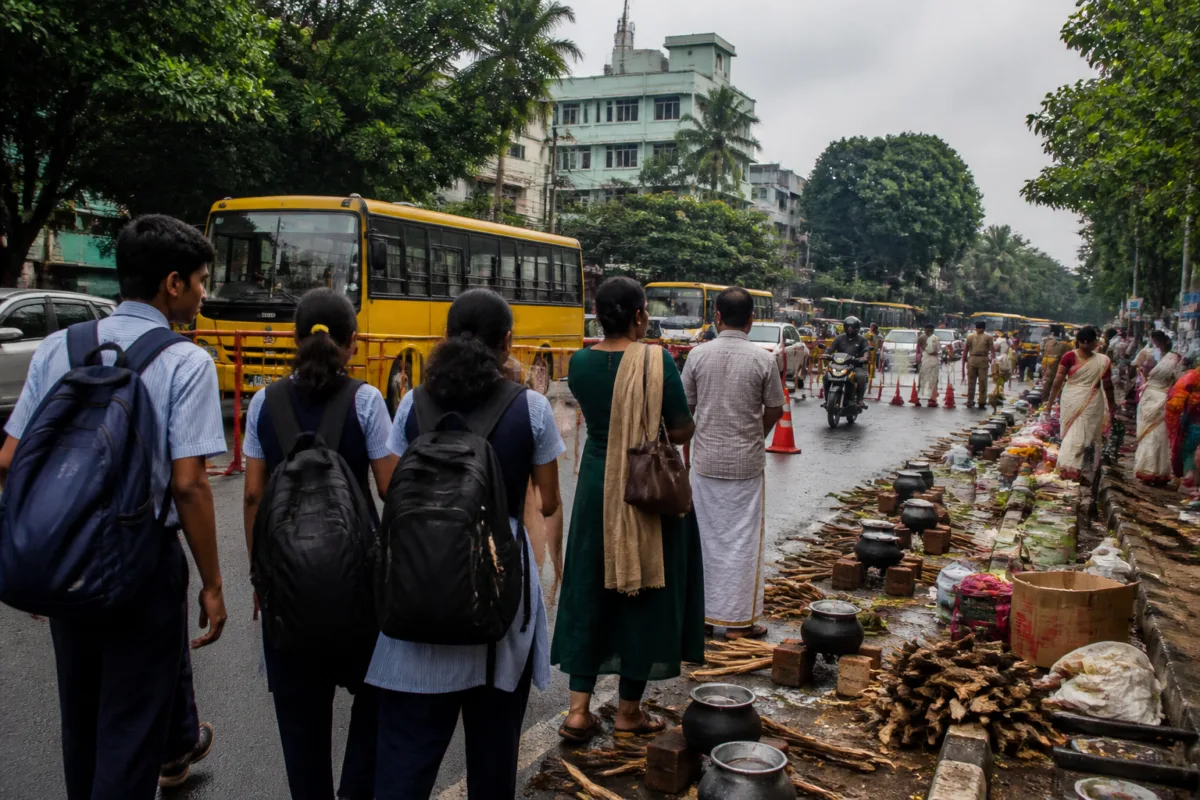
The scheduling of CBSE examinations on Attukal Pongala day has exposed a recurring urban governance problem in Thiruvananthapuram: national systems often operate on uniform calendars, while cities function according to local festivals, mobility restrictions and public-space pressures. The Class X science examination and Class XII examinations in automotive, fashion studies and NCC are scheduled for February 22, 2027, when thousands of women are expected to gather across the city for the ritual associated with Attukal Bhagavathy Temple.
The immediate concern is not the examination timetable alone. It is whether students, school buses, parents and examination staff will be able to move through a city where roads may be blocked, traffic diverted and public transport disrupted. The issue has been raised by parents because the festival is also observed as a local holiday in Thiruvananthapuram, creating a mismatch between the city’s civic rhythm and the national examination schedule.
According to the report by Times of India – Thiruvananthapuram, Attukal Pongala brings large crowds and temporary changes to road access. Several roads may be closed or have limited access, while traffic diversions can affect routes well beyond the immediate temple area. A parent, D S Binulal, said an area within a radius of more than 5km around the temple would be out of bounds and expressed concern about how his daughter would reach her science examination centre.
That concern illustrates why examination access should be treated as an urban mobility question rather than only an education-administration dispute. A student’s ability to reach a centre depends on a chain of systems: the location of the school, road closures, police diversions, bus operations, household travel arrangements and the time allowed for contingencies. If any one of these systems fails, a centrally fixed examination schedule can create unequal consequences for students living in different parts of the city.
The difficulty is intensified by the geography of a citywide festival. Attukal Pongala is not confined to a single venue. Women gather in large numbers across roads and neighbourhoods to prepare the offering, meaning that the event affects public space beyond the temple precinct. The report specifically notes the possibility of road blockages, temporary closures, restricted access and disruption to public transport. These conditions can make an ordinary school journey unpredictable even when the examination centre itself remains open.
The problem also reveals the limits of applying a uniform national calendar without a formal local-access assessment. CBSE examinations are conducted on dates intended to be common across the country. Ibrahim Khan, chief patron of the CBSE schools management association, said the dates are uniform nationally and suggested that schools in Thiruvananthapuram could submit a representation to the CBSE regional office in the city.
That proposed route places the responsibility for resolving a city-level mobility conflict on schools and their management associations. It also raises a question about the timing of coordination. Once an examination timetable is published, schools must identify the conflict, collect representations, approach the regional office and wait for a decision, while families make arrangements around a date that may or may not change. The report does not establish whether a formal representation has already been submitted or whether any authority has committed to altering the schedule.
There are precedents for modifying examination dates when national schedules collide with major local conditions. The report states that CBSE rescheduled examinations in Kerala in 2013 after they clashed with the Onam holidays. In 2017, it revised examination dates in Tamil Nadu when they coincided with assembly elections. These examples show that a standardised calendar is not necessarily inflexible, although they do not establish whether the current Thiruvananthapuram schedule will be changed.
The precedents are significant because they distinguish two separate questions. The first is whether the examination dates can be changed. The second is whether the city can guarantee safe and reliable access if the dates remain unchanged. A decision to retain the schedule would require more than an announcement that centres will operate. It would require clear information about routes, closures, reporting times, transport availability and arrangements for students affected by restrictions.
This is where the issue becomes a test of institutional coordination. CBSE controls the examination calendar and examination rules. Schools manage centres, communicate with students and coordinate staff. Local authorities and traffic agencies manage road access and diversions. Public-transport agencies determine whether buses can operate on affected routes. Families, meanwhile, carry the practical burden of getting students to centres on time. The supplied report does not indicate that a joint operating plan has been announced by these institutions.
The absence of such a plan is especially important because school buses may struggle to operate on the festival day. Parents who normally depend on school transport may have to make individual arrangements. Others may face difficulty dropping children at centres if roads near the temple or along diversion routes are restricted. These are not identical impacts: a family living close to an affected area may face direct access restrictions, while a student travelling from another part of the city may face longer and less predictable travel because of diverted traffic.
The examination subjects involved also matter. The Class X science paper is a core examination for a large group of students, while the Class XII papers listed in the report affect students taking automotive, fashion studies and NCC. The report does not provide the number of candidates or examination centres involved, so the scale of the affected student population cannot be established from the available evidence. Nevertheless, the risk is concentrated around a high-stakes event where late arrival or missed access can have consequences beyond an ordinary school day.
A local holiday adds another layer of complexity. Holidays can reduce routine institutional activity, but a major festival can simultaneously increase demand on roads, public transport, police deployment and public spaces. The city therefore experiences two different forms of scheduling pressure at once: regular educational operations are expected to continue for examinations, while civic activity is reorganised around the festival. The conflict is not simply between a holiday and a school day; it is between two legitimate citywide uses of infrastructure.
The case also highlights a wider weakness in urban planning: event management is often treated as a temporary traffic exercise rather than as a continuity requirement for essential services. Large festivals, elections, processions and emergencies can all alter movement patterns. Schools, hospitals, examination centres and workplaces cannot always be relocated or suspended. Where institutions know that a recurring event creates major access restrictions, the relevant calendars need to be compared before dates become operational commitments.
Attukal Pongala is a recurring event, and the report identifies the scale of its street-level impact through large gatherings, road restrictions and public-transport disruption. That recurrence creates an opportunity for advance coordination. It also makes the conflict less like an unforeseen emergency and more like a scheduling risk that can potentially be identified during planning. The supplied material, however, does not show whether such a formal calendar-screening mechanism exists between CBSE authorities and local agencies.
The historical examples cited by the CBSE schools management association suggest that representations can influence examination scheduling when local circumstances are serious enough. But relying on representations after publication can produce uncertainty for students. Families need definitive instructions, not merely the possibility of a revised date. Schools also need time to arrange invigilation, transport, centre access and communication. Any change would therefore have administrative consequences beyond moving a date on a calendar.
If the date is retained, the core public-interest requirement will be reliable access. That would mean communicating the examination-centre arrangements well in advance and clarifying how students should travel through affected areas. It would also require authorities to identify whether closures are absolute or time-bound, whether examination vehicles receive access and how public transport will function on the day. These operational details are not yet supplied in the report, and their absence is part of the uncertainty facing families.
If the date is revised, the change would demonstrate that national examination systems can accommodate local urban realities when the consequences are clearly documented. It would also create the need for a revised communication chain so that schools, students, parents and staff receive the same information. The 2013 Kerala and 2017 Tamil Nadu precedents indicate that rescheduling has occurred before, but they do not by themselves determine what decision will be taken in Thiruvananthapuram.
The larger urban question is how institutions design access for people who must travel through a city undergoing temporary but extensive transformation. A road closure is not only a traffic-management decision when it affects a student travelling to a fixed examination centre. A public holiday is not only a calendar entry when it changes bus operations and household responsibilities. A national timetable is not fully neutral when local conditions make compliance easier for some students than for others.
For now, the evidence establishes a clear conflict between the CBSE examination schedule and the anticipated mobility conditions on Attukal Pongala day. It does not establish whether CBSE will reschedule the papers, whether schools have submitted a formal representation or what traffic and transport plan will be implemented. The next significant developments are the response from CBSE’s regional office, any representation by schools and the operational directions issued for road access and public transport on February 22, 2027.

