


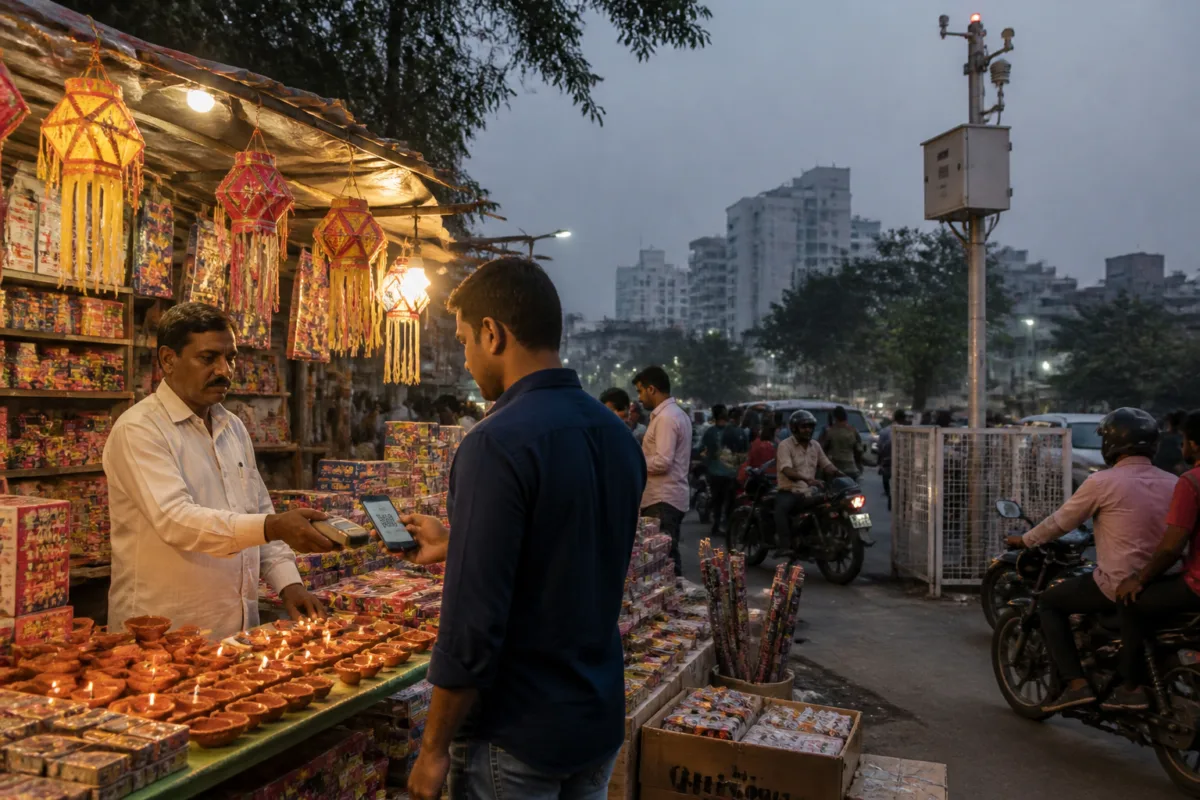
Delhi-NCR Diwali now operates through three systems that were far less visible a decade ago: a digital payments network, a court-defined framework for firecrackers and an air-quality monitoring regime. The festival’s rituals remain familiar, but the machinery around them has changed from cash transactions and customary celebration to QR codes, timed permissions and official pollution bulletins.
That transformation is visible in the Supreme Court’s November 2, 2026 directions. The court allowed certified green crackers in Delhi-NCR on November 7 and 8, but only between 6am and 7am and between 8pm and 10pm. The complete ban returns from November 9. Bursting is also prohibited within 300 metres of hospitals, nursing homes, health centres, old-age homes and notified silence zones.
The order is not an isolated intervention. It is the latest stage in a regulatory process that began after the Supreme Court suspended licences for the sale of firecrackers in Delhi-NCR in November 2016 in the Arjun Gopal case. In October 2018, the court permitted the manufacture and sale of improved and green crackers subject to conditions. In an April 2025 order, it recorded a complete ban in the region on the manufacture, storage, sale and use of firecrackers, citing the pollution situation. The court said any relaxation would depend on scientific evidence showing that green crackers caused the “bare minimum” pollution.
The result is that an activity once governed mainly by custom is now structured through court orders, product certification, licensed sales, designated locations, time windows and restrictions around sensitive institutions. The change also illustrates a wider urban governance problem: Delhi-NCR functions as one connected airshed and metropolitan economy, but its enforcement responsibilities remain distributed across several administrations.
The payment side of the festival has changed just as sharply. The Unified Payments Interface was launched on August 25, 2016, with 21 banks. By FY2025-26, 703 banks were live on the network, according to a PIB release marking UPI’s tenth year. Annual UPI transactions rose from 1.78 crore in FY2016-17 to 24,161.69 crore in FY2025-26. Transaction value increased from Rs 0.07 lakh crore to about Rs 314 lakh crore over the same period.
These are national figures, not measurements of Diwali shopping in Delhi-NCR. They cannot establish how much festive commerce has moved from cash to digital payments or whether neighbourhood markets have gained or lost business. They do, however, show the scale of the payment infrastructure now available during everyday retail transactions, including the small-value purchases that are common during a festival.
In the first half of 2025, person-to-merchant payments accounted for 63% of UPI volume, according to the PIB release cited in the report. Of these transactions, 86% were below Rs 500. That pattern is significant for understanding the street-level experience of festive commerce. A payment system that can process low-value purchases at scale changes the transaction between a customer and a small shopkeeper, even when the goods, market and negotiation remain familiar.
The contrast with 2016 is particularly clear. UPI was still in its first year when Diwali fell that year. The payment network has since moved from a new financial technology to an everyday retail habit. In calendar year 2025 alone, UPI processed about 22,000 crore transactions, or roughly 60 crore a day, according to the government release. The festive shopping bag may still contain diyas, decorations and sweets, but the payment mechanism behind it is increasingly digital.
The air-quality record adds another layer to this changing urban system. On October 30, 2016, the CPCB’s 4pm bulletin recorded Delhi’s AQI at 431, Faridabad at 410 and Gurugram at 317. Delhi was in the severe category. On Diwali 2025, the AQI stood at 345 at 4pm, in the very poor category, according to CPCB data cited by the report. The difference was 86 points.
That comparison cannot be treated as proof that firecracker restrictions alone produced cleaner air. Diwali fell 10 days earlier in 2025 than in 2016, and temperature, wind, humidity and stubble-burning conditions can vary. The two readings also represent different dates and atmospheric conditions. They are indicators of change, not a controlled assessment of the effect of a single policy.
The detailed CPCB record from Diwali 2016 shows why the festival became a recurring subject of environmental governance. At Pitampura, PM10 reached 1,297 micrograms per cubic metre and PM2.5 reached 1,238. At ITO, the readings were 878 and 797 respectively. These were station-level particulate measurements, not citywide averages, and they cannot be directly compared with an AQI value.
Meteorological conditions also mattered. The CPCB report recorded a mean wind speed of 1.3 metres per second on Diwali 2016, compared with 3.4 metres per second in 2015. The Diwali-night mixing height was 152 metres, against 324 metres the year before. These figures demonstrate why air-quality outcomes cannot be read only through the number of crackers sold or burst. Pollution dispersal depends on atmospheric conditions as well as emissions.
The regional geography makes the governance still more complicated. Delhi, Noida, Ghaziabad, Gurugram and Faridabad celebrate on the same dates and share transport, labour and pollution flows, but they do not constitute a single municipal or administrative unit. Different municipal bodies, state governments and pollution-control authorities are involved in enforcement, market regulation, sanitation and environmental monitoring.
This fragmentation affects how residents interpret public information. A Delhi AQI reading cannot automatically represent conditions in Noida, Gurugram, Ghaziabad or Faridabad. Similarly, a restriction issued or enforced in one jurisdiction may not answer questions about sales, compliance or air quality in another. The term Delhi-NCR describes an integrated urban region, but official data and administrative action are often recorded city by city.
The cracker rules also show the layered nature of regulation. The October 2025 framework allowed the sale of green crackers listed on the CSIR-NEERI website from October 18 to 20, and only through licensed traders at designated locations. Crackers brought in from outside NCR were restricted. Barium-based and unapproved products were prohibited, as were laris, serial crackers and online sale and purchase. The 2026 directions retain the broad approach while specifying two daily use windows and restoring the complete ban from November 9.
This framework places several responsibilities on public institutions. Courts define the legal boundaries; pollution agencies provide monitoring and scientific evidence; local administrations oversee markets and enforcement; and different authorities must communicate rules to residents and traders. The effectiveness of the system therefore depends not only on the wording of an order but also on how consistently it is implemented across a region with multiple jurisdictions.
The available record is stronger on regulation and measurement than on household behaviour. It does not establish whether families have changed how they celebrate, whether neighbourhood markets have lost ground to online platforms, or how many traders and consumers comply with restrictions. It also does not explain why air quality was better in 2025 than in 2016. Comparable commercial, mobility, enforcement and household-level data would be needed to answer those questions.
That gap matters because the visible changes around Diwali can otherwise create an impression of a complete transformation without showing how residents experience it. A QR payment confirms a transaction but does not reveal whether a small shop has become more profitable. A court order sets a time window but does not show compliance across every neighbourhood. An AQI bulletin records conditions at a particular time and place but does not by itself identify the contribution of each pollution source.
What the evidence does confirm is narrower and more useful. Over the past decade, the institutional infrastructure surrounding Delhi-NCR Diwali has expanded. Digital payments have scaled dramatically. Firecracker use has moved from a largely customary activity into a court-supervised regulatory framework. Air quality is now an established part of the festival’s official record, with monitoring data providing a basis for public restrictions and debate.
The deeper urban question is how a connected metropolitan region governs activities that cross administrative boundaries. Delhi-NCR’s festival economy, traffic, air and consumer networks operate across cities, while authority remains divided. The annual cycle of court orders, designated markets, enforcement measures and city-specific readings makes that tension visible every year.
The lamps and markets may preserve the continuity of the festival, but the record since 2016 shows that its operating environment has changed. The QR code, the court order and the 4pm bulletin are now part of Delhi-NCR’s Diwali infrastructure. What remains less clear is how effectively those systems work together across the region—and what comparable data will show about the festival’s next decade.

