


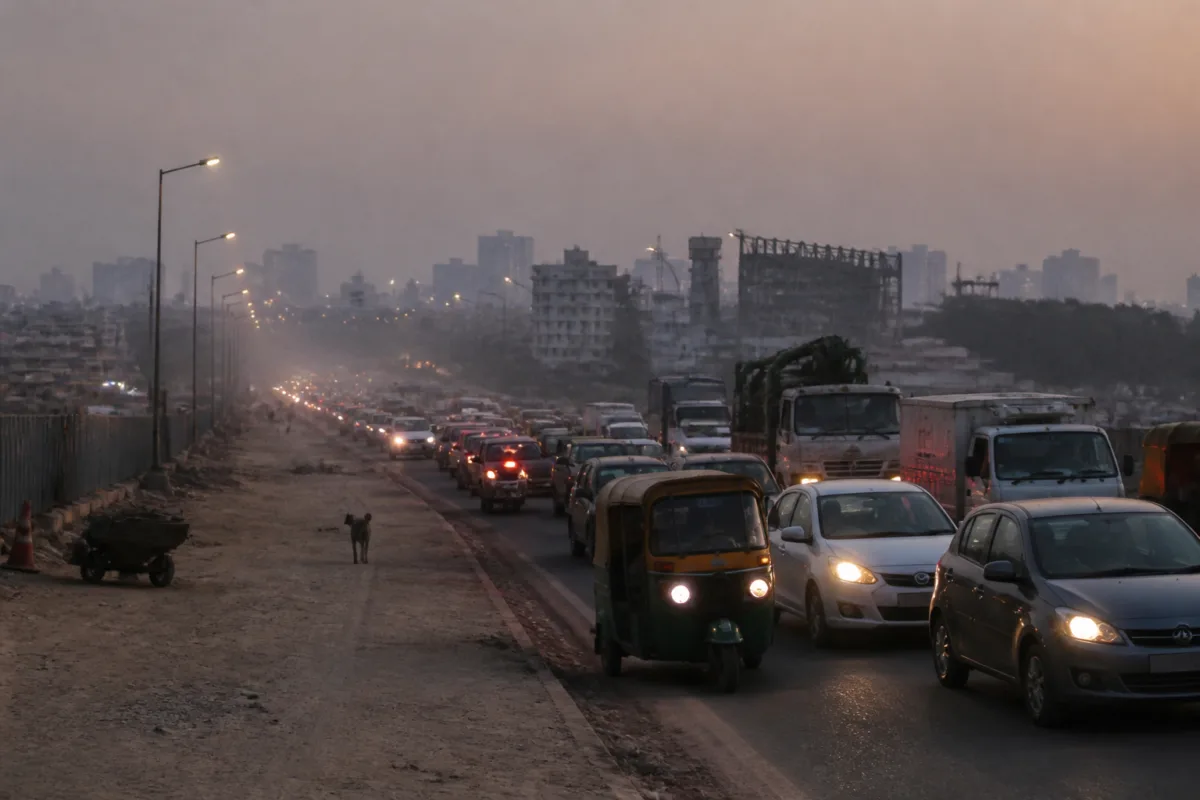
Ahmedabad’s air pollution during the Diwali period is being measured not only through firecracker smoke but also through the city’s everyday traffic, construction activity, road dust and winter weather. AQI readings recorded on 7 November reached 240 near Ahmedabad airport, 239 in Rakhiyal and 232 in Raikhad, according to the report by Divya Bhaskar – Ahmedabad. The figures place the focus on a wider urban system in which festival emissions add to pollution already generated by routine city activity.
The reported readings are significant because they show how pollution can vary sharply across locations within the same city. While Ahmedabad’s AQI was reported at 176 on 7 November, the airport, Rakhiyal and Raikhad areas recorded higher evening readings at 7 pm. The report also noted that Ahmedabad’s AQI had been 175 on 4 November. These numbers describe a city where air quality is not a single city-wide condition but can differ according to traffic intensity, construction, local dust, weather and the concentration of emissions around particular neighbourhoods.
The distinction matters for governance. A city-wide average can indicate the broad direction of air quality, but it does not necessarily show what residents are breathing at a busy road junction, near a construction site or in a densely occupied neighbourhood. The station-level figures cited in the report point to the importance of monitoring locations individually, particularly during periods when emissions from fireworks coincide with low winter-level air movement.
The report explains the winter pollution pattern through the behaviour of air close to the ground. Roads, buildings and bridges release heat accumulated during the day after sunset. According to the explanation cited in the report, this contributes to a layer roughly 50 to 100 metres above the ground that restricts the upward movement of air. Cooler air remains closer to the surface, and pollutants can become trapped in this lower layer rather than dispersing quickly. The resulting accumulation can contribute to smog and fog-like conditions.
This mechanism means that the effect of any individual pollution source depends partly on the atmosphere in which it operates. Firecrackers may release smoke and fine particles during the festival period, but traffic exhaust, construction activity and dust from roads continue throughout the year. When the air is not moving sufficiently, these sources can accumulate in the same lower layer. The urban problem is therefore not limited to a few nights of celebration, even though fireworks can create an additional short-term increase in emissions.
Environmentalist Mahesh Pandya, quoted in the report, said that air quality in large cities such as Ahmedabad requires particular attention during October, November and December. He attributed pollution during the Diwali period to the combined effect of fireworks, vehicles, construction work and dust, while cautioning against treating firecrackers as the only cause of rising AQI. The observation shifts the discussion from festival behaviour alone to the city’s daily emissions profile.
The historical figures cited in the report support that broader view, although the report also says that official station-wise verification is necessary. During the Diwali period between 2021 and 2025, Ahmedabad’s AQI was reported to have ranged approximately from 139 to 254. In 2021, the festival-period AQI was described as being around 250 to 280, while the previous year’s level was reported at about 350. The figures are not directly comparable without details of the monitoring station, date, time and measurement conditions, but they indicate that festival-period air quality has fluctuated substantially.
The report gave comparable ranges for other major Gujarat cities. Surat’s AQI during the Diwali period between 2021 and 2025 was reported at approximately 110 to 195, Vadodara’s at 130 to 215 and Rajkot’s at 115 to 205. These figures should not be read as a simple ranking of city performance because local geography, wind conditions, monitoring locations and the timing of measurements can affect results. The report specifically noted that Surat’s coastal air and wind conditions may influence how pollutants disperse.
Even with those limitations, the comparison demonstrates why pollution control cannot rely on a single statewide response. Ahmedabad’s traffic volumes, construction activity and dust may create a different emissions pattern from Surat’s coastal conditions or the circumstances of another city. Municipal agencies therefore need local monitoring and local enforcement, rather than assuming that a uniform festival advisory will produce uniform results.
The health implications described in the report are concentrated among people who may be more vulnerable to smoke and fine particles. Children, older people, newborns and individuals with asthma or other breathing difficulties may experience greater discomfort when smoke and dust levels rise. Reported effects include eye irritation, throat irritation, coughing and breathing difficulty. These observations underline the need for public warnings and timely access to air-quality information during high-pollution periods.
The issue also exposes a coordination challenge. The report says that the Gujarat Pollution Control Board needs adequate staff and equipment to monitor pollution continuously and provide information that allows departments to respond on time. It identifies the police, municipal corporation, district collector’s office, fire brigade and other departments as agencies that would need to work together on awareness, enforcement and safety.
That institutional arrangement reflects the fact that air pollution is produced and managed across several urban systems. The pollution control authority monitors air quality, the municipal corporation is connected to roads, construction and civic operations, the police may be involved in enforcing restrictions, and the fire brigade has a role in fire safety. If these agencies operate separately, the city may record pollution without translating the information into timely action at the locations where residents are most exposed.
Pandya suggested that Ahmedabad could consider a controlled community celebration at a designated open location and fixed time, citing London’s Wembley area as an example mentioned in the report. Such an arrangement would require local authority approval, fire-safety measures and adequate public safety provisions. The suggestion is presented as an option, not as an announced government policy or an existing Ahmedabad programme. Its practical relevance depends on planning, enforcement and whether the designated arrangement can prevent additional risks rather than merely shift them to one place.
The central evidence in the report is therefore two-fold. Ahmedabad recorded elevated AQI readings in several areas on 7 November, and the city’s festival-period pollution has to be understood alongside routine emissions and winter atmospheric conditions. The reported data does not establish how much of the recorded pollution came from fireworks, vehicles, construction or dust individually. It does, however, support the conclusion that attributing the entire seasonal problem to one source would leave important urban causes unaddressed.
The remaining gap is detailed, station-wise and source-specific information for the reported readings. The report itself says that the cited figures require verification against official monitoring records. That limitation is important because AQI varies by place and time, and broad ranges cannot substitute for a consistent measurement series. What the available evidence confirms is that Ahmedabad’s air-quality challenge intensifies during a period when fireworks, traffic, dust and winter conditions overlap. The next important development is whether monitoring agencies and municipal departments publish and act on location-specific data during the remainder of the festival and winter pollution period.

