


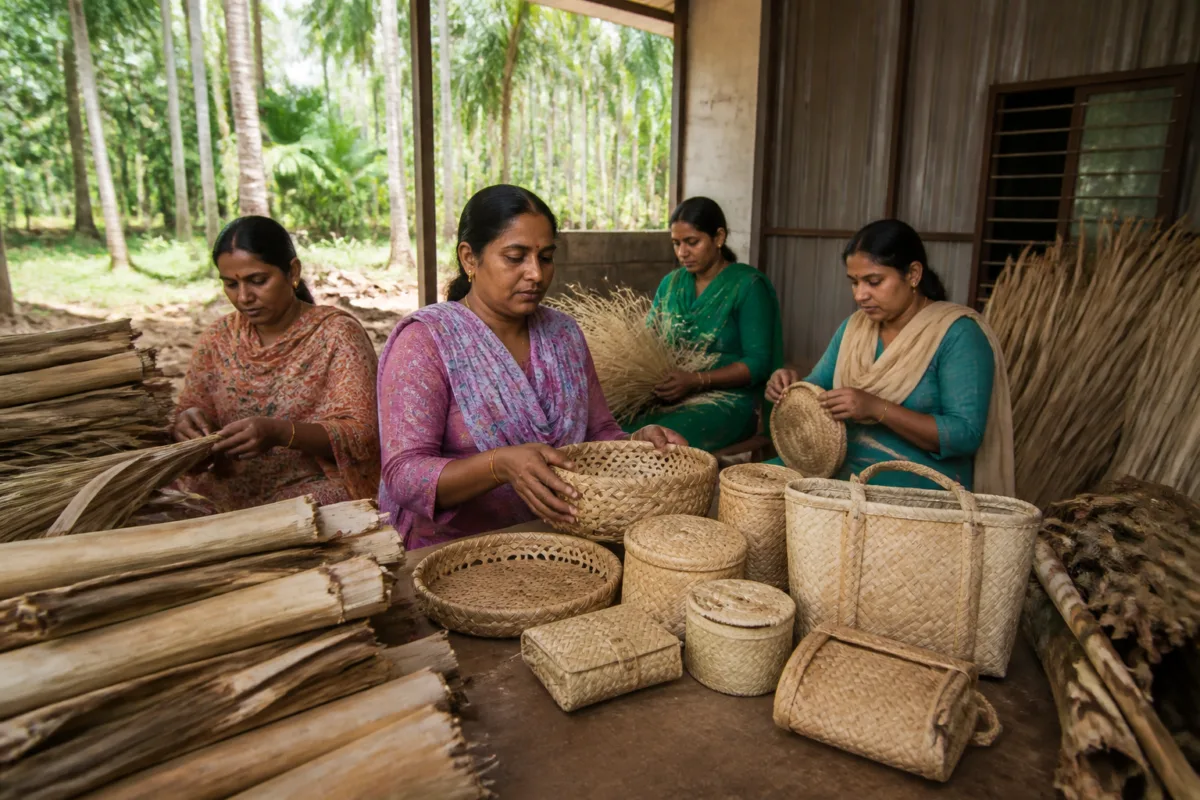
A women-led enterprise in Al etti village, within Karnataka’s Dakshina Kannada district, is converting banana stems that would otherwise be left to decompose or used as fodder into bags, mats, baskets, pouches, household products and other eco-friendly goods. The initiative, reported from Sullia taluk, shows how a crop residue can become a source of income when local institutions connect farmers, self-help groups, skills programmes and a market.
The enterprise is being led by Aruna Kumari along with Ushavathi, Kavitha, Savitha and Shobha. The group is preparing about 40 products from banana fibre, including handbags, mats, bags, dusters, baskets, pouches, decorative items and household-use materials. The range matters because the activity is not limited to processing raw fibre for a single product. It is attempting to create a small local value chain in which agricultural residue is collected, processed and converted into goods for sale.
The report places the initiative in the Al etti Gram Panchayat area and says that members of women’s self-help groups from Al etti, Aranthodu and Sampaje villages are participating. The enterprise therefore operates across a cluster of villages rather than as an isolated household activity. Its reported institutional links include the Deendayal Antyodaya Yojana under the Union rural development ministry, the National Rural Livelihoods Mission, the Department of Skill Development, Entrepreneurship and Livelihoods, the Dakshina Kannada Zilla Panchayat’s Sanjeevini unit, the taluk panchayat’s women-focused empowerment project and the Integrated Agriculture Cluster Livelihood Service Centre.
That institutional architecture is central to understanding the initiative. The reported activity is not simply a product-making project started by a private business. It brings together women’s groups, local government bodies, rural livelihood programmes and a sales channel. The arrangement indicates how enterprise support can work at the village level when training, raw-material access and market access are treated as connected requirements rather than separate administrative tasks.
The raw material is available within the local agricultural system. Farmers in Dakshina Kannada grow banana as an intercrop among areca nut and coconut plantations. After the banana bunch is harvested, the stem is commonly left in the plantation to decompose. The report also says that some farmers cut the stems and place them near areca nut trees to become manure, while others use part of the material as cattle feed. The fibre enterprise introduces another use for the same material before or alongside those existing uses.
This distinction is important. A banana stem is not automatically waste in every farm. It can return to the soil or be used as fodder. The new enterprise adds a commercial pathway to that existing rural resource cycle. Its environmental value, as presented in the report, lies less in claiming that every stem must be diverted into products and more in showing that material traditionally treated as low-value can support additional income when a processing and marketing system exists.
The reported procurement arrangement is direct. The group buys banana stems from farmers’ plantations, paying ₹2.50 per stem. If farmers dry and supply the stems, they receive about ₹250 per quintal. These payments are modest at the unit level, but they establish a formal transaction around material that farmers may otherwise leave in the plantation, use for manure or provide as fodder. The model also makes the cost of raw material visible, which is necessary for assessing whether the enterprise can sustain production beyond initial institutional support.
The group’s leader, Aruna Kumari, told the publication that products made from banana stems are being sold at the Sanjeevini market in Mangaluru and that demand is higher than the group’s ability to supply. This is an important reported signal, but it also identifies the next operational challenge. Demand alone does not guarantee a viable enterprise. The group must be able to secure sufficient stems, process them consistently, maintain product quality, organise production among participating members and meet the requirements of the market.
The market connection changes the character of the initiative. Without a buyer, banana-fibre work would remain a training or demonstration activity. Sales through the Sanjeevini market give the products a route to consumers and provide a setting in which the group can test its product range. The report does not provide sales volumes, revenues, production costs or profit margins, so the financial performance of the enterprise cannot be established from the available material. What can be established is that the activity has moved beyond preparation of products for internal use and has entered a local market.
The initiative also illustrates the administrative importance of aggregation. Individual farmers may have only small quantities of stems after harvesting, while individual women may not have the equipment, skills or market access needed to build a product business alone. Bringing together several self-help groups across Al etti, Aranthodu and Sampaje creates a larger base of participants and raw material. The report does not specify the processing technology or the number of women involved, but it identifies the group structure as the organising mechanism for the enterprise.
For rural local governments, this kind of activity sits at the intersection of several responsibilities. Panchayat-linked programmes can support livelihoods, connect residents to public schemes and help create market access. Zilla Panchayat and taluk panchayat units can contribute institutional coordination, while livelihood missions and skill-development departments can support training and enterprise formation. The reported involvement of multiple agencies suggests that the initiative depends on coordination across departments rather than on one standalone subsidy.
That dependence is also a point of fragility. The article records that the unit is functioning with government support and has contributed to the economic self-reliance of rural women. It does not establish how long the support will continue, whether the enterprise has independent working capital, or whether the group has a plan for equipment replacement, packaging, transport and expansion. These questions are not reasons to discount the initiative; they are the practical measures that determine whether a supported pilot becomes a durable local enterprise.
The story’s broader urban connection lies in the relationship between production villages and urban markets. The products are made in villages in Sullia taluk but sold in Mangaluru through the Sanjeevini market. This links agricultural landscapes, rural women’s labour, local government programmes and urban consumption. The value chain is small, but its geography is significant: material generated in plantations can be processed in a rural cluster and sold in a nearby city without requiring the raw material to move through a distant industrial system.
It also places women’s economic participation within the physical geography of the region. The initiative is built around self-help groups and is led by women who collectively undertake processing and product preparation. The report does not provide individual income figures or employment numbers, so the scale of the livelihood effect cannot be quantified. However, the structure described is clear: women’s groups are using a locally available agricultural material to produce marketable goods, while farmers receive payments for stems supplied directly to the enterprise.
The environmental claim must similarly be read with precision. Banana stems already have uses as organic matter and cattle feed, and the report does not compare the environmental impacts of those uses with fibre processing. It does, however, document a reuse pathway that creates products from material often left in plantations after harvest. The key lesson is not that one use should universally replace another, but that rural resource planning can recognise multiple possible values for agricultural residue.
The evidence currently confirms four elements: a local supply of banana stems, a women-led processing group, a diversified product range and a market connection in Mangaluru. It also records support from rural livelihood and local-government institutions, along with payments to farmers for stems. The evidence does not establish production capacity, profitability, the number of participating members, the quantity of stems processed or the long-term sales performance.
Those missing measures will determine whether the Sullia enterprise remains a promising local example or becomes a replicable model for other farming clusters. For now, the initiative demonstrates a grounded form of circular economy: not a large industrial conversion plant, but a village-level effort that connects agricultural residue with women’s work, public programmes and an urban market. Its next test is whether that chain can maintain quality, supply and income after the initial institutional support and early market interest are no longer sufficient on their own.

