


The Delhi domestic worker abuse case in Shaheen Bagh is not only a report of alleged violence inside a private home. It also exposes how a child can remain outside the ordinary visibility of schools, neighbourhood institutions and labour monitoring systems while being made to work for long hours and kept away from her family.
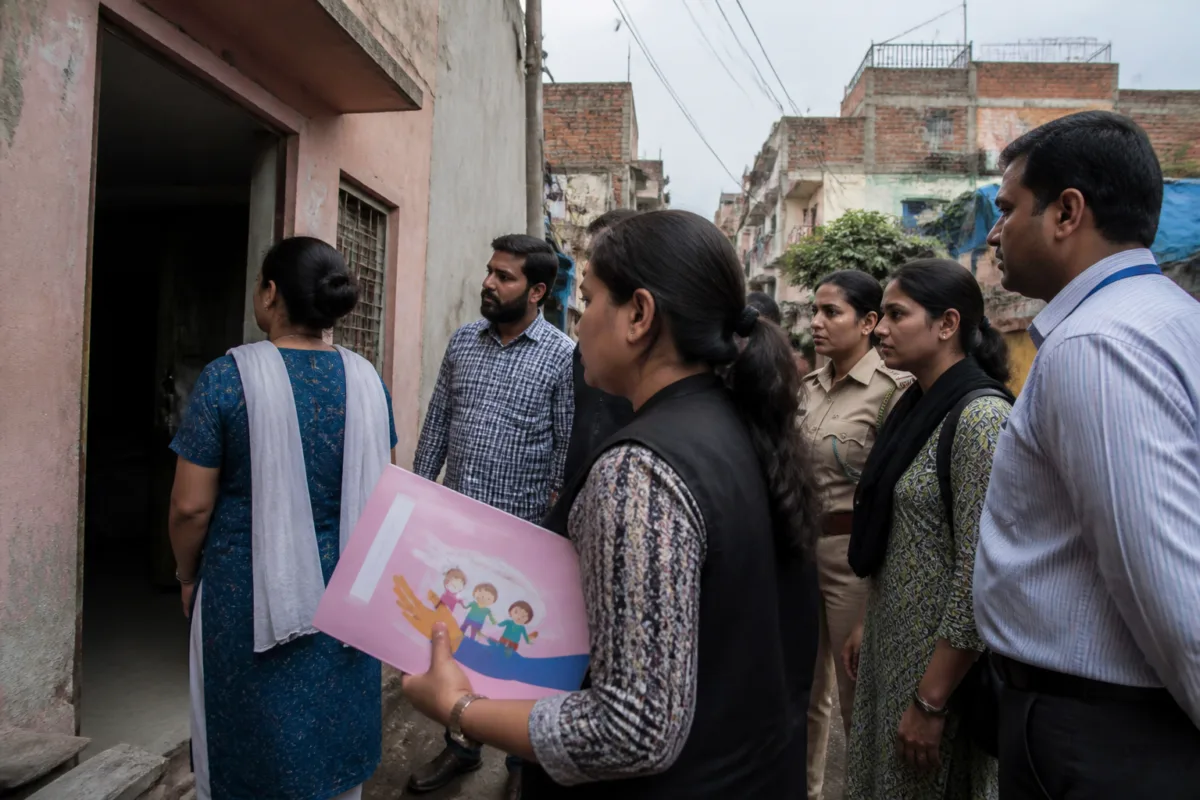
According to a report by Live Hindustan – NCR, a 16-year-old girl was rescued from a house in Abul Fazal Enclave-2 during a joint operation conducted on November 3 and 4. The operation involved the Labour Department, Delhi Police and representatives of the Association for Voluntary Action, an organisation working on child rights, following a complaint. The report said the girl had been working as a domestic worker and had been kept away from her parents for about a year.
The police and the NGO described allegations of severe abuse. The girl told officials that she was made to work from 6 am to 2 am, performing sweeping, mopping, dishwashing and cleaning. She reportedly received tea at around 11 am and was often given leftover food. She alleged that a woman identified as Sadaf repeatedly burned her with a hot iron and a heated knife, and beat her for minor mistakes.
The report also said the NGO found multiple injuries and older wound marks, including burn injuries on the girl’s back and deep wounds on her head. The girl allegedly told officials that she had once been denied food and water for three consecutive days. The source report attributes these details to the girl’s statements and the NGO’s account; they remain allegations to be examined through the legal process.
The institutional response followed a specific chain. The complaint was taken up after the Association for Voluntary Action approached the authorities. The SDM of Kalkaji directed a joint rescue operation. The girl was then presented before the Child Welfare Committee, and her statement was recorded before a magistrate, according to the report. The committee directed that she be admitted to the All India Institute of Medical Sciences for treatment.
The SDM also ordered the Shaheen Bagh police station to register a case under provisions of the Child and Adolescent Labour (Prohibition and Regulation) Act, 1986, and the Juvenile Justice (Care and Protection of Children) Act, 2015. The report stated that no arrest had been made at the time of publication.
This sequence matters because the incident shows that child protection in a city is not performed by one agency alone. A complaint may begin with an NGO or a community contact, but rescue, labour enforcement, police investigation, medical care, child welfare proceedings and judicial recording of a statement are separate institutional steps. Any gap between those steps can leave a vulnerable child unprotected or make it harder to establish what happened.
The case also illustrates the difficulty of monitoring domestic work inside private residences. A construction site, factory or commercial establishment is generally more visible to inspectors and neighbours. Domestic work, by contrast, takes place behind the doors of a household. The reported allegations suggest that the girl’s working hours, injuries, food deprivation and restricted contact with her parents remained hidden for an extended period.
The account of communication with the family is particularly significant. Police reportedly said the girl was allowed to speak to her parents only two or three times during the approximately one year she was away from home. The NGO alleged that her face was covered during those calls so that her parents could not see her injuries. The girl was also reportedly afraid to initially speak to officials because she had allegedly been threatened with death if she disclosed the abuse.
These details point to the difference between formal access and meaningful access to help. A child may technically have a family contact, a phone call or a route to a public authority, yet still be unable to describe her condition freely. In this case, the report said the girl was initially frightened before later speaking before the Child Welfare Committee. That progression underscores the importance of child-sensitive procedures rather than treating silence as evidence that no abuse occurred.
The alleged employment arrangement raises another concern. The NGO said the girl had been placed in the house by another woman and received only Rs 18,000 for about a year of work. The report does not establish the full terms of that arrangement or identify all people who may have been involved. It does, however, describe a chain in which a child from a settlement in Labour Vihar was moved into domestic work, separated from her parents and allegedly placed in a setting where there was little external oversight.
The reported location is important to the urban dimension of the case. Shaheen Bagh and Abul Fazal Enclave-2 are dense residential areas where homes, informal settlements, rental arrangements and service work exist close to one another. The source report identifies the girl as a resident of the Labour Vihar slum in Shaheen Bagh, but it does not provide broader data on how many children from the area are engaged in domestic work or how many inspections have been conducted. Those gaps should not be filled with assumptions. They do show, however, why a single rescue cannot by itself measure the scale of the problem.
The case also places responsibility across different levels of administration. The SDM acted as the authority directing the joint operation and ordering registration under the two cited laws. The Labour Department formed part of the rescue team, while the police were responsible for the criminal case. The Child Welfare Committee dealt with care, protection and treatment, and a magistrate recorded the girl’s statement. The arrangement is institutionally broad, but the report does not say how these agencies will coordinate after the rescue, who will monitor the girl’s rehabilitation or whether anyone has been arrested.
The girl’s stated wish to resume her education and become a teacher provides the clearest indication of what protection must mean beyond removal from the alleged place of abuse. The report said the committee was informed that she wanted to restart her studies. At the time of publication, the confirmed next step was medical treatment at AIIMS. The source does not establish the longer-term education, family-support or rehabilitation plan.
That distinction is central. A rescue is an immediate intervention, not the complete resolution of a child-protection case. Medical care may address physical injuries, but the reported fear, isolation and alleged threats also form part of the protection challenge. The supplied report does not provide an assessment of the girl’s psychological condition or details of counselling and follow-up care, so those matters remain unreported rather than presumed.
The evidence currently establishes a rescue, a series of allegations recorded through official channels, a joint administrative response and the registration process ordered under the cited laws. It does not establish the final criminal liability of the accused person, the complete chain of recruitment or the outcome of the investigation. Those questions depend on the police case, the magistrate’s record, medical findings and subsequent proceedings.
For Delhi’s urban administration, the larger question is how children working in private homes become visible before a crisis. In this case, visibility came through an NGO complaint and a coordinated operation. The report does not say whether an earlier inspection, neighbour complaint or school-based alert had occurred. That missing information is itself relevant: the city’s formal protection system can act when a case reaches it, but the report offers no evidence that it detected the alleged abuse during the preceding year.
The developments that require monitoring are therefore concrete: whether arrests follow the case registration, what the investigation establishes, whether the medical and child welfare processes continue, and whether the girl is able to return to education. The immediate rescue has removed her from the reported setting. The unresolved institutional task is to ensure that protection, accountability and rehabilitation continue after the operation ends.

