


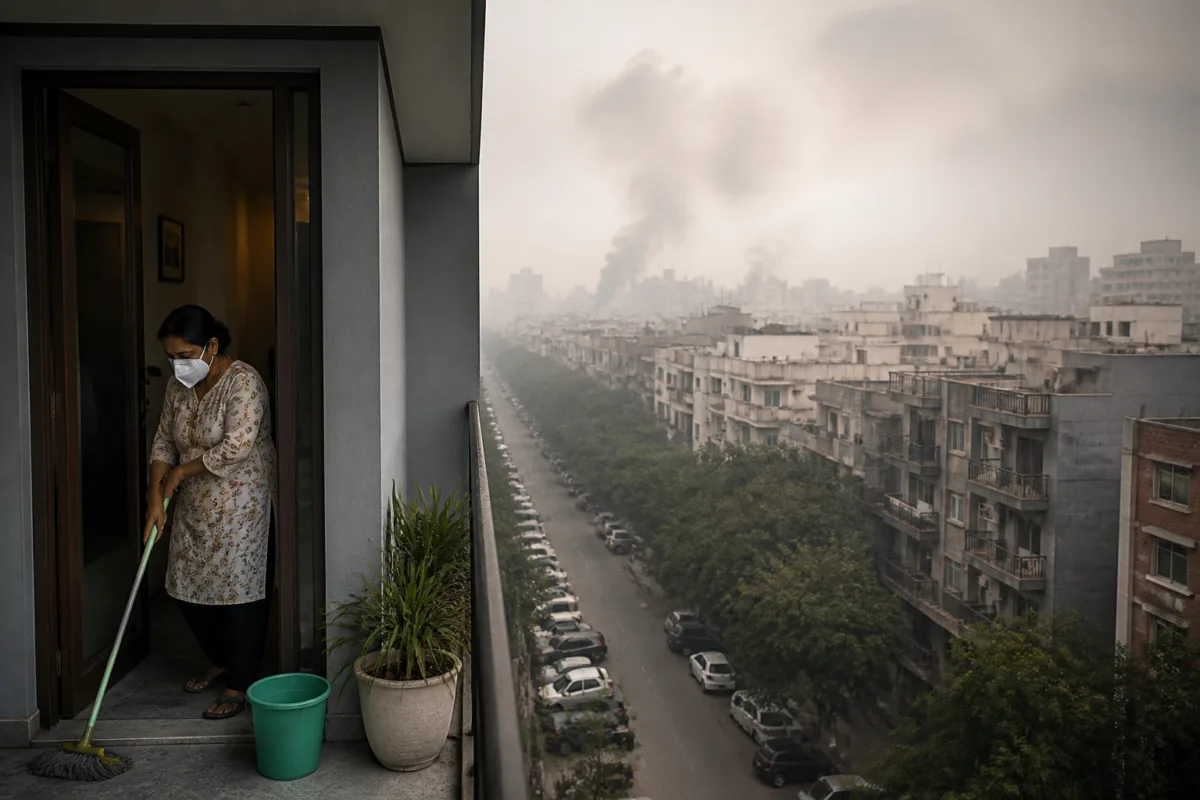
Delhi air pollution during Diwali is usually discussed through the visible plume of firecrackers, but the health burden described by doctors begins earlier and can continue after the celebrations. The supplied report identifies a layered exposure pattern involving household dust, mould spores, cleaning-agent fumes, fine particulate matter and toxic gases. Together, these sources can aggravate asthma, chronic obstructive pulmonary disease (COPD), eye conditions and cardiovascular stress, particularly among children, older adults, pregnant women and people with existing heart or lung disease.
That framing shifts the question from a single-night pollution spike to the way urban exposure accumulates across homes, streets and public spaces. In Delhi, residents may be exposed while cleaning their houses, travelling outdoors, exercising, attending festive gatherings or returning home after pollution levels rise. The report does not provide an AQI reading or an independent measurement of pollutant concentrations, but the medical accounts it cites explain why the period around Diwali can be difficult for people whose respiratory and cardiovascular systems are already vulnerable.
The first layer is domestic. Intensive sweeping, dry dusting and the movement of stored household items can release dust, mould spores and allergens into indoor air. This is especially relevant in the days before festivals, when homes may undergo more extensive cleaning than usual. The report says these particles can trigger allergic reactions and worsen asthma and COPD. It also links exposure to strong cleaning agents with irritation of the airways.
This makes household cleaning an important but often overlooked part of the urban pollution story. The boundary between indoor and outdoor air is not absolute, particularly during episodes of severe pollution. Dust generated inside a home can affect occupants directly, while outdoor pollution can enter through openings and ventilation. The report’s recommendations, including damp mopping instead of dry sweeping and keeping windows closed during severe pollution episodes, reflect the need to manage both sources rather than treating outdoor smoke as the only risk.
Dr (Maj) Rajesh Bhardwaj, founder of Med First ENT Centre, distinguishes between symptoms that may indicate an allergy and those that may point towards an infection. He says repeated sneezing, itching, watery nasal discharge and coughing immediately after dust exposure are more likely to indicate an allergy, while fever, body aches and a progressively worsening sore throat may suggest an infection. He also cautions against unnecessary medication, particularly antibiotics, for allergy-related symptoms.
The distinction matters in a city where pollution-related irritation, seasonal illness and allergy symptoms can overlap. The report does not suggest that every cough or sore throat is caused by pollution. Instead, the medical advice points to the need for residents to observe the timing and pattern of symptoms and to avoid treating possible allergies as bacterial infections without appropriate medical advice.
The second layer is chemical exposure. Dr Neetu Jain, senior consultant in pulmonology, critical care and sleep medicine at PSRI Hospital, says inhaling dust particles along with chemical fumes can damage the airway lining, increase mucus production and trigger inflammation. For vulnerable individuals, she says, this can cause sudden bronchospasm and affect oxygen exchange. Even people without a pre-existing respiratory condition may experience wheezing, chest tightness or breathlessness.
This account adds an indoor-air dimension to the festival period. Cleaning products are not normally counted alongside traffic, construction dust or firecracker emissions in public discussions about Delhi air pollution. Yet the report suggests that exposure can begin before the outdoor pollution peak, when household activities disturb settled dust and release fumes. The medical concern is therefore not limited to what residents see in the sky; it also includes what is stirred up inside rooms.
Firecracker emissions create a further layer. The report says the risk may persist after Diwali, when fine particulate matter and harmful gases add to an already polluted atmosphere. Dr Avi Kumar, additional director of pulmonology at Fortis, says fine particles can penetrate deep into the lungs, aggravate existing respiratory conditions and, with prolonged exposure, increase the risk of lung cancer and heart disease. He also stresses that the concern applies to non-smokers.
The report does not quantify the contribution of firecrackers to Delhi’s overall pollution levels, nor does it establish a causal estimate for long-term disease risk during one festival period. Its significance is instead in describing how short-term exposure can worsen existing conditions and how repeated or prolonged exposure to fine particles is medically concerning. That distinction is important when communicating risk: immediate irritation, an asthma flare-up and longer-term disease risk are not identical outcomes, even though they may be connected through exposure to polluted air.
The effects are not confined to the lungs. Dr Neeraj Sanduja, director of Viaan Eye and Retina Centre, Gurgaon, says dust, smoke and toxic gases can irritate the ocular surface and disrupt the tear film. The symptoms he identifies include redness, itching, burning, watering and dryness. Children, contact lens users and people with pre-existing dry-eye or allergic conditions may be particularly vulnerable.
Eye irritation provides a visible example of how pollution is experienced at street level. A person may not develop a serious respiratory episode but may still face discomfort, reduced tolerance for outdoor activity or difficulty wearing contact lenses. By including ocular effects, the report broadens the health picture beyond emergency respiratory cases and shows that pollution can affect everyday functioning in less dramatic but widespread ways.
The cardiovascular dimension is more serious. Dr R S Mishra, principal director and head of internal medicine at Max Smart Super Speciality Hospital, Saket, says PM2.5 particles can enter the bloodstream and trigger inflammation, placing additional stress on the heart and blood vessels. The groups requiring particular caution, according to the report, include children, older adults, pregnant women and people with underlying heart or lung conditions.
These groups also reveal the unequal distribution of pollution risk. A citywide pollution episode does not produce the same health burden for every resident. People with asthma, COPD, cardiovascular disease or dry-eye conditions may experience effects at lower levels of exposure than healthier adults. Children and older adults may also depend on family members or caregivers to modify travel, exercise and household routines. The report therefore presents pollution protection as a public-health issue involving households, workplaces, schools and healthcare providers rather than as an individual choice alone.
The practical advice cited in the report is largely about reducing exposure during high-pollution periods. Doctors recommend checking AQI levels before going outdoors, avoiding outdoor exercise when pollution is high and wearing a well-fitted N95 mask when going out is unavoidable. At home, they advise keeping windows closed during severe pollution episodes, using a HEPA air purifier and choosing damp mopping over dry sweeping.
These measures also show the limits of household-level protection. Checking the AQI can help residents make decisions, but it does not reduce pollution at source. An N95 mask may reduce inhalation exposure when properly fitted, but it cannot make outdoor activity risk-free. A purifier may improve indoor air in some settings, but its usefulness depends on the room, the device and how it is operated. The supplied report does not provide performance comparisons or specify a particular purifier model, so the advice should be understood as exposure-reduction guidance rather than a complete solution.
The institutional responsibility is similarly broader than festive messaging. Doctors can identify symptoms and advise vulnerable patients, but the conditions described in the report involve air-quality management, pollution monitoring, public communication and enforcement of applicable rules. Municipal authorities, pollution-control agencies, healthcare institutions and residents each operate at different points in the chain. The report does not detail government measures or enforcement arrangements, leaving those parts of the response outside the evidence supplied here.
What the report does establish is the importance of timing. The health burden may begin with pre-festival cleaning, intensify with outdoor exposure and firecracker smoke, and continue after the celebrations as fine particles and gases remain a concern. That sequence is more useful than treating Diwali pollution as a single event confined to one evening. It also explains why people who do not use firecrackers themselves may still be affected by the wider urban environment.
Delhi air pollution, in this account, is not only a problem of visible smoke or outdoor emissions. It is an interaction between seasonal pollution, household dust, chemical fumes, individual vulnerability and the duration of exposure. The supplied medical guidance supports practical steps such as AQI checks, avoiding strenuous outdoor activity during high pollution, using a well-fitted N95 mask when necessary, damp mopping and limiting indoor infiltration during severe episodes. What remains unestablished in the report are the precise pollution levels, the relative contribution of each source and the measured effectiveness of individual interventions. Those gaps matter, but they do not diminish the central public-health lesson: protection during Diwali must account for the full exposure cycle, inside homes as well as outside them.

