


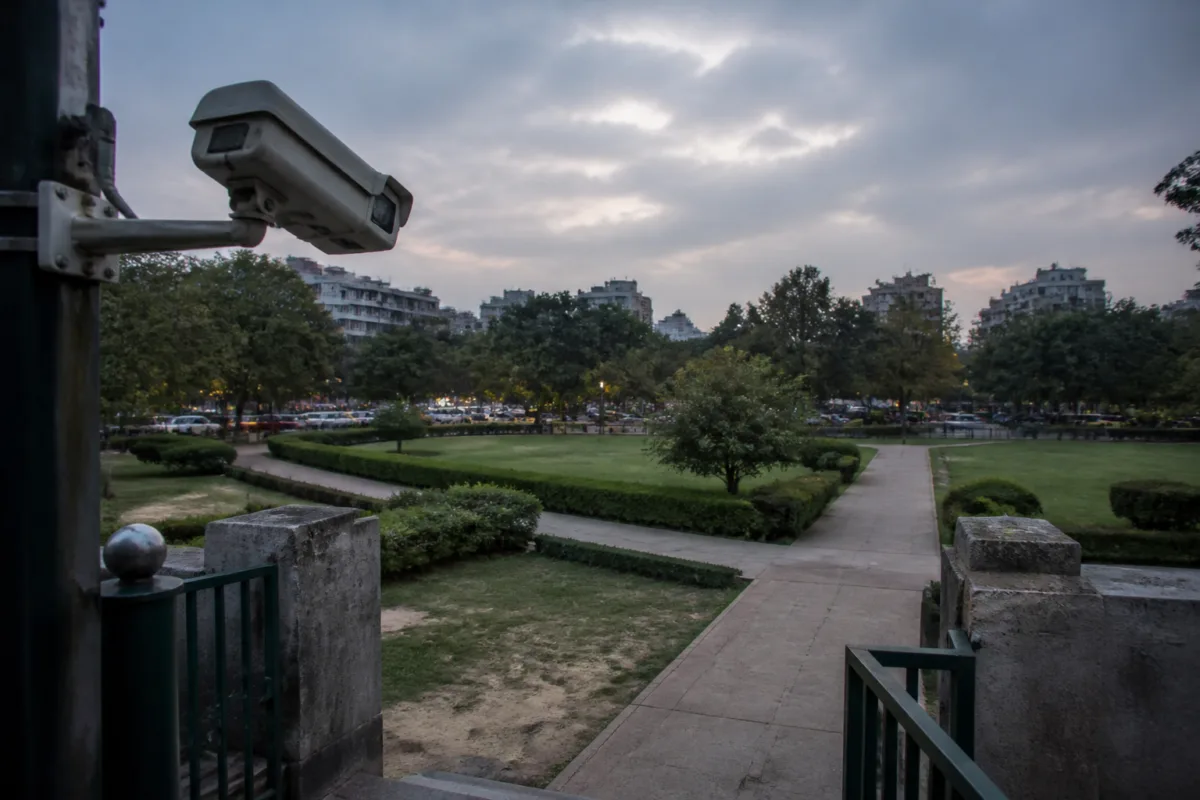
The Aastha Kunj Park rape case has moved towards the charge-sheet stage, with Delhi Police examining footage from more than 300 cameras, recording statements from about 60 people and preparing a large body of documentary and forensic evidence. The investigation offers a detailed view of how a serious crime in an urban public space is reconstructed through surveillance networks, witness accounts, digital forensics and court procedures. It also raises a central question for city governance: does the presence of cameras make a public space safer, or does it mainly improve the chances of proving what happened after a crime has taken place?
According to a report by Live Hindustan – NCR, Amar Colony police have completed scrutiny of roughly 1,500 pages of investigation material. Around 900 to 1,000 pages are being finalised for the charge sheet, alongside approximately 50 supporting documents. The main charge-sheet section is expected to be about 75 pages. Police may file it in Saket court next week, although the report describes this as a preparation stage rather than a completed filing.
The case relates to an alleged gang rape of a 17-year-old girl at Aastha Kunj Park in Delhi. The incident is reported to have taken place on September 22, when the girl, who lived in Faridabad, visited the Kalkaji Temple on her birthday with a minor male friend. After the visit, the two were travelling towards the ISKCON Temple and stopped in the park to eat chips, according to the report. Police allege that three men confronted them, threatened them with a knife and pistol, and sexually assaulted the girl at separate secluded locations inside the park.
The three accused named in the report are Hemant, Mukesh and Asif. They have been arrested and are currently in judicial custody, according to the report. The allegations remain subject to judicial proceedings, and the charge sheet will present the police case for consideration by the court rather than establish guilt by itself.
The reported investigation shows the extent to which an urban crime scene can extend beyond the location where the offence allegedly occurred. Police examined more than 300 CCTV cameras installed in the park and along surrounding routes. Investigators reportedly used the footage to trace the three accused before and after the alleged offence, including their arrival at the park, one accused reaching the area on a motorcycle and their return home afterwards.
That chain is significant because public-space investigations rarely depend on one piece of evidence alone. In this case, the police account combines camera footage with statements, forensic samples, clothing, a judicial identification parade and mobile-phone examination. The alleged sequence of movement is being assembled across multiple locations rather than inferred only from what may have happened inside the park. The value of the surveillance system therefore lies not simply in recording an incident, but in helping investigators connect people, vehicles, routes and time periods.
The report also says that forensic samples were collected from the scene by a Central Forensic Science Laboratory team. The clothing of the accused and proceedings related to their judicial identification parade are expected to form part of the charge sheet. These elements show how a public-space crime is translated into a judicial record: physical evidence, identification procedures, witness statements and digital material must be documented and presented in a form that can be examined in court.
At the same time, the case highlights the limits of surveillance-led policing. Police reportedly found that the three accused had deleted their chat histories and sent their mobile phones for forensic examination. Investigators are attempting to recover the digital evidence. This means that the existence of a large camera network does not automatically produce a complete account. Footage may establish movements, but other parts of an investigation can depend on data recovery, witness testimony and forensic examination.
The distinction matters for urban policy. CCTV cameras are often presented as a visible answer to safety concerns in parks, streets, transit areas and other public spaces. In this case, the footage is described as important evidence, but it is being used after an alleged offence to reconstruct movements and support the prosecution. The report does not establish whether the cameras prevented the incident, whether live monitoring was taking place, or whether personnel responded to any warning before the alleged assault. Those questions are not answered in the supplied material, but they are essential to judging the actual safety performance of a surveillance system.
A camera network is therefore only one part of public-space governance. Its effectiveness depends on placement, functioning equipment, retention of recordings, access protocols, trained investigators and the ability to link footage from different points. The reported examination of more than 300 cameras suggests a substantial investigative workload. It also indicates that the urban surveillance environment is dispersed across a park and its connecting roads, rather than concentrated at one crime scene.
The physical design of Aastha Kunj Park is also relevant to the case, although the report provides limited details about the park’s layout. The alleged assault is reported to have taken place at separate secluded locations. That description places attention on visibility, access, movement and the relationship between landscaped public areas and surrounding routes. It does not, on its own, establish a design failure or assign responsibility to a civic agency. However, it shows why public-space safety cannot be assessed only by counting cameras. A park may have extensive surveillance coverage and still contain areas where people are isolated from passers-by or immediate assistance.
The investigation also crosses institutional boundaries. The alleged incident involved a minor, required police investigation, forensic work, judicial custody and eventual scrutiny by the Saket court. A special public prosecutor has been appointed to conduct the case, according to the report. The material being prepared for court includes police records, forensic documents, identification proceedings and digital evidence. This makes the charge-sheet process an administrative and institutional exercise as much as a legal milestone.
The numbers reported in the case illustrate that process. More than 300 camera feeds were examined; statements from around 60 people were recorded; nearly 1,500 pages were scrutinised; and between 900 and 1,000 pages were being prepared for the charge sheet, with about 50 key documents expected to accompany it. These figures do not measure whether the investigation is legally sufficient, because that determination belongs to the court. They do, however, show the volume of material that investigators say they have assembled before filing.
The timeline also matters. The alleged incident occurred on September 22, while the report published on November 7 said police were preparing to file the charge sheet the following week. The investigation consequently covers a period of several weeks between the reported offence and the anticipated court filing. During that period, police examined camera footage, recorded statements, collected forensic samples and sent phones for examination. The source does not provide a detailed day-by-day account of the investigation or explain whether any evidence remains pending.
For residents, the case presents a difficult distinction between perceived safety and post-incident accountability. A camera may reassure people that a public space is being monitored, but reassurance is not the same as protection. The reported evidence indicates that cameras can help trace movements and support a prosecution. It does not show that surveillance alone can prevent an attack, ensure rapid intervention or make secluded areas safe.
The case also underlines the importance of handling information about survivors with care. The girl’s age is central to the legal context, but her identity and personal details must remain protected. Reporting on the investigation should focus on the institutional process, the evidence described by authorities and the court’s eventual assessment, without turning the survivor’s experience into unnecessary detail.
What the supplied account establishes is that Delhi Police are preparing a charge sheet based on a large investigation involving CCTV footage, witness statements, forensic material, identification proceedings and digital examination. What remains unresolved is how the court will assess that material, whether deleted mobile data can be recovered, and whether the charge sheet will be filed in the time indicated by police sources. The larger urban lesson is narrower but important: surveillance can strengthen the evidentiary chain after a crime, but safer public spaces require more than cameras and must also be judged by visibility, monitoring, access to help and institutional response.

