


Andhra Pradesh’s decision to restrict firecracker sales to packaged products in five districts after the Vetlapalem blast has created a clear regulatory boundary: public access to fireworks will continue, but local manufacturing will not. The policy protects against an immediate repetition of production-related risks, yet it also leaves manufacturers, workers and dependent families without a recognised route back into an industry they say is their only source of livelihood.
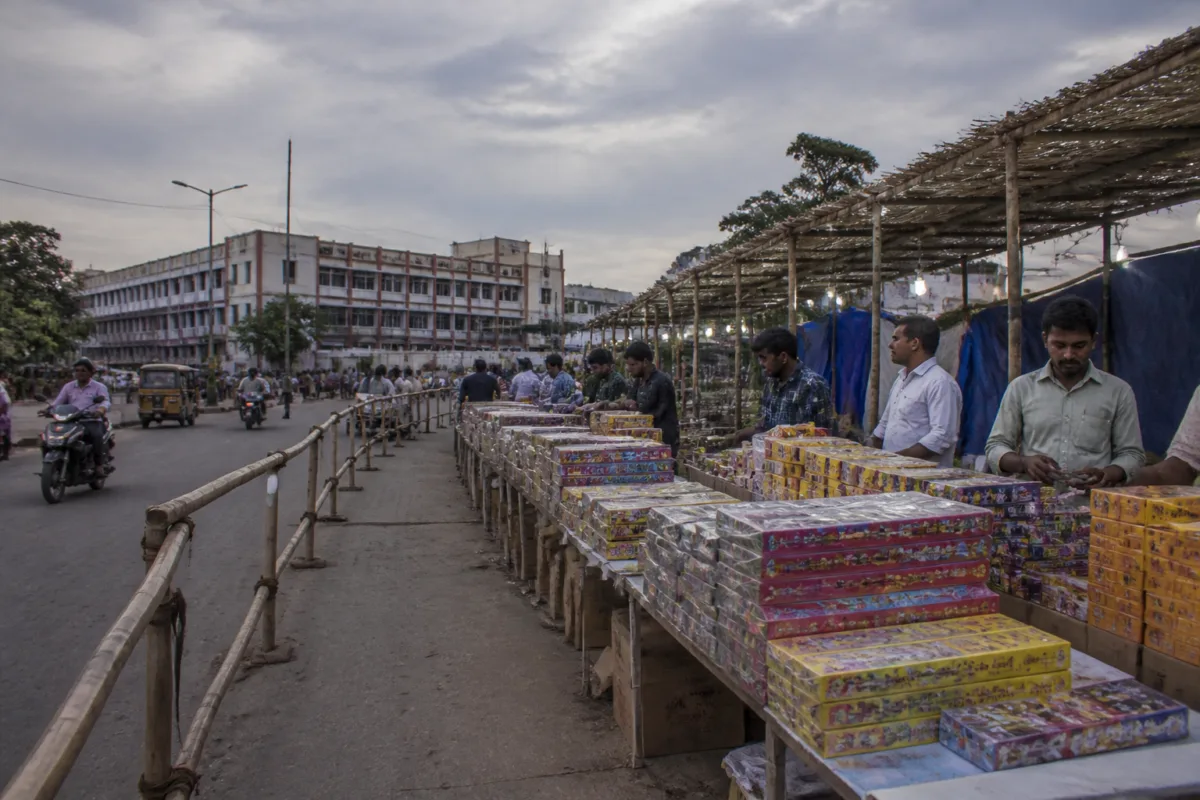
The state has issued temporary licences to nearly 2,000 traders for the sale of packaged firecrackers during Diwali in Kakinada, Konaseema, Eluru, East Godavari and West Godavari. At the same time, manufacturing licences in these districts remain revoked after the explosion at a cracker-making unit in Vetlapalem, in Samalkot mandal of Kakinada district, on February 28, 2026. The blast killed nearly 30 people, according to the report.
The decision therefore separates two activities that are often treated as part of the same seasonal market. Traders may sell products manufactured elsewhere, subject to temporary licensing, while units within the affected districts cannot resume production. This distinction has allowed the government to keep a regulated Diwali market open without restoring the manufacturing system that authorities consider unsafe after the tragedy.
That distinction also shows how a crisis response can shift risk rather than eliminate the underlying economic activity. Manufacturing has been stopped locally, but demand for firecrackers remains. The state’s immediate control is over where and under what conditions products can be sold. The longer-running dispute concerns whether production can resume, and under what institutional safeguards.
The government’s position has been shaped by the scale of the Vetlapalem incident. Chief Minister N. Chandrababu Naidu adopted a strict stance after the blast and suspended four officials on the day of the incident. More than 30 manufacturers subsequently approached the Andhra Pradesh High Court seeking permission to restart production. Various government departments have filed counter-affidavits referring to regulations under the Explosives Act.
This legal challenge is significant because it moves the dispute beyond a seasonal licensing question. The manufacturers are not merely asking for access to the Diwali market; they are contesting the continued closure of their production units. Their case, as described in the report, rests on two arguments: that firecracker production is their only skill and that hundreds of families depend on the trade, and that all manufacturers should not be held responsible for one accident.
The state’s response rests on a different administrative logic. After a fatal industrial accident, licensing authorities are expected to examine whether existing permissions, operating practices and inspection systems were adequate. The counter-affidavits invoking the Explosives Act indicate that the government is relying on the regulatory framework governing hazardous production rather than treating the blast as an isolated event with no bearing on other units.
The central institutional question is whether a licence is being treated as a one-time approval or as part of an ongoing safety system. A manufacturing licence can authorise an activity, but the existence of a licence alone does not establish that a unit is operating safely at every point in time. The report does not provide details of inspections, violations, emergency arrangements or the specific failure that caused the Vetlapalem blast. Those gaps matter because they determine whether the state’s response is a targeted correction or a broad suspension of an entire district-level industry.
The present policy is also different from a permanent prohibition. Authorities have not approved applications from manufacturers who expected their licences to be restored two or three months before Diwali. The report does not state that manufacturing has been permanently banned, nor does it provide a timeline for reconsideration. The immediate fact is that the applications remain unapproved and the units remain shuttered.
That uncertainty has a direct economic effect. Manufacturers say hundreds of families depend on the trade, while the continued closure removes production income before the main seasonal selling period. The report describes manufacturing as the affected workers’ only skill, making the issue larger than the commercial interests of unit owners. It concerns whether a regulatory shutdown is accompanied by any transition mechanism for workers and families who cannot easily move into another occupation.
The manufacturers have also expressed readiness to comply with safety rules and regulations. Their position suggests that they are seeking a conditional path to reopening rather than rejecting regulation altogether. However, the supplied report does not establish what additional safeguards the authorities would require, whether fresh inspections have been completed, or whether any remediation plan has been accepted.
This is where the case exposes a recurring governance problem in hazardous urban and peri-urban industries: enforcement is most visible after a disaster, while the less visible work of monitoring, training, emergency planning and compliance takes place continuously. The report records the suspension of officials on the day of the blast and the subsequent licence revocations, but it does not establish how the regulatory system functioned before the incident or how it will be redesigned afterwards.
The geography of the decision further complicates the issue. The restriction covers Kakinada, Konaseema, Eluru, East Godavari and West Godavari, a group of districts with manufacturing units, traders and agricultural households linked to the seasonal economy. The government has therefore applied a district-level response rather than limiting the consequences to the individual unit named in the accident.
For traders, the new system creates a legal channel but not necessarily a stable market. Nearly 2,000 temporary licences have been issued for packaged firecracker sales, indicating a substantial administrative exercise to regulate retail activity during Diwali. Yet traders are worried about sales, with prices reported to be 20–30 per cent higher than last year. The higher prices are occurring alongside weakened purchasing power among farmers and agricultural labourers after extensive damage to agricultural and horticultural crops.
This combination could produce a difficult commercial season even though sales are legally permitted. Traders face higher product costs, while customers in farming communities have less disposable income. The report does not provide sales forecasts or district-wise licence figures, but it clearly links the firecracker market to the wider rural economy. Seasonal demand is not independent of crop performance, household income or local employment.
The location of retail activity has also changed in Kakinada. The firecracker sales venue has been shifted from Mc Laurens School grounds to the new road beside the Government Girls Polytechnic College because vote counting for local body elections is being held at the school. This is a temporary administrative adjustment, but it illustrates how public events, civic facilities and commercial activity compete for urban space during peak periods.
The relocation also raises practical questions that are not answered in the supplied material: how the new site has been assessed for crowd management, emergency access and separation from surrounding activity, and whether the temporary retail arrangement has been coordinated across the relevant departments. The report confirms the relocation, but it does not provide the safety conditions attached to the new venue.
The contrast between packaged sales and local manufacturing is therefore important. A packaged product may be easier for authorities to identify and regulate at the point of sale, but retail licensing does not by itself explain how storage, transport, display and crowd movement will be managed. Likewise, shutting manufacturing units removes production from the districts but does not resolve the broader question of how hazardous goods are governed through their full chain of movement.
The policy landscape now involves at least three layers of responsibility. The state government has imposed the post-blast restrictions and authorised temporary retail licences. Government departments are defending the restrictions in court under the Explosives Act. Local administration is handling practical arrangements such as the relocation of the Kakinada sales venue. The courts, meanwhile, are examining manufacturers’ requests to resume production.
The available evidence does not show whether these responsibilities are being integrated into a common reopening or monitoring framework. Nor does it establish whether manufacturers have been given written compliance conditions, inspection schedules or a process through which individual units can demonstrate readiness. Without those details, the dispute remains suspended between two positions: a broad shutdown justified by a fatal accident and an industry seeking to prove that safer production is possible.
The numbers in the report show the scale of the competing pressures. Nearly 30 people died in the Vetlapalem blast. More than 30 manufacturers approached the High Court. Nearly 2,000 traders received temporary licences. Firecracker prices have risen by 20–30 per cent compared with last year. These figures describe a system in which public safety, legal permissions, seasonal commerce and household incomes are connected, even though the state has separated manufacturing from retail sales.
What remains unestablished is equally important. The report does not identify the technical cause of the blast, specify the compliance failures at the unit, state how many workers have lost income, or explain the conditions under which manufacturing licences might be reconsidered. It also does not say whether the temporary packaged-product policy is limited to this Diwali season or will continue until a longer-term decision is taken.
The immediate policy outcome is clear: packaged firecrackers may be sold through temporary licences in the five districts, while manufacturing licences remain unapproved. The larger urban-governance question is whether the state can convert a post-disaster shutdown into a transparent, enforceable and economically accountable safety system. The next developments to watch are the High Court proceedings, the government’s response to manufacturers’ applications and any formal framework for inspections or reopening.

