


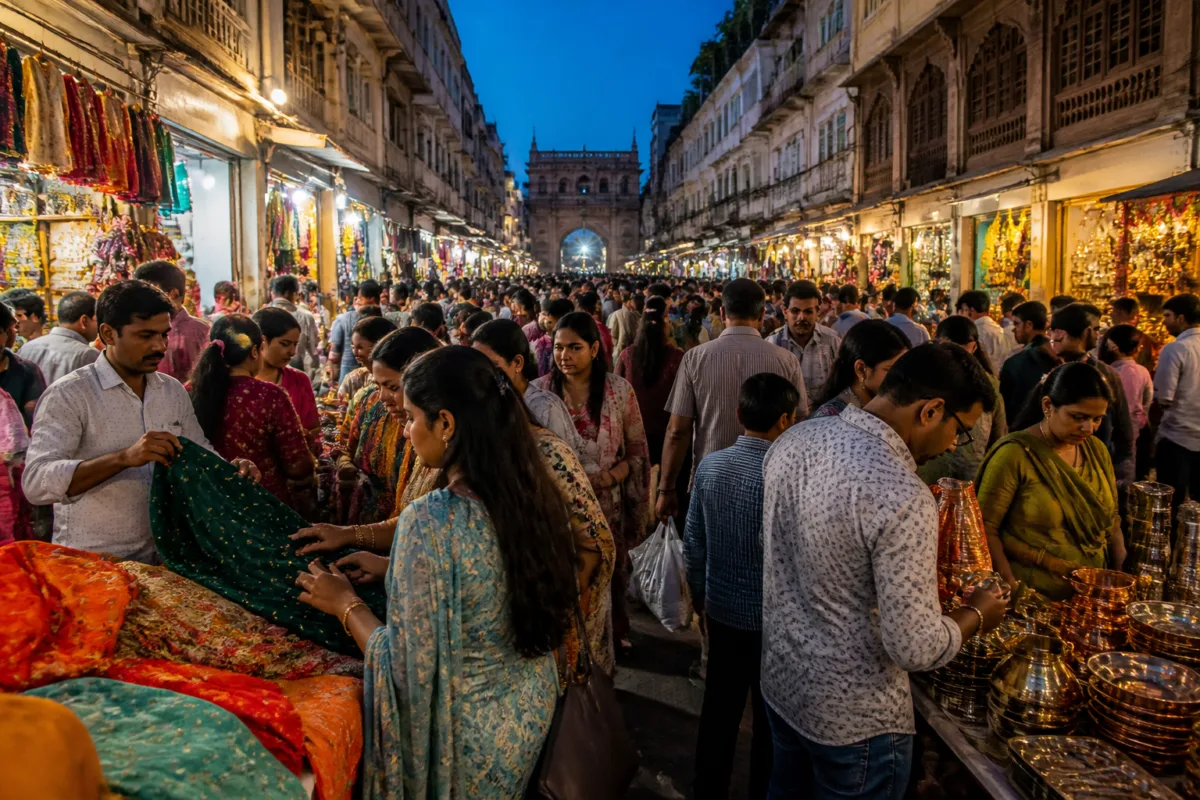
Ahmedabad’s Diwali shopping season is revealing a sharp contradiction in the city’s urban economy: households are paying substantially more for clothing, food, fireworks, electronics and household goods, yet major markets remain crowded and traders expect strong festive sales. The pattern suggests that inflation has not removed demand from the city’s traditional retail districts; instead, it is changing what people buy, how much they buy and where they look for value.
According to a report by Gujarat Samachar – Ahmedabad, prices across several Diwali-related categories have risen by roughly 20% to 30% over the past year. A four-member middle-class household that previously budgeted around Rs 16,000 to Rs 17,000 for clothing, sweets, fireworks, household goods and other festive purchases may now spend between Rs 20,000 and Rs 21,000, the report said. The increase has occurred even though household incomes have not recorded a comparable rise, according to the report.
That gap between income and festive expenditure is important because Diwali shopping is not limited to discretionary consumption in Ahmedabad. It supports a wide network of retailers, wholesalers, transporters, manufacturers, artisans, food producers and temporary workers. The city’s older commercial areas, including Manek Chowk, Kalupur, Relief Road, Micro-cond and the Delhi Darwaja area, continue to function as specialised retail ecosystems where seasonal demand is concentrated.
The reported shopping rush therefore reflects more than a festival buying habit. It shows how established urban markets absorb price shocks while retaining customers through product substitution, smaller purchases, new product categories and the cultural importance attached to seasonal spending.
Clothing remains one of the strongest examples. Retailers told the publication that business during the Diwali season could rise to two-and-a-half times its usual level. Shops in Ahmedabad are reportedly receiving customers until around 11 p.m., while buyers are arriving from across Gujarat and neighbouring states because the city is a major textile market.
At the same time, clothing prices have increased. Traders cited a rise in the price of a bale of cotton from about Rs 50,000 to Rs 72,000. Prices of rayon, silk and other materials have also risen, pushing ready-made clothing prices up by an estimated 20% to 25%. The report noted growing demand for blended fabrics as consumers respond to higher prices for original materials.
This is a familiar urban market response to inflation: demand does not necessarily disappear, but the composition of demand changes. Consumers may shift from premium material to blended fabric, reduce the quantity purchased or prioritise clothing for particular family members. The retail market remains active, but the same level of activity may no longer represent the same volume of goods per household.
The same adjustment is visible in dry fruits. Traders attributed a 25% to 30% rise in prices to disruptions in import and export supply chains amid conflict in the Middle East. Cashews that previously sold for around Rs 700 to Rs 800 were reported to be available at Rs 900 to Rs 1,000. Almond prices were reported to have risen from around Rs 600 to Rs 1,000.
In response, some customers are shifting towards dried berries, including raspberry, blueberry, cranberry and blackberry products priced at around Rs 700 to Rs 800, according to the report. The substitution illustrates how festive retail in an established city market can preserve the ritual of gifting while changing the underlying product. What matters to consumers may be the presence and presentation of a gift, even when the original commodity becomes less affordable.
Traditional metalware is also returning to the centre of festive shopping. The Kalishara market in Manek Chowk continues to attract buyers looking for bronze dinner sets, brass cookware, copper bottles, utensils, lamps, bells and decorative objects. The report said that copper, brass and bronze products, once seen as less prominent in modern household consumption, are finding renewed demand during Dhanteras and in corporate gifting.
This revival connects cultural practice with the physical structure of Ahmedabad’s older markets. Specialised bazaars continue to offer goods that are not easily found in modern retail formats. Metal utensils and antique objects reportedly arrive from places including Mugadbad in Ghipina and southern India, while customers from Ahmedabad and surrounding states visit the old-city markets for these products.
The continued role of such markets also reveals the limits of a simple online-versus-offline explanation of urban retail. Digital commerce may serve routine purchases, but festival shopping often depends on the ability to compare products physically, negotiate prices, purchase culturally significant goods and access specialised clusters. Older market districts remain valuable because they combine supply, knowledge, tradition and destination appeal in a single urban setting.
The cost pressures are equally visible in fireworks. Retailers in the Delhi Darwaja and Kalupur markets reported price increases of 20% to 30%, with fireworks arriving from Sivakasi in Tamil Nadu and parts of Uttar Pradesh. Alongside traditional products, newer items such as Halloween bombs, drone bombs, caterpillar fireworks and matchbox-style guns are reportedly attracting children.
The report also noted that green crackers have gained ground over the past two years because they are marketed as producing lower air and noise pollution. However, it cautioned that some ordinary fireworks may be sold at higher prices under the green-cracker label. That claim is attributed to the report and is not independently established in the supplied material, but it points to a governance challenge in festive markets: consumers need clear product information when environmental claims affect purchasing decisions.
Food markets show a similar combination of price escalation and product innovation. Ahmedabad’s sweet shops are reportedly selling around 50 varieties, including newer products such as Biscoff balls, cafe mocha biscuits and pistachio-kunafa sweets aimed at younger customers. Traditional sweets such as peda, mohanthal and kaju katri remain part of the festive range.
The report attributed higher sweet prices to increases in the cost of milk, dry fruits, sugar and cooking gas. Customers may pay an additional Rs 60 to Rs 150 per kilogram. In the savoury food market, more than 80 varieties of farsan are reportedly available in Kalupur, including ganthiya, sev, chevdo, chakri, puri and mathiya. Higher prices for oil, spices and gram flour have raised farsan prices by around Rs 40 to Rs 80 per kilogram.
The reported shift from kilogram purchases to smaller quantities is one of the clearest signs of inflation’s effect on urban households. A market can remain crowded while the average basket becomes smaller. Sales activity, therefore, does not by itself show that consumers are financially comfortable. It may instead indicate that households are protecting certain festive purchases by reducing quantities or substituting products elsewhere.
Ahmedabad’s Diwali economy also shows how formal and informal systems overlap. Modern businesses increasingly manage accounts through computers and mobile phones, but traders continue to observe the tradition of worshipping physical red account books at the beginning of the new financial year. The report said that the price of a red account book had risen from Rs 200 to Rs 240 because of higher paper and transport costs, without a reported fall in demand.
The persistence of physical calendars and account books alongside digital business systems demonstrates that urban economic change is not always a clean replacement of old practices with new ones. Commercial districts often operate through a layered system in which digital payments, mobile communication and computerised accounts coexist with traditional objects, face-to-face relationships and seasonal rituals.
The larger issue is how inflation travels through the urban supply chain. The report links price increases to production costs, transportation, distribution, imported commodities, raw materials and cooking fuel. The final retail price is therefore shaped by multiple stages before a product reaches an Ahmedabad household. When cotton, paper, oil, sugar, gas or imported dry fruits become more expensive, the impact is distributed across households, retailers and producers.
For the city, the evidence points to an economy that remains resilient in activity but pressured in affordability. Traders expect stronger turnover in some categories, but customers are also adapting through substitution, blended materials, smaller quantities and different gift choices. These behaviours can keep markets active while concealing the reduction in purchasing power at household level.
The supplied report does not establish citywide sales totals, household income data, official inflation measurements for each category or verified comparisons with previous Diwali seasons. It also does not quantify the contribution of these markets to Ahmedabad’s employment or municipal revenue. What it does establish, through trader accounts and observed market activity, is that the festival economy is absorbing substantial price increases without losing its urban visibility.
The central question for Ahmedabad is therefore not simply whether Diwali markets are crowded. It is whether strong footfall is translating into higher real consumption or merely reflecting the effort of households to preserve customary spending under more difficult conditions. The answer will depend on sales volumes, basket sizes, income trends and post-festival demand—data not provided in the current report. For now, the city’s markets show a distinct form of inflation-era resilience: people continue to spend, but the contents and affordability of that spending are changing.

