


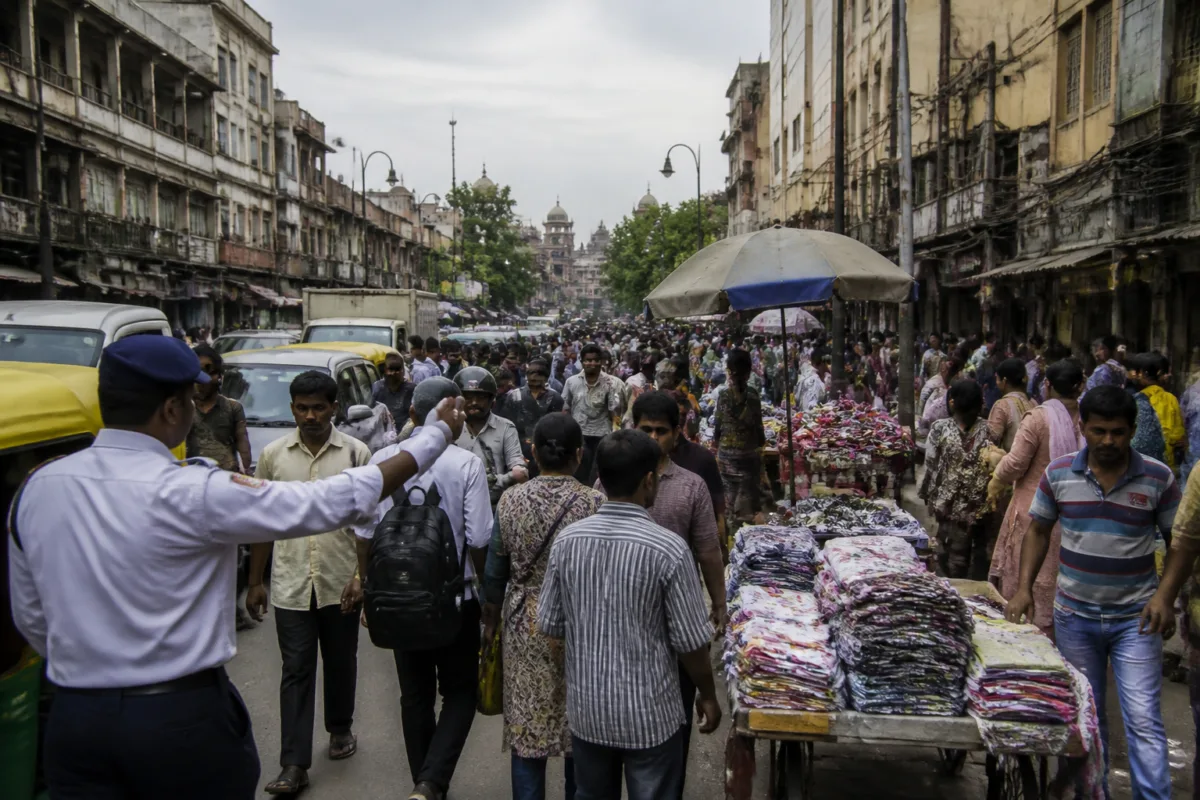
The Delhi High Court has directed senior civic, district and police officials to meet over continuing encroachment and illegal vending in Chandni Chowk, after observing that the situation on key roads had become disorderly and dangerous.
A division bench of Justices Prathiba M Singh and Dinesh Bhatt raised concerns about the lack of effective action during a hearing on a 2023 petition filed by the Chandni Chowk Sarv Vyapar Mandal. The bench questioned the inactivity of the Special Task Force (STF), saying it had failed to implement decisions taken by the task force on December 7, 2023.
The court’s observations followed the examination of photographs showing the condition of Chandni Chowk and surrounding roads. According to the report, the bench said illegal vending and encroachments had again reached a dangerous level despite earlier directions.
The court ordered the Assistant Commissioner of the Municipal Corporation of Delhi, the Deputy Commissioner of the North Delhi district, the Deputy Commissioner of Police (Traffic), and Additional Deputy Commissioner of Police-I to hold a meeting at 11 am on Friday. Three representatives of the petitioners have also been directed to participate in the meeting.
The officials must file a status report before the next hearing, which has been scheduled for November 26. The report is expected to set out the action taken to address unauthorised vending and encroachment on the identified roads.
The proceedings relate to earlier directions issued on April 19, 2022. The court had directed authorities to remove encroachments and unauthorised vending from the main road between the Red Fort and Fatehpuri, as well as from H.C. Sen Marg and Subhash Marg. Authorities were also instructed to prevent the areas from being occupied again.
The latest hearing indicates that enforcement remains an ongoing challenge in one of Delhi’s busiest and most commercially important historic districts. Chandni Chowk combines high pedestrian volumes, retail activity, wholesale trade, heritage sites and major road connections, making the usable width of its roads and footpaths important for both movement and emergency access.
The court’s directions place responsibility across multiple agencies rather than on the municipal corporation alone. The participation of the traffic police, district administration, Delhi Police and petitioner representatives is intended to bring the agencies together before the status report is submitted.
The order also links the current situation to the implementation of earlier STF decisions. The court’s concern is therefore not limited to the existence of encroachments, but also to whether enforcement orders are being carried out consistently and whether cleared areas remain free of renewed occupation.
The immediate next step is the officials’ meeting on Friday morning. The authorities must then submit their status report before the November 26 hearing, when the court is expected to review the measures taken on the three roads and the steps proposed to prevent fresh encroachments.

