


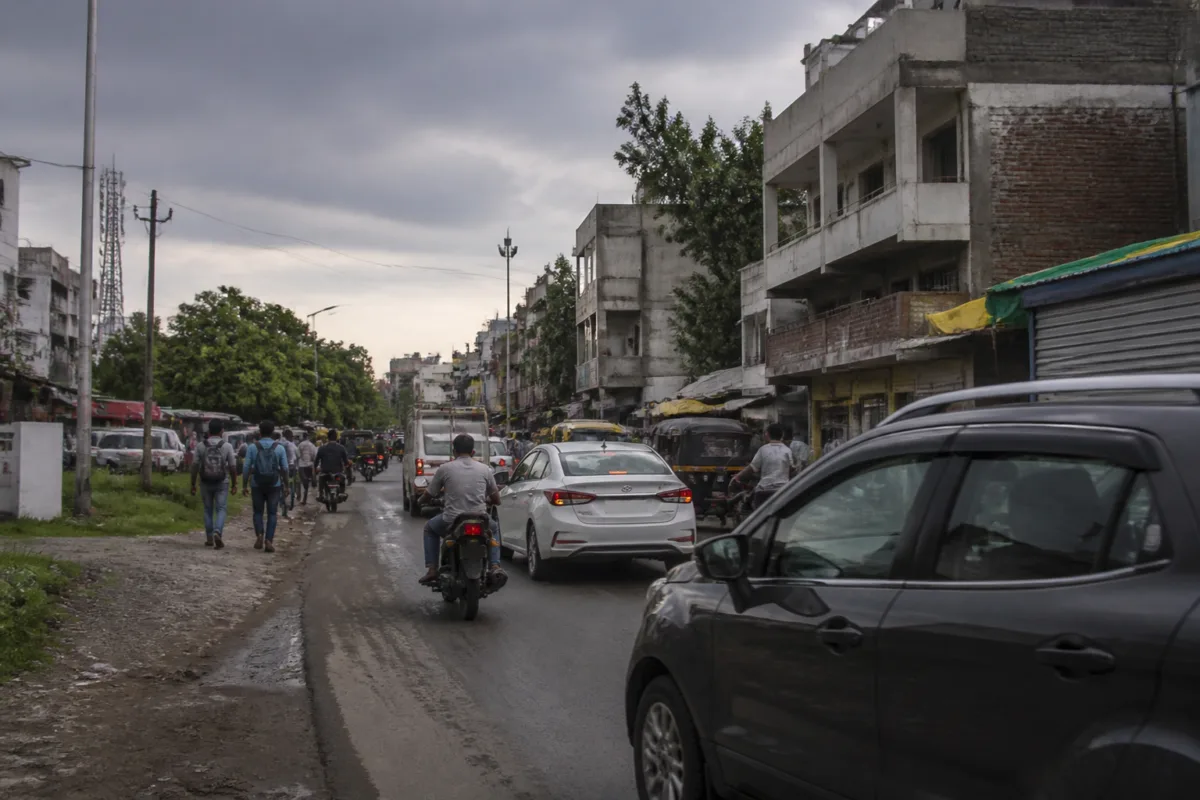
The fatal accident that killed 31-year-old Ashwini Phalke on the Godhani road in Nagpur has been followed by police cases against 12 residents, but the deeper story is the conflict over a road that residents say has become unsafe because of its narrow width, roadside encroachments and speeding. The incident shows how a public-safety failure can quickly become a law-and-order problem when residents believe routine urban administration has not addressed a dangerous stretch.
According to a report by the Times of India – Nagpur, Phalke died in the accident on Tuesday while her husband, Pankaj, and their six-year-old son, Advit, were injured. The report identifies the affected corridor as the stretch connecting Mankapur-Zingabai Takli to Godhani Railway Road. Residents and activists said the road had witnessed several accidents in recent months and demanded widening, removal of encroachments and stricter checks on speeding.
The immediate public response was disruptive and unlawful, according to the police complaint cited in the report. A group gathered on the carriageway, blocked traffic for several hours, allegedly threw stones and damaged the iron gate of a biryani outlet. Several roadside shops were also ransacked. Police booked 12 residents for unlawful assembly, forcibly stopping vehicles, causing damage to property and creating a public nuisance.
That sequence matters because it reveals two separate failures that are often collapsed into one. The first is the reported safety condition of the road. The second is the manner in which citizens responded after a fatal crash. A dangerous road cannot justify vandalism or the obstruction of emergency and everyday movement. At the same time, criminal cases against protesters do not by themselves answer whether the road had been allowed to remain hazardous despite repeated accidents and complaints.
The supplied report does not establish the road’s sanctioned width, its ownership, the number of verified crashes on the stretch, or which agency is responsible for widening and maintaining it. Those omissions are not minor details. Urban road safety depends on clear institutional responsibility: one authority may control the carriageway, another may regulate traffic, and local enforcement may be responsible for encroachments or roadside activity. Without a documented division of responsibility, public complaints can circulate without producing a measurable intervention.
The dispute over the iron gate is also significant. Protesters reportedly claimed that the structure of the biryani outlet was encroaching on the road. The report records the allegation and the damage to private property, but it does not say whether the structure had been formally measured, inspected or found to violate an approved building or road line. That distinction is essential. Encroachment removal must be based on survey records, sanctioned plans and due process, rather than on an angry crowd’s judgement after a crash.
Road widening is often presented as the most immediate solution when a corridor becomes congested or dangerous. But widening alone does not explain every crash. The report also refers to speeding, roadside shops and a narrow carriageway. These factors can interact: limited road space may force vehicles and pedestrians into close proximity, while informal activity along the edge can reduce visibility and usable width. If speed enforcement remains weak, a wider road could still carry serious risks. The available evidence does not establish which factor contributed directly to the accident involving Phalke, so responsibility for that specific crash should not be inferred from the broader complaints.
The Godhani episode nevertheless demonstrates why accident reporting should not end with the immediate cause of one collision. Residents described the stretch as a “killer road” and demanded action after what they said was a pattern of accidents. Whether that description is supported by official crash records is not stated in the report. The claim should therefore be tested against police data, hospital records, traffic-engineering inspections and complaints received by the relevant civic and traffic authorities. Such documentation would help distinguish a recurring corridor-level risk from a single tragic incident followed by public anger.
The administrative question is equally important. A road-widening demand requires more than a public announcement. It involves identifying the road boundary, checking land and building records, assessing utility shifting, determining the funding source and establishing how traffic will be managed during construction. Encroachment action may require notices, hearings and coordinated enforcement. Speed checks require regular deployment, equipment and reporting. The report does not say whether any of these steps had begun before the accident or whether authorities had issued a formal response after the protest.
The police action, however, is documented more clearly. The complaint names residents from Bajrang Nagar, Bailwada, Bharatwada, Kalmeshwar, Zingabai Takli and Godhani, among other localities. The charges relate to the protest conduct: blocking a public road, obstructing traffic, damaging property and creating a public nuisance. These allegations will have to be dealt with through the legal process. They should not be treated as proof that the residents’ underlying road-safety concerns were false, just as the residents’ concerns cannot be treated as a defence for vandalism.
This separation between the public-safety issue and the protest offence is central to responsible urban governance. Authorities must protect private property and preserve traffic movement while also examining whether repeated complaints indicate a preventable infrastructure problem. If the road is genuinely narrow or obstructed, enforcement against protesters without a parallel safety assessment could leave the original risk unchanged. If the complaints are not supported by engineering or crash data, the widening demand may require a different response focused on speed management, access control and lawful regulation of roadside activity.
The information available in the report does not reveal the road’s traffic volume, design speed, pedestrian movement, lighting, drainage, signage or crash history in numerical terms. It also does not identify whether the affected stretch has been inspected by a traffic engineer or whether any widening project has received administrative approval. These are the facts needed to move the debate from anger to an accountable plan. They would also clarify whether the main intervention should be reconstruction, encroachment control, traffic enforcement or a combination of measures.
For residents, the immediate concern is straightforward: whether they can use the Mankapur-Zingabai Takli to Godhani Railway Road without facing an avoidable risk. For the administration, the challenge is more structured. It must establish what happened in the fatal accident, verify the alleged history of crashes, map the road boundary, inspect roadside structures and publish the next steps under the responsibility of the relevant agencies. For the police, the legal cases will proceed separately from that assessment.
The Godhani case therefore leaves two obligations in view. The first is to hold accountable those accused of unlawful assembly, obstruction and property damage through due process. The second is to determine whether the road conditions described by residents represent a documented and continuing safety hazard. The supplied report confirms the fatality, the injuries, the protest and the police action; it does not yet establish the engineering findings or an implementation timeline. Those official records will determine whether the episode leads to a safer corridor or remains another cycle of accident, protest and criminal cases.

