


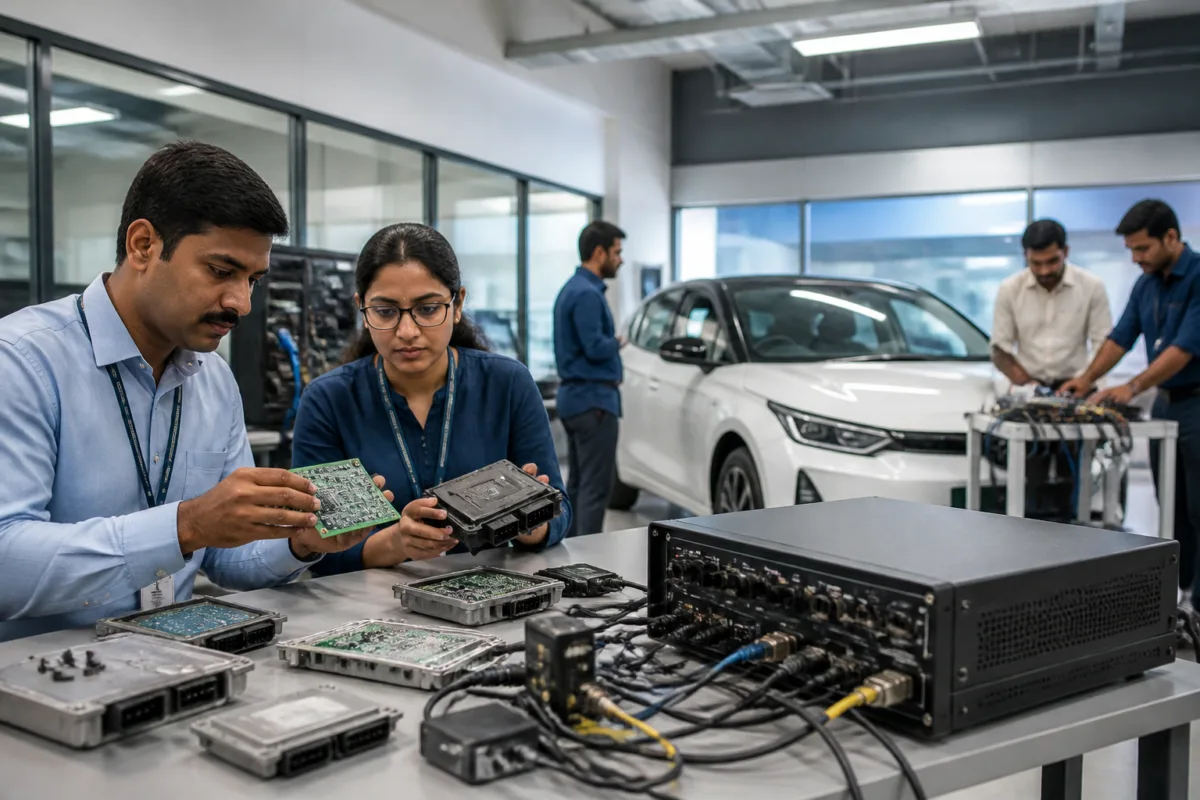
The Central Institute of Road Transport (CIRT) has launched an Automotive Cybersecurity Penetration Testing Laboratory at its Bhosari campus in Pune as the institute begins a year-long programme focused on safer and secure mobility. The facility will test the digital systems used in connected, electric and increasingly automated vehicles, including electronic control units, telematics, infotainment systems and in-vehicle networks.
CIRT showcased the laboratory during a media interaction on Wednesday, as it marked six decades of work in vehicle testing, certification, road safety and transport-sector capacity building. The institute completed 59 years since its establishment in 1967 and entered its 60th year in September 2026. Its Diamond Jubilee programme, themed “Ensuring Safer and Secure Mobility”, will continue until September 2027.
The laboratory will provide vulnerability assessment and penetration testing services for vehicle manufacturers and component suppliers. CIRT said its Automotive Cybersecurity Division will also evaluate the security of over-the-air software updates, vehicle-to-vehicle and vehicle-to-everything communication systems, and electric vehicle charging interfaces.
The division provides audits of Cyber Security Management Systems and Software Update Management Systems for Certificates of Compliance, along with vehicle type approval under AIS-189 and AIS-190. Its activities are aligned with UN Regulations R155 and R156, ISO/SAE 21434 and ISO 24089. CIRT said advisory and certification services are handled by independent teams under its impartiality policy.
“Cybersecurity is now a condition of vehicle safety, not an add-on,” said Farukh Makhdoom, Head of Automotive Cybersecurity and the Management Development Centre at CIRT. He said the Pune laboratory would allow Indian manufacturers and suppliers to validate the cyber resilience of their vehicles domestically against Indian and United Nations requirements before the vehicles reach the road.
CIRT Director Dr Devendra Singh said the institute’s next phase would focus on testing, certification and human capability as India moves towards connected, software-defined, electric and automated vehicles. The institute was established through a joint initiative of the Ministry of Road Transport and Highways and the Association of State Road Transport Undertakings to support testing and capacity building for state transport undertakings.
CIRT currently has 10 laboratories accredited by the National Accreditation Board for Testing and Calibration Laboratories under ISO/IEC 17025. It has trained more than 80,000 officials through over 2,000 programmes and issued 38 official Bharat NCAP safety ratings between financial years 2023-24 and 2025-26. It also serves as the Command and Control Centre for Bharat NCAP and has operated an Automotive Cybersecurity Division since 2025.
The Diamond Jubilee programme will include webinars and workshops on connected vehicles, V2V and V2X communication security, public transport safety, bus testing, electric vehicle testing and artificial-intelligence-based automated driving tests. CIRT will also launch the “Moving India Safely” road-safety outreach campaign and develop an automotive cybersecurity talent ecosystem involving students, academic institutions and industry professionals.
The programme is scheduled to conclude with an Expo-cum-Conference and closing ceremony in September 2027. The event is expected to cover automotive cybersecurity, vehicle safety and security, Bharat NCAP 2.0, advanced driver-assistance systems validation, testing and certification, and the Cyber Resilience Act.

