


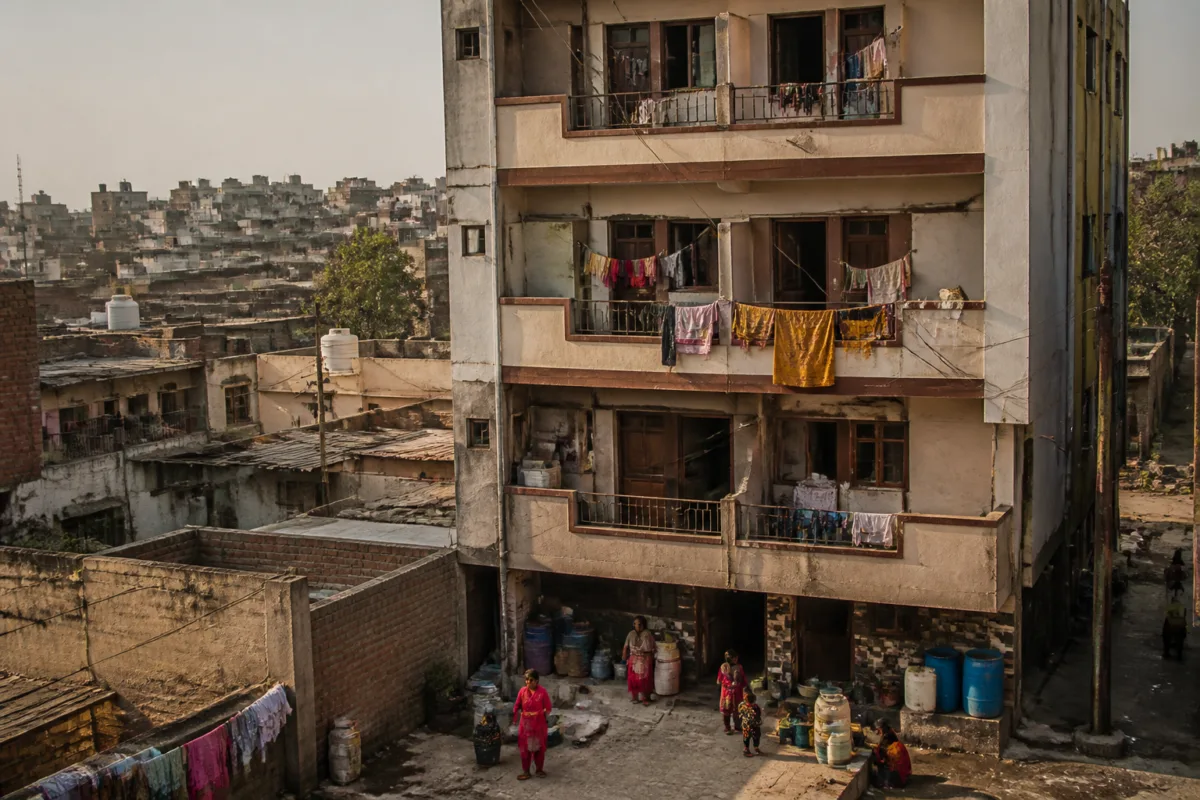
Delhi’s housing scheme is placing an unusually important question at the centre of slum rehabilitation: when several generations live in one building, should they be counted as one family or as separate households? The answer could determine whether an eligible structure is considered for one residential unit or as many as three, according to a report by Live Hindustan – NCR on the Delhi government’s new rehabilitation policy.
The report says the policy is intended to provide pucca homes to 20 lakh families living in slum settlements. It also describes separate treatment for married sons and widowed daughters who live with their own spouses, children or dependants on different floors of the same building. The distinction is not automatic. It depends on how households live, the documents they hold and whether those documents establish separate residence before the policy’s cut-off requirements.
That makes the family definition more than an administrative detail. In a rehabilitation programme, the unit of entitlement is often the household rather than the structure. A single informal building may contain parents, married children, grandchildren and other dependants, but the housing authority must still translate that complex arrangement into an eligibility record. The policy described in the report appears to recognise that a building can contain multiple functioning households even when those households share the same plot or address.
The practical consequence is significant. If parents and their unmarried children live on the ground floor, while a married son lives with his wife and children on the first floor, the two portions may be considered separate families. If another married son lives with his family on the second floor, that portion may also qualify as a separate family. In the example given by the report, one building could therefore be considered for three residential units, provided all other eligibility conditions are met.
The same principle is extended to widowed daughters. A widow living with her children on a separate floor from her parents and other family members may be considered a separate household under the policy. The report says she would need to establish that separate residence through documents such as a ration card or electricity connection issued before 1 January 2025. The address on those documents must correspond to the floor where she lives with her children.
This requirement reveals the administrative logic behind the scheme. The government is not relying only on a family’s verbal account of how rooms or floors are occupied. It is seeking documentary evidence that a household functioned separately before the cut-off date. That approach is designed to distinguish long-standing household divisions from arrangements created after the policy was announced, although the supplied report does not describe the complete verification process or the authority responsible for making final decisions.
The cut-off date also makes existing paperwork central to the housing claim. A separate electricity connection or ration card is not merely a welfare document in this context; it becomes evidence of residence and household identity. Families with formal records may therefore find it easier to establish separate eligibility than families whose internal divisions have existed for years but were never reflected in official documents.
This is a familiar challenge in urban rehabilitation. Informal settlements are often physically dense but socially and economically diverse. A single room, structure or plot can support several adults who manage food, income, childcare and expenses separately. Yet official records may continue to show one address, one utility connection or one household. When rehabilitation is linked to documentary proof, the quality and age of those records can influence the distribution of new homes.
The Delhi policy, as described by Live Hindustan – NCR, appears to address this gap by looking at both living arrangements and essential documents. The report says authorities will examine the way families live and verify documents linked to the relevant floor. This suggests that physical separation within a building will need to be matched by documentary evidence. It also indicates that entitlement will not be decided solely by the number of people registered at the property.
The distinction between a married son and a widowed daughter is particularly important because the policy examples involve different forms of family dependence. A married son living with his wife and children is treated as potentially separate when he occupies another floor. A widowed daughter living with her children may receive similar consideration, but the report specifically highlights the need for a separate ration card or electricity connection issued before the cut-off date. The policy’s treatment of other household arrangements is not established in the supplied material.
The reported ceiling of three possible residential units in one building also shows how the policy could affect the scale of rehabilitation. If a large number of eligible buildings contain multiple documented households, the number of units required could be considerably higher than a simple count of structures would suggest. Conversely, if families cannot produce the required documents, multiple households may be treated as a single unit. The report does not provide an estimate of how many households fall into either category.
That uncertainty matters because the headline figure of 20 lakh families describes the intended reach of the policy, not necessarily the number of homes already sanctioned, constructed or ready for allotment. The supplied report does not specify the construction schedule, financing arrangement, land parcels, project locations, agency responsible for delivery or timeline for verification. It also does not clarify whether the 20 lakh figure refers to all eligible families across Delhi or to the projected beneficiary universe under the rehabilitation policy.
Those implementation details will determine whether the family-definition rules translate into actual housing supply. A policy may recognise multiple households in one building, but authorities will still need to survey structures, validate documents, identify eligible residents, arrange land or redevelopment capacity and deliver units. The report confirms the eligibility examples and documentation requirements, but it does not establish the status of these later stages.
The rules also place a burden on residents to preserve and produce old records. Electricity connections, ration cards and address details may have changed over time, especially in settlements where residents have moved between floors or where utility accounts were held by landlords, relatives or previous occupants. The report does not say how the administration will handle missing documents, disputed addresses, shared meters or households that are separate in practice but not in the paperwork.
For residents, the immediate issue is therefore not simply whether a married son or widowed daughter can qualify separately. It is whether the household’s living arrangement can be demonstrated in the form required by the scheme. The policy examples offer a route to multiple units, but they also make verification a decisive stage between recognition in principle and an actual housing entitlement.
The larger urban question is how Delhi’s rehabilitation system will define the people it is meant to house. Counting only buildings can understate the number of households living within them. Counting every claimed household without documentary checks can make the allocation vulnerable to duplication or disputes. The reported policy attempts to balance those concerns by combining household separation with a documentary cut-off, but the supplied material does not yet show how consistently or transparently that balance will be applied.
What the report establishes is that Delhi’s proposed housing framework may allow separate consideration for parents, married sons and widowed daughters living on different floors, with the possibility of up to three units in a qualifying building. It also establishes that eligibility depends on broader conditions and document verification, including pre-1 January 2025 proof for a widowed daughter’s separate residence. The next points to monitor are the official policy document, the verification procedure, the treatment of households lacking records, and the timeline for converting eligibility decisions into completed homes.

